
Veteran Spotlight
by Richard D. L. Fulton
Joseph Wood, Jr.
Founder of Woodsboro
Joseph Wood, Jr. was born on September 17, 1743, at Bohemia Acres, Cecil County, to parents Joseph, Sr., and Sarah Wood.
Wood had one sister, Mary Greene, via Sarah. Following the death of Wood’s mother in 1747, he subsequently acquired two half-brothers, Abraham and John, and five half-sisters, Catherine, Elizabeth, Rachel, Rebecca, and Ruth, as a result of his father’s second marriage to Catherine Hedges.
Wood married Eveline Buress Reed in 1769. They had four daughters, Mary, Sarah, Elizabeth, and Catherine, and one son, Joseph Wood, III. Wood’s wife had apparently died while giving birth to Wood, III; the date of her death and the birth of their son is given as taking place on the same day: January 9, 1781.
Shortly after Wood’s marriage to his second wife in 1769, he constructed his farm and built a Georgian-style manor house in Northern Frederick County in 1770 on land that would become the future site of Woodsboro. According to the state Department of Planning’s Maryland Historical Trust website (MHT), Wood’s patented “Woods Town Land,” which was located on part of the former Monocacy Manor, and he had laid out a village he called “Woodberry,” located on the east side of the Monocacy River.
Some plats recorded the village’s name as “Woodsberrytown,” according to the Historical Marker Database (hmdb.org).
However, regarding the actual date of the manor house’s construction, the Historic Register (of the National Park Service [NPS]) website stated, “Whether he built the house at the time he was married in 1769 prior to his purchase of the land, or in 1772 after the purchase, is not clear, although it was not uncommon during this period for land to be occupied prior to actual ownership.”
The MHT also noted that the homestead had included an associated smokehouse and an early-19th century brick end bank barn.
But whatever the case may have been, life at Wood’s homestead would become impacted by a little dispute with England … called the American Revolution.
On January 6, 1776, Wood was nominated by the Convention of the Province of Maryland to serve as lieutenant colonel of the 2nd Battalion of the Maryland Militia under Colonel James Johnson, according to the NPS.
As a sort of an aside, Johnson also established the Catoctin Iron Furnace, which was supplying ammunition and artillery shells for use by the Continental forces at Yorktown, some of which, by happenstance, may also have been among the last of the ammunition fired by the Continental Army in the Revolutionary War.
In July and August 1776, Wood served as an enlistment agent in Frederick County for the “Flying Camp” of Maryland. During the summer of 1776, General George Washington had sought the formation of a flying camp, comprised of 10,000 men with the intent that they defend the middle colonies. Frederick County (which at the time encompassed a much larger region) had supplied a massive contingent.
What is a Flying Camp? According to the Mount Olive Cemetery, “A ‘flying camp’—in the military terminology of the day—referred to a mobile, strategic reserve of troops,” or in other words, it was a military unit capable of rapid deployment.
Subsequently, Wood, as lieutenant colonel, led the 37th Battalion of the Maryland Militia along with Colonel Johnson, which had been established in 1777 to primarily function “as a home guard for Western Maryland, and was instrumental in putting down local Loyalist uprisings.” The unit had originally been formed as the Second Battalion of the Frederick County Militia in 1776.
By 1780 Colonel Wood commanded the Frederick Battalion of the Maryland Militia, according to the NPS.
The town of Woodsberry, and/or Woodsberrytown, was eventually changed to Woodsborough, and finally, to Woodsboro, which was incorporated in 1836.
Wood passed away in 1788 in Woodsboro, and he was buried in the Grace Rocky Hill Lutheran Church Cemetery in Woodsboro.
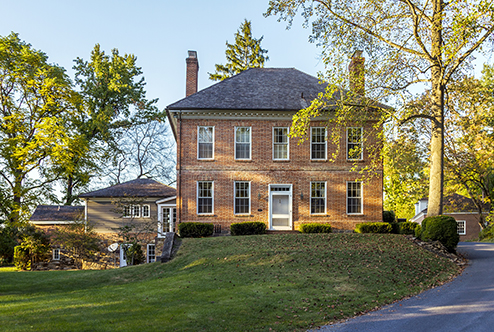
Woods Mill manor house, home of Joseph Wood, Jr.
