
Veteran Spotlight
by Richard D. L. Fulton
Henry B. Pecher
First Adams’ Pacific POW
Fairfield resident, Henry Benedict Pecher, was born on February 10, 1919, to parents Jacob Henry Pecher, who was 35, and Helen Grace Sanders, and they had nine children (in order of birth): Paul Lafayette, Anna Agatha, Henry Benedict, Miriam Magdalena, Alfonsus J., George M., Francis Eugene, Joseph A., and Theresa V.
Pecher graduated from Fairfield High School. After graduation, he became employed at the Dave Oyler Motors Company in Gettysburg.
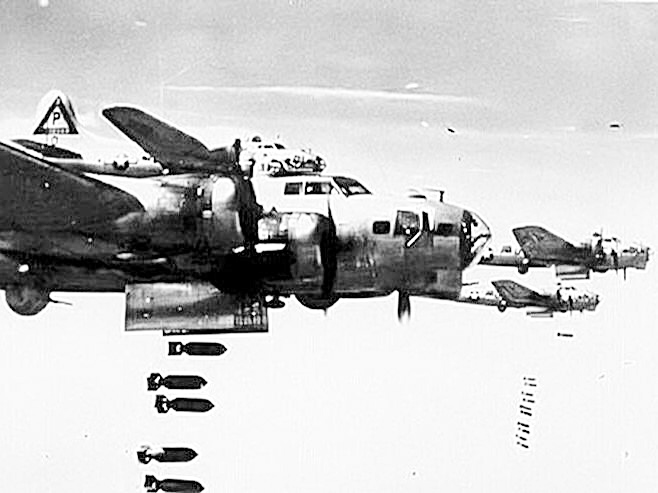
He enlisted in the Army Air Corps in 1939 at age 20 and served as a gunner on a “Flying Fortress” (four-engine Boeing B-17 bomber), after having been trained as an aerial engineer. He was subsequently assigned to the 19th Bomber Group at Clark Airfield in Manila, Philippines, according to an article published in May 21, 2004, edition of The Gettysburg Times, stating that he had achieved the rank of technical sergeant.
In the last letter his parents had received from Pecher on April 10, 1942, before he “went dark,” he had written, “I hope and pray to the good Lord that I may live through (sic) this war. I would like to come home and raise a nice little family. Please pray for us fellows over here and ask the Blessed Mother to deliver us from the enemy,” according to an article published in the August 28, 1942, edition of The Times.
The next letter they received concerning Pecher was not from Pecher, but rather, from Major General James Alexander Ulio, in August, in which Olio had written that Pecher had been serving in the Philippine Islands at the time of its surrender, and that, “I deeply regret that it is impossible for me to give you information, other than that which is contained in this letter (regarding the status of Pecher’s whereabouts),” essentially declaring that the aviator was missing in action.
Subsequently, Pecher was identified as having been taken prisoner by the Japanese (making him the first Adams County man captured by the Japanese), and the details of how it had all come about began to appear in the press.
According to an issue of The Gettysburg Times, Pecher was aboard several B-17s that had been assigned to rescue General Douglas McArthur from Mandana Island following the allied armies’ retreat from Corregidor. Pecher’s B-17 was not so lucky, and flew low in order to detect the intended landing field in the dark, and in doing so, he “caught a wave and crashed in the water.” The aviator sustained a broken nose and several head gashes, yet he was still capable of swimming for six hours to reach land, only to be captured by the Japanese.
After having been repatriated at the end of the war and after having been a POW for more than 40 months, Pecher reported that he and others had been subjected to “a heart-breaking diet of work, beatings, and starvation diets,” according to an article published in the November 7, 1945, issue of The Gettysburg Times, noting that he had weighed 175 pounds before being captured, and weighed only 112 pounds when he was released by the defeated Japanese on September 7. For much of the War, he was held in POW camps in and around Tokyo.
Following his return to the United States at the end of the surrender of Japan, he was then stationed at the Valley Forge Hospital for treatment and was on furlough from the military as of June 1946, according to the September 29, 1946, edition of The Gettysburg Compiler. While being hospitalized at Valley Forge, Pecher was presented with the Distinguished Flying Cross, the Purple Heart, the Good Conduct Medal, the Distinguished Unit Badge, and the Prisoner of War Medal.
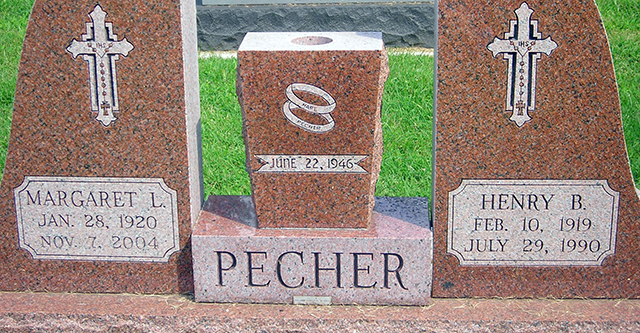
Pecher then married Margaret Louise Hare of Waynesboro on June 22, 1946, and they eventually became the parents of seven children.
And yet, in August 1950, he re-enlisted in the Air Force.
Pecher passed away at the age of 71 on July 29, 1990, in Fairfield, and was subsequently interred in Saint Mary’s and Saint Rita’s Catholic Cemetery, located in Hamiltonban Township.
