
Veteran Spotlight
by Richard D. L. Fulton
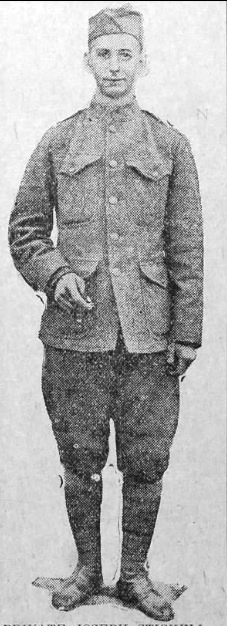
Joseph M. Stickell
KIA Meuse-Argonne Offensive
Joseph “Joey” M. Stickell, of Waynesboro, Pennsylvania, was born on April 14, 1889, to parents John Nevin and Lucy Mentzer Stickell, and had two brothers, John Norman Stickell (1892-1973) and Grayson Mentzer Stickell (1894-1962).
Stickell was baptized as a Lutheran on May 31, 1890, in Waynesboro, presumably at the Evangelical Lutheran Church, and remained a member of that church. He was also a member of the church’s Whetstone Bible class.
According to an article published in the December 11, 1918, edition of the Waynesboro Record, Stickell “was born and reared in Waynesboro and attended the local schools.”
Prior to having been drafted into the Army, Stickell was employed as a driver for the Adams Express Company in Waynesboro, and “made a countless number of friends, and there is scarcely a resident of Waynesboro who will not recall the name ‘Joey,’ as he was so frequently called,” according to the Record.
Stickell registered for the draft at age 28 on June 17, 1917, in the First Ward, Waynesboro. His draft registration card described him as having been of medium height and of a slender build, with brown eyes and black hair.
At age 29, Stickell was inducted into the Army at Greencastle on May 25, 1918, and received his training at Camp Meade, Maryland, where he was assigned to the 15th Battalion, 152nd Depot Brigade (a training unit) until June 13. Commencing on June 13, he was assigned to Battery F, 312th Field Artillery until June 18.
On June 17, Stickell was assigned to Company K, 314th Infantry Regiment, 79th Infantry Division, where he held the rank of private. He was deployed to France, arriving on July 8.
According to military records, Stickell participated in the following Meuse-Argonne Offensive engagements: Malancourt, Montfalcon. Montillois, Belleau Woods (Bois Bellieu), Bois de Chênes, Cote Romange (Romagne-sous-Montfaucon), Crepian, Chaumont, Gilberey, Wavnell Moiray.
On the day of Stickell’s death on the frontlines in France, the Record had reported that the last letter (dated October 17) his parents had received from him had “enclosed a coupon for his Christmas box and stated what he would like to have. The family sent the carton and granted his wishes…”
The next message his parents received was not from their son, but rather, it was from Adjutant General Sill, who wrote, “Deeply regret to inform you of the death of your son, Joseph Stickell, killed in action on November 4.”
“Thus,” the Record reported, “the first native son of Waynesboro has paid the supreme sacrifice while in active service on the blood-soaked battlefields of France.”
Stickell had been killed by the Germans 10 days before the signing of the armistice effectively ending World War I.
According to a post on Stickell’s memorial page on Find a Grave and attributed to the history section of the American Legion Joseph Stickell Post 15, Stickell was killed during the Third Phase of the Argonne Offensive, and “was returning from the front for rations, and while crossing the heights, east of the Meuse River, he was struck by a high explosive shell and killed instantly.”
Memorial services for Stickell were held on November 9, 1918, along with services for another Waynesboro war casualty, Harry Blumbaugh, at the Lutheran Church in Waynesboro, the Record had reported in its November 8 edition, further noting that services were also to be held at the Waynesboro American Legion, which had just been renamed the American Legion Joseph Stickell Post.
Stickell was initially buried in the American Sector at a nearby cemetery until 1921, when his body was returned home to Waynesboro upon the request of his mother. He was subsequently buried in Green Hill Cemetery, Waynesboro, with full military honors, after lying in state in the Lutheran Church.
Private Joseph M. Stickell of Waynesboro, Pennsylvania.
Source: November 8, 1919, The Waynesboro Press
