
The Story of the Maryland National Guard at Camp Ritchie from 1934
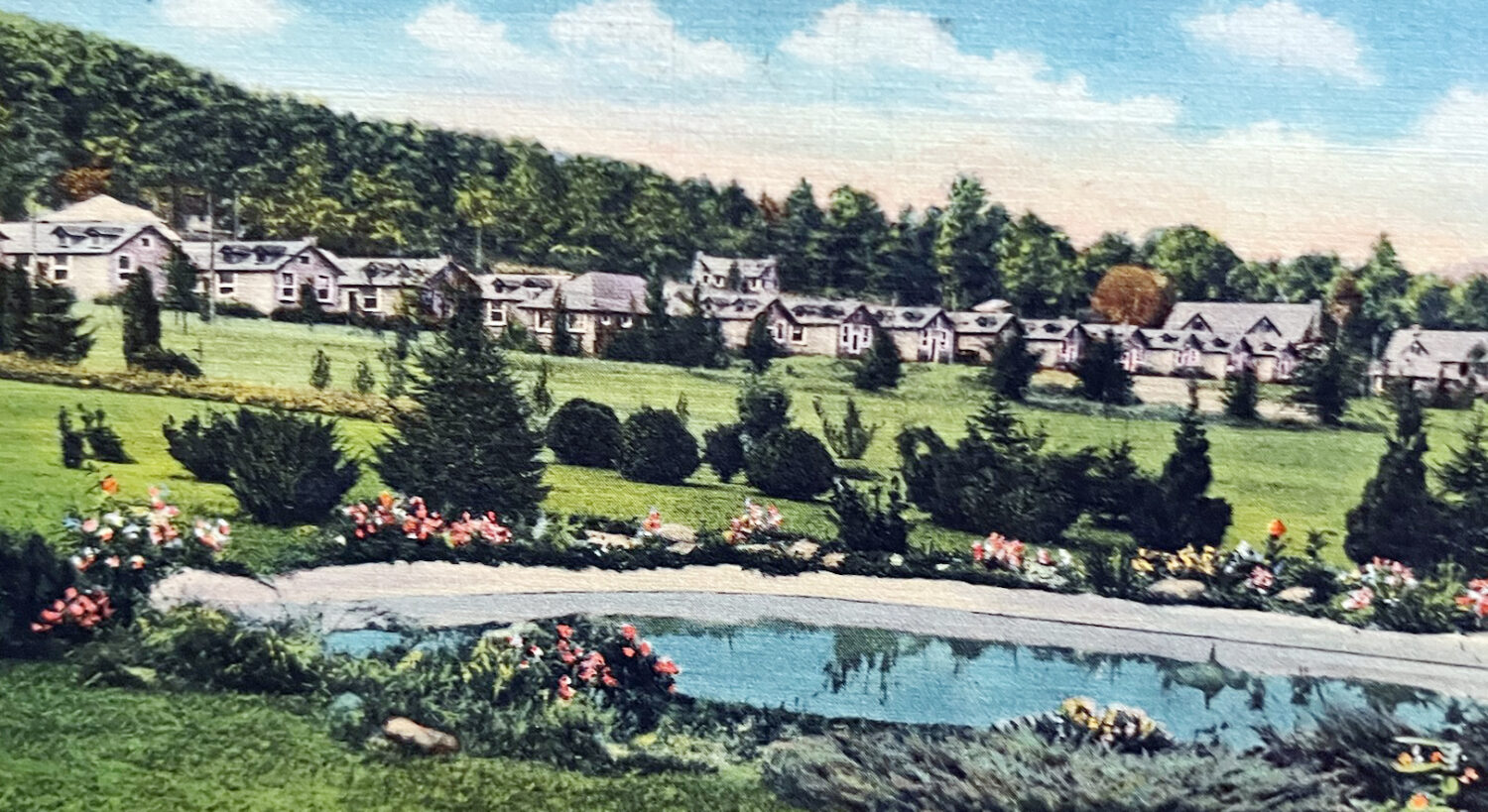
Excerpts from The First Anniversary Year Book
Thanks to Jim Barton for lending me his father John’s year book.)
1934-1937
The history of the battalion is intertwined with the proud history of the Maryland Army National Guard. Its lineage can be traced to its initial activity as the 29th Division Ordnance Office during the period prior to May 3, 1937. On May 3, 1937, it was organized and federally recognized at Camp Ritchie, Maryland, as Company D, 104th Quartermaster Regiment, Maryland Army National Guard.
In the fall of 1934, the Maryland National Guard was issued its first modern transportation: seven station wagons and thirty 1½ ton Chevrolet trucks. This was a welcome addition of much-needed equipment; however, there were no provisions for an organization of regular drivers to handle these new trucks, and without properly trained personnel, they would not last very long. The motorized vehicles were capable of great speed, and in inexperienced hands, could become quite dangerous.
In 1935, the 29th Division held its maneuvers at Mount Gretna, Pennsylvania, in connection with the 28th Division and other troops of the First Army. Drivers were detailed from the Infantry Regiments to handle these 37 vehicles during the training period, as well as a Detachment at Mount Gretna to operate as a unit under the command of Lieut. Leland T. Reckord. At that time, this was the only method of having any control over the operation of the trucks. This method proved successful, and all the vehicles were returned to Camp Ritchie.
In the fall of 1935, Maryland was issued its second allotment of trucks: forty 1½ ton Chevrolet trucks and three ambulances, but still no provisions for an organization of drivers. Early in 1936, Congress passed the War Department Bill, which provided for an increase of strength of the National Guard, to become effective during the fiscal year of 1937. This would not help much for the approaching maneuvers of 1936, scheduled for the 29th Division at Indiantown Gap, Pennsylvania.
Note: Beginning in 1936, the military began to move numerous buildings from Mount Gretna to Fort Indiantown Gap (From Mount Gretna Borough News).
Around March of 1936, Capt. Robert F. Barrick and Lieut. Leland T. Reckord approached General Milton A. Reckord, the Commanding General of Maryland National Guard, about organizing the first truck company to be trained as truck drivers, using them during the camp of 1936 and form a nucleus around which to build a Company.
General Reckord agreed, and a plan was worked out whereby 10 men could be enlisted for the State of Staff and 20 for Company B, 1st Infantry of Hagerstown, Maryland. This was the beginning. A circular was put out in the vicinity of Camp Ritchie, giving the requirements of membership. The quota was filled, and the first drill was held June 1, 1936. The following were in command: State of Staff officers –Capt. Robert F. Barrick, Lt. Leland T. Reckord, Cpl. Donald Shindledecker, and Cpl. Harry A. Wade. State Staff Recruits – Walter Andercyk, Edwin Baker, Lee Baker, Ruben Brown, Stanley Brown, Marshall Bowman, Edward Deal, Otha Dennis, Chester Frasier, and Fred Gaver.
On May 3, 1937, the name was changed from a provisional company to Company D, 104 Q.M. Regiment. This meant that they had an official name and Federal recognition and also meant that there would be Noncommissioned Officers, Privates, and other ratings, where proper pay would be earned according to rank. Before this, everyone was given the pay of Private.
The roster for Company D, 104 Q.M. Regiment at this recognition ceremony consisted of the following: Capt. Leland T. Reckord, 2nd Lt. Otha L. Dennis, 1st Sgt. Frederick E. Dewees, and Supply Sergeant Stanley G. Brown; Sergeants – Marshall M. Bowman, Ruben C. Brown, Floyd E, Burns, John W. Pryor, Lawrence A. Wolfe: Corporals – George E. DeLawter, Walter K. Larimore, Clarence W. McClain, Charles E. McGlaughlin, Paul R. Wade: Privates First Class – Walter W. Andercyk, Edwin T. Baker, John E. Barton, Carrol L. Haugh, Marion B. Pryor, Albert E Punt, Francis G. Ridenour, Vincent W. Robinson, Howard W. Ruth, and Kelso W. West: Privates – Lee M. Baker, Wade D. Bowman, Edward A, Deal, Richard H. Dewees, Robert J. Fitz, Chester M. Frazier, Fred E. Gaver, Glen E. Gaver, Robert C. Hahn, Lawrence A, Harbaugh, Paul G. Heumer, Maurice C. Jones, Ira K. McGlaughlin, Vincent W. Robinson, Lloyd A. Ross, Joseph L. Ross, Walter A. Rowe, Harold L. Sanders, Raymond L. Sease, Sharon Shindledecker, John L. West, G.M. Martin, and T. Wilhide. In addition, there were thirty guests present.
Following the mustering ceremony, the group retired to the mess hall, where Ken Willard and Clarence Pryor had prepared a delicious turkey dinner, which was enjoyed by all.
Preparing For War
In preparation for participation in World War II, Company E, 104th Q.M. Regiment was federalized on February 3, 1941, at Camp Ritchie, Maryland, as an element of the 29th Infantry Division, Company E, 104th Q.M. Regiment; redesignated March 12, 1942 as the Maintenance Platoon, Headquarters Company, 104th Q.M. Battalion; redesignated August 1, 1942, as the Ordnance Maintenance Battalion; and redesignated September 27, 1943, as the 729th Ordnance Light Maintenance Company.
As an important support element of the 29th Infantry Division, the 729th Ordnance Light Maintenance Company was subjected to vigorous and extensive training, both in the States and in England, which culminated with their successful landing with the 29th Infantry Division at Omaha Beach on June 6, 1944. During the following months, this unit was actively engaged in performing its maintenance support mission in areas of the European Theater of Operations, earning Campaign streamers for Normandy (with arrowhead), North France, with Rhineland and Central Europe also added to their colors. Additional decorations included a Guerre (with palm) embroidered BEACHES OF NORMANDY, Meritorious Unit Commendation, and French Decision Number 268.
The 729th Ordnance Light Maintenance Company was inactivated at Camp Kilmer, New Jersey, on January 17, 1946, and was redesignated as the 729th Ordnance Light Maintenance Company, Maryland National Guard. This unit was federally recognized January 6, 1947, at Camp Ritchie and was moved to a new station at the State Military Reservation, Havre de Grace, Maryland, on December 1, 1951, where it was expanded and redesignated as the 729th Ordnance Battalion, 29th Infantry Division on April 6, 1953, with headquarters at Havre de Grace. This unit’s designation as an ordnance battalion was changed to the 729th Maintenance Battalion on March 1, 1963, and designated as a Maintenance Battalion (Direct Support) on January 21, 1968, and relocated to Havre de Grace, State Military Reservation on May 1, 1990.
Elements of the Battalion were called to Federal Service during the Civil Riots in Baltimore and Washington, D.C., in 1968 and 1969. On December 1, 1971, it was changed to a Maintenance Battalion (General Support). In 1972, the battalion was relocated to the new headquarters at the William C. Purnell Armory in Glen Arm, Maryland. It was reorganized and redesignated as the 729th Maintenance Battalion (GS-DS)(TAACOM) on March 1, 1979; reorganized and redesignated as the 297th Maintenance Battalion (GS-TAACOM) on June 1, 1986.
On July 1, 1994, the Headquarters was reorganized and redesignated as the 297th Support Battalion (Corps). On September 1, 1996, Headquarters was again reorganized as the 1297th Support Battalion (Corps). On September 9, 2004, the unit was ordered to active duty in support of Operation Iraqi Freedom.
