
Maryland on Stamps & Covers
SS Frederick Victory
By Richard D. Fulton
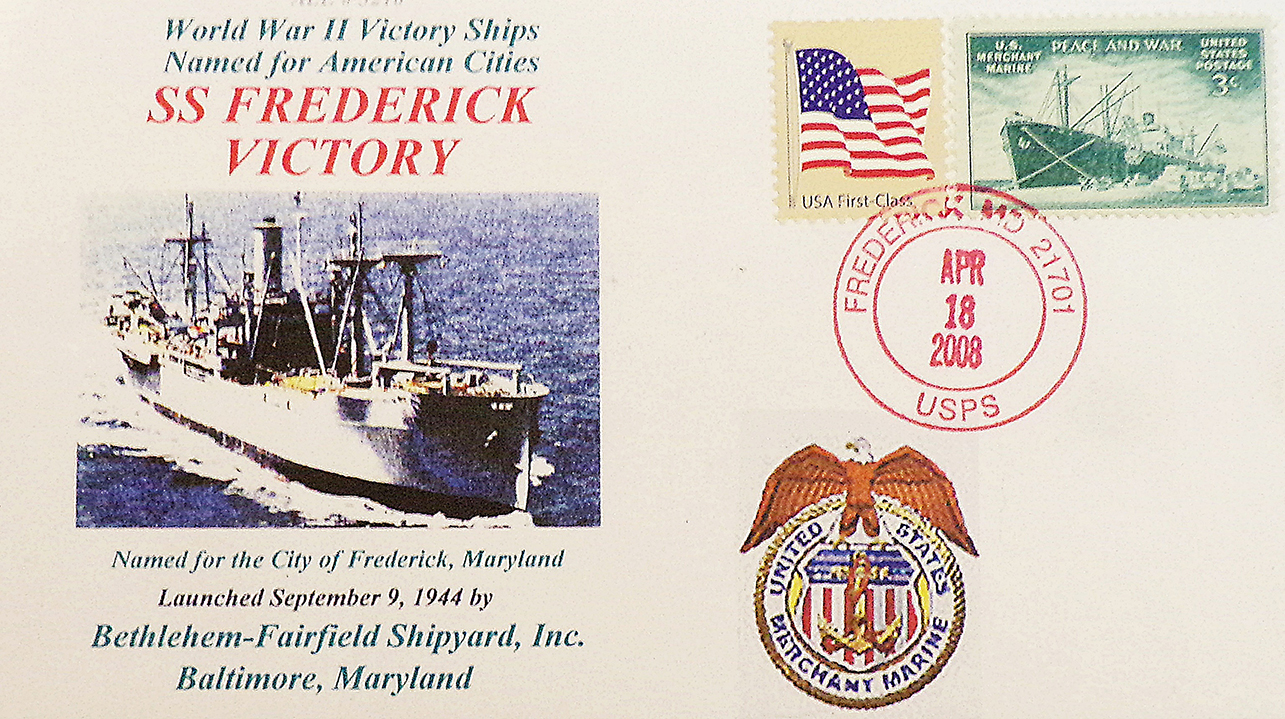
The United States Postal Service (USPS) issued a series of commemorative covers on April 18, 2008, in recognition of the Victory ships launched during World War II, which were employed with the task of transporting supplies and troops to overseas ports during the war.
One of the covers was dedicated to the SS Frederick Victory. The cover depicts the logo of the United States Merchant Marine Corps and a photograph of the SS Frederick Victory. Also printed on the cover is “World War II Victory Ships Named for American Cities,” seen above the photograph of each ship. Printed below the ship’s picture is: “Named for the City of Frederick, Maryland, Launched September 9, 1944, by Bethlehem-Fairfield Shipyard, Inc. Baltimore, Maryland.”
The cover features a three-cent Merchant Marine commemorative postage stamp that was issued on February 26, 1946, along with a current stamp, to bring the total postage up to the current rate. The combative covers were postmarked at the Frederick Post Office.
The Victory ships and the Liberty ships for which they were launched to replace were “manned” by Merchant Marines, a civilian organization created by the Merchant Marine Act of 1936 that established the U.S. Maritime Commission, which was conceived to aid the Department of Defense in the management and delivery of essential supplies to support the military, which subsequently also included providing troops’ transportation.
The Liberty ships were initially launched in 1941 but ultimately proved to be too slow to avoid enemy submarine attacks, which led to the creation of the Victory ships. Although many of the 2,710 Liberty ships launched between 1941 and 1945 remained in service throughout and beyond World War II, the construction of 531 of the more modernized and faster Victory ships built between 1944 and 1946 provided safer passage.
The SS Frederick Victory was constructed and launched by Bethlehem-Fairfield Shipyard, as previously stated, in 1944. An article that appeared in the October 4, 1944, edition of The Knoxville Journal noted that the SS Frederick Victory was the “first vessel of its type constructed on the Atlantic coast.” The article was published in the wake of (no pun intended) a “grueling 11-hour trial-run of Baltimore,” traveling at full speed for four hours.
The (October 5, 1944) Buffalo News described the trial run in more detail, noting that as the ship was barreling forth at full speed, the engines were “suddenly reversed,” then came to a stop “in an incredible short period” and began to “back into a wide circle.” The entire routine was carried out twice.
The (Frederick) News published an invitation in their September 7, 1944, edition for those who wished to attend the official launching of the SS Frederick Victory. The advertisement read, “All residents of Frederick City and County are cordially invited to attend the launching of the SS Frederick Victory” to take place on the morning of September 9.
“Those going,” the article advised, “must meet at the Belvedere Hotel… not later than 9:30 a.m., as the group must go as a body to the Bethlehem-Fairfield Shipyard. Those attending must furnish their own transportation…”
The launching of the ship went “without a hitch,” as they say, except for an uncooperative champagne bottle. According to a September 9 article in The (Frederick) News, the wife of Frederick Mayor Hugh V. Gittinger was designated to christen the ship before it was launched. “Mrs. Hugh V. Gittinger… spoke the words, ‘I christen thee Frederick Victory’ as she swung the champagne bottle toward the bow,” but the ship had already shifted, resulting in a near-miss.
The newspaper reported that the shipyard’s general manager, J. M. Willis, gave the bottle “mighty urging,” but he also missed. However, “The bottle (did) swing in wide arcs,” and “just as the stern reached the water, (the bottle) swung back and smashed against the bow-plates.”
The 455-foot, 7,607-ton ship ultimately failed to avoid the champagne bottle, but apparently, it was better at avoiding enemy submarines.
The ship could not, however, escape its final travesty, that having been …when the ship was ultimately scrapped. Presently, only three Victory ships of the 531 launched remain as museum ships.
