
Maryland on Stamps & Covers
Baltimore-Washington HPO
Richard D. L. Fulton
TThe United States Postal Service (USPS) inaugurated its first Highway Post Office (HPO) on February 10, 1941, and added a Baltimore-Washington route to the HPO system on November 16, 1943.
Each time a new route was added to the service routes of the HPO, a commemorative “first-trip cover” was issued in order to commemorate the event.
The Baltimore-Washington first-trip cover featured a Baltimore, MD and Washington, D.C. Highway Post Office cancellation on the face of the envelope, with the addition of “TRIP 1” and “FIRST TRIP,” and canceled at the Washington, D.C. Post Office on the back.
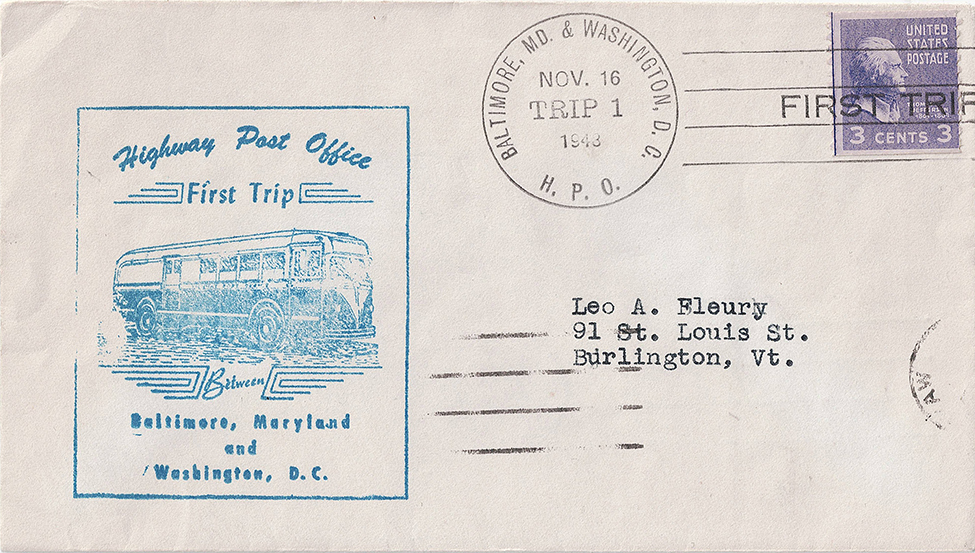
The illustration (called a cachet) located at the left side varied from cover to cover, depending on the route being commemorated. In this case (cover shown right), the cachet features a depiction of one of the HPO buses, along with the appropriate wording. Various postage stamps were used since the stamps were not pertinent to the commemorated subject.
The United States Postal Service (USPS) inaugurated the HPOs in 1941 as a response to declining railroad traffic in the early 1940s, according to the Smithsonian National Postal Museum’s website (postalmuseum.si.edu). The decline of railroad passenger traffic was attributed to the outbreak of World War II, in combination with the growth of America’s roadways and vehicle use (resulting in less passenger traffic for the railroads).
According to the Postaltimes website (Postaltimes.com), the railroads, which had been the primary movers of mail in the United States via their Railroad Post Offices (RPOs), began to discontinue unprofitable passenger routes, resulting in mail service to communities across the country being drastically affected.
On paper, the Highway Post Office was officially established on July 11, 1940, when President Franklin D. Roosevelt signed the bill into law, creating the news mail delivery system.
Most of the custom-built HPO buses employed by the USPS were manufactured by the White Motor Company, with interiors, when the mail was sorted, reflecting the design that had been utilized in the RPOs. The red, white, and blue buses were initially 33 feet in length, later expanding to 35 feet, according to multiple sources. Individual routes were limited in distance to no more than 170 miles, which generally involved numerous post office stops along the way.
Postaltimes noted that the postal staff that worked on each of the buses typically included two clerks and one clerk in-charge, and that the HPO workers were armed, as were those who had worked in the RPOs. In some cases, contractors were also utilized, especially as drivers.
From 1941 to 1974, the USPS established more than 400 routes, apparently owning some 170 buses, each costing approximately $31,000 ($350,000 in today’s dollar equivalency).
The USPS ended the HPOs on June 30, 1974, resulting from increased automation and use of local mail delivery, and the establishment of centralized mail-sorting operations. The date also represented the date the last still-in-operation HPO route in Cleveland parked their buses for the last time.
The USPS experimented with a variety of somewhat novel means of delivering mail in the United States and elsewhere over the decades, including the usage of lighter-than-air ships (Navy-owned blimps), glider mail, rocket mail (a short-lived effort to deliver mail from military ships offshore to onshore bases), and helicopter mail.
And, last but not least, mail delivery via a modified cruise missile was attempted in 1959. The missile was launched from a submarine, the U.S.S. Barbero, which delivered 3,000 pieces of mail 100 miles from the location of the submarine to Florida in 22 minutes, traveling at 600 miles an hour. At a cost of $1 million, it was deemed too expensive to become practical, according to smithsonianmag.com (Mail Delivery By Rocket Never Took Off by Kat Eschner, June 8, 2017).
Baltimore-Washington HPO cover. Source: Collection of Richard D. L. Fulton
