
Maryland on Stamps…
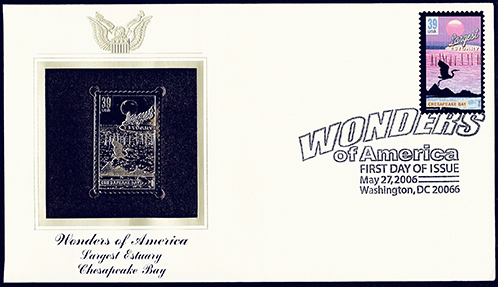
Chesapeake Bay: 2006
Richard D. L. Fulton
On May 27, 2006, the United States Postal Service (USPS) issued a set of 39-cent stamps commemorating Wonders of America, one of which focused on the Chesapeake Bay.
The Chesapeake Stamp depicted a blue heron flying within a background of a sunset over the Chesapeake Bay and a silhouette of a series of mountains (not sure there is a series of mountains anywhere along the bay, but given that the USPS once depicted the blackbird as the Maryland state bird….).
The USPS’ decision for commemorating the Chesapeake Bay as one of its Wonders of America series was due to the fact of the Chesapeake Bay being denoted as the largest estuary in the United States.
So, what is an estuary? An estuary is a partially enclosed body of water (such as a bay), inclusive of any wetland bordering it, fed by river water that ultimately mixes with ocean saltwater.
The Birth of the Bay
The stage was set for the beginning of the Chesapeake Bay, but not from geological events having occurred in the Mid-Atlantic region. In fact, the bay traces its origins as having been the result of a visitor from outer space.
About 35 million years ago, a meteor, “a comet- or asteroid-like object from space,” crash-landed into what is now the Delmarva Peninsula, near Cape Charles, Virginia, according to chesapeakebay.net.
The object was of such size and mass that when it struck the area, it created an impact crater (referred to as the Exmore Crater), being the size of Rhode Island and as deep as the Grand Canyon.
While the crater did not create the bay as such, it provided a basin in which area rivers that existed at that time found their way into the crater en route to the sea, primarily having been the Susquehanna River (which, as an aside, is one of the oldest rivers on Earth).
The Susquehanna ultimately found its way into the impact crater, thereby creating a river valley leading into the crater. The moment in time in which the waters of the Susquehanna entered the crater marks the event as the true birth of the bay.
When the Ice Age began to end as the result of the ongoing period of global warming, the meltdown of the glaciers resulted in an untold deluge of water entering the Susquehanna River Valley, to a degree that the water backed up, undercutting the cliffs and terrain that bordered the now-drowned river valley, ultimately producing the bay as it exists today.
The Bay Today
Today’s Chesapeake Bay is more than 200 miles long and, in places, up to 30 miles wide (the narrowest width being approximately 23 miles across), with a water surface of 3,237 square miles.
The Postal Commemorative Society stated in a flyer provided with their First Day of Issue cover that the average depth of the bay is 30 feet. Approximately 700,000 acres of water in the bay is so shallow “that a man just over 6½ feet tall could navigate (the water on foot) without getting completely submerged.”
The Chesapeake estuary constitutes the focal point of what is termed as being the Chesapeake watershed, the watershed being comprised of all the waterways whose waters are ultimately deposited into the bay.
The watershed that supports the bay is more than 60,000 square miles in extent and includes and/or reaches into six states, Washington D.C. inclusive.
Is the Bay Still Growing?
Since Captain John Smith (of Pocahontas fame) discovered the bay in 1608, the bay has widened some 300 feet, cutting into and exposing even more of the 15-million-year-old Calvert Cliffs on its western shore, and eating into the flat wetlands of the Eastern shore.
The natural widening of the bay (the result of erosion caused by wave action) continues on, unrelentingly.
According to chesapeakebay.net, Maryland’s Poplar Island encompassed several hundred acres. By the 1940s, only 200 acres remained. Presently, the area is being restored by using dredge material from the Baltimore Harbor.
The growth of the size of the bay should be good news, one would suppose, for all those engaged in fishing and trapping the bay’s rich, aquatic inhabitants. Today, the bay annually generates some 500 million pounds of seafood, according to fisheries.noaa.gov.
