
LOOKING BACK
A Man Was Left To Drown
by James Rada, Jr.
At the end of March 1913, many people in Frederick County were watching the Midwest, where severe flooding was damaging property and taking lives. However, the county was not without its own devastating weather.
“Blown by a strong wind, a downpour of rain such as is seldom seen in these parts was driven from the heavens and continued for more than an hour, starting about 6 o’clock,” The (Frederick) News reported. “The rain poured down in sheets, and with the strong wind, it was blinding. In a short time every place was flooded.”
Streets became rushing streams, and streams became flooded rivers. Fields became swirling lakes, destroying crops.
Over the course of two days, two inches of rain fell, but half of that amount fell within a single hour, which is what precipitated the problems. Temperatures dropped 30 degrees in a day, from temperate mid-60s to freezing. At Brunswick, the Potomac River rose 16 feet in a short time. Worse yet, this storm was a preview of things to come, as the tragic storms in the Midwest were expected to move toward Maryland.
One good thing came from the storm, though. It stopped a large forest fire on Catoctin Mountain. Firefighters were struggling to contain a fire that had so far burned 500 acres. Winds were driving the flames to consume even more, and the firefighters were losing the containment battle. Then the rains came in and doused the fire enough that the firefighters could gain the upper hand.
That didn’t help John Hoke, a carpenter at Mount St. Mary’s College. The Emmitsburg Chronicle noted in his obituary, “The splendid edifices which, in recent years, have been reared at Mount St. Mary’s and to which her authorities and alumni point to with great pride are to a great extent the monuments of his skill and handicraft.”
John finished work on March 27 and went into Emmitsburg to drink at a bar. When he decided to head home, which was two miles away, a friend worried that John wasn’t in any shape to walk so far.
The friend walked with John towards the edge of town and was convinced his friend was sober enough to make it home on his own. He said goodnight and headed back to town.
The next day, when John didn’t show up for work, a search was started to locate him. Townsmen and college students fanned out in the direction where John’s friend had last seen him.
Unrelated to the search, a young boy was walking near Toms Creek, which was still out of its banks, swollen from the rains. He saw a man clinging to a bush with one arm, waving the other arm, and calling for help.
For some reason, the sight didn’t alarm the boy. “The little fellow offered no help, and then the water was about waist-deep around the man,” according to The News. “The boy did not report that matter until night.”
The boy’s father had him show him where the boy had seen the man. There was no one there. However, the father noted it was also downstream from where most people had been searching for John.
The search resumed the next day once the sun was up. The searchers found his body near Sister’s Dam. He had been washed into a field and left in the mud when the water receded.
Coroner M. F. Shuff was summoned. He examined the body and determined an inquest wasn’t necessary. It was deemed an accidental drowning.
The belief was that John was perhaps not as sober as he had appeared two nights earlier. He may have walked to the edge of the flooded Toms Creek, which he needed to cross to get home. Deciding that he couldn’t do it, at least at night, he instead lay down near the creek and went to sleep or passed out.
“During the night the rain and the high water came and he found himself surrounded by water and in a dazed condition, and was unable to save himself,” The News reported.
He left behind a wife, married daughter, and four grandchildren.
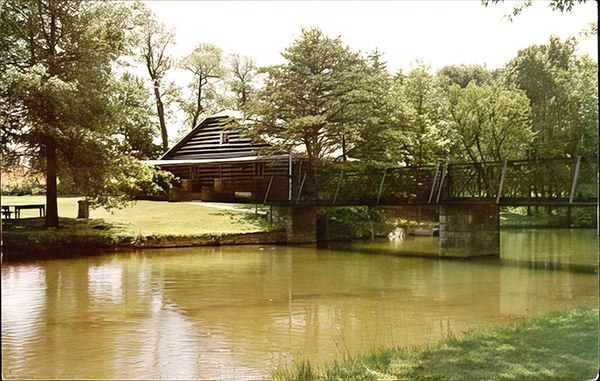
An old postcard view of Toms Creek near St. Joseph College.
