
LOOKING BACK
An Unlucky Train
by James Rada, Jr.
Three accidents. Two deaths. One injury. All involved one unlucky Western Maryland Railway train during a single weekend.
The string of unfortunate events began on Saturday, March 13, 1926, at the rail yards in Hagerstown, Maryland. The Western Maryland Railroad arrived in Hagerstown in 1872, and its presence there helped the city grow as the railroad’s footprint there grew until it became the busiest point of the Western Maryland Railway system. Not only did nearly all of the Western Maryland Railway trains pass through the city or originate there, but other railroads also connected to the Western Maryland Railway at that point. The Jamison Yard was the primary rail yard in the city. At the railroad’s peak, the rail yard could handle 3,000 rail cars.
On March 13, Joseph Mullen, a flagman with the Philadelphia and Reading Railroad, was standing on the rear of the tender of a Philadelphia and Reading engine. The engine was preparing to take a draft of freight cars before continuing on to Harrisburg, Pennsylvania.
A Western Maryland Railway engine was also preparing to take freight cars to Baltimore at the same time. It was being run through a cross-over track, the track the Philadelphia and Reading train was on.
“The tenders sideswiped and Mullen was caught between them and rolled the entire length of the tender,” The (Hagerstown) Morning Herald reported.
Mullen was torn apart and crushed. “His head and shoulders were found a distance of twenty feet from his legs and other sections of his body were strewn about the track,” according to The Herald Mail.
Police investigated the accident and determined that no inquest was needed. The cause of death was quite obvious. Mullen’s remains were shipped to Harrisburg to his widow. He also left behind an orphaned one-year-old child.
That was the first mishap.
The track was cleared, and the Western Maryland Railway crew continued with their preparations to take their train to Baltimore. While doing so, T. W. Wilhide, the conductor in charge of the train, dropped a heavy iron bar on his foot. He was injured so badly, he had to leave work for the hospital.
That was the second mishap.
Dorsey A. Swink, a local conductor in Hagerstown, was brought in to relieve Wilhide as the conductor, and the train continued east to Thurmont. On March 14, the train had to shift cars while in Thurmont.
“Swink was attempting to board the engine of the train where he is believed to have missed his footing and fell beneath the wheels of the train,” The Herald Mail reported.
His co-workers found him a short time after the accident still alive. They carried Swink on a stretcher for a quarter mile to get to a doctor. Dr. Morris A. Birely rendered first aid, but he was in bad shape. One leg had been severed between the ankle and foot, and the other leg had deep cuts. He also suffered from internal injuries, but he was conscious.
Birely managed to stabilize him, and they sent him on to the Frederick hospital. Swink was still conscious when he reached the hospital, but he died soon after. He was survived by his wife, son, and daughter.
And that was the third mishap.
Three accidents all involving the same Western Maryland Railway train happening over the course of a single weekend. It is fortunate that the train didn’t develop a reputation for being jinxed after that.
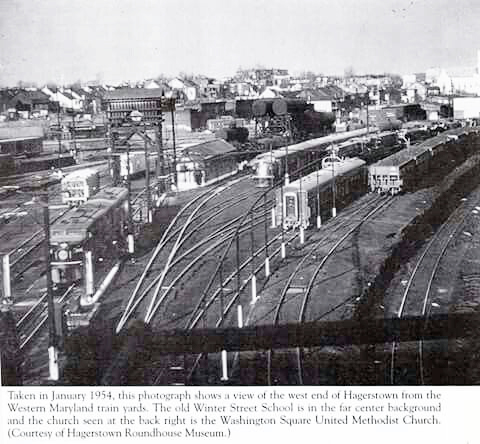
The Western Maryland Railway train yards in Hagerstown, Maryland.
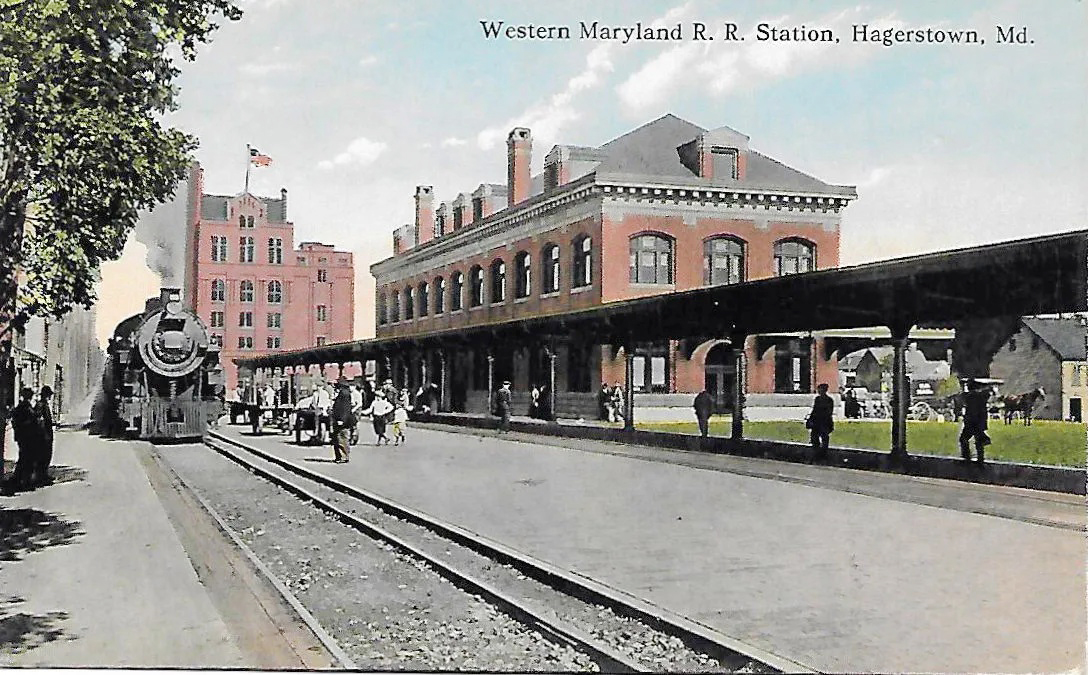
The train station in Hagerstown, Maryland. Photos Courtesy of Wikimedia Commons
