
LOOKING BACK
A Woman’s Curse on Site R
Although construction of Site R under Raven Rock Mountain used advanced construction techniques to protect the lives of essential members of the federal government, it couldn’t avoid the superstitions of the men who built it and the lives those superstitions cost.
In 1951, when Dennis Koontz was a young man, he got a job helping build a tunnel at Raven Rock. He had never done such work before, but he knew someone who got him the job. “He talked of air machines and sledge hammers, of the new drilling techniques, of powder percentages, primer delays, on and on, until I was convinced I had grabbed a mule too mean to ride,” Koontz wrote in an article titled, “GHQ Atomic Age.”
To make things more confusing, Koontz didn’t know what the tunnel was to be used for. That was above his pay grade. His job was just to do what he was told, and two of the first things he was told were not to bring a woman into the tunnel and not to whistle while he was in the tunnel.
When he asked why, he was told that women underground were bad luck and whistling would cause rock falls.
He accepted the “do nots” at first, but as he started to work, he realized that they didn’t make much sense within the reality of the situation.
“Just what a man would do with a woman in a place too rocky and wet even to sit down escaped me,” he wrote. “And there is no noisier place on all God’s earth than a tunnel being driven. A whistle just could not be heard.” He said that his ears would not function properly for an hour after finishing his shift and leaving the tunnel.
His job wasn’t to ask why; it was to do what he was told. So, he never brought a date into the tunnel, and he never whistled.
Nor did any of the other workers, and the site’s safety record stayed free of fatalities.
However, a government inspector was either ignorant of unwritten rules or foolish. To impress a local woman, he brought her into the C-D portal at Site R to show off what he was in charge of.
Then the problems began.
The construction of Site R began at the four portals A, B, C, and D. Large equipment, some with wheels as tall as a man, tunneled into the mountain to meet at precise locations underground. “Down the road from A-B and C-D, one of these trucks rolled every two minutes, on its way to the fill where the rock was dumped,” Koontz wrote. “Powerful bulldozers scraped boulders into piles.”
Then, the news about the inspector spread. One worker announced at a bar after the shift ended, “One of the inspectors took her in C-D. They fired the stupid bastard, but she’d already been in there.”
The workers fell silent. Some of them must have wondered when the other shoe would drop.
It began two days later.
When the cables on the boom of a steam shovel got tangled, the shovel operator climbed the boom to untangle the cables while his apprentice manned the controls. The apprentice should have been the one to climb the rig, though. Instead, because he was inexperienced at the controls, he pulled the wrong lever, and the boom smashed into the rock wall, crushing the operator.
Koontz, the skeptic, attributed the accident to carelessness on the part of a man who should have known better. “But the old hands shook their heads,” he wrote. “The woman. The job was running on bad luck.”
When a man is killed on the job, work ends for the rest of the shift, and men on the next two shifts don’t work out of respect for the dead man. Then the workers will soon work an extra shift, not to make up for the shifts not worked, but to donate the money from the extra shift to the dead man’s family.
The problems didn’t end here, though.
“As if the first death were the kick-off, trouble piled up like linemen on a center plunge,” Koontz wrote. “Ed Mundy kicked his hard hat 30 and 40 yards per try when told of broken tractor treads, cracked blocks, busted drills. But he kept the material and the equipment flowing, and the job sputtered on.”
Later, a man decided to take a nap during his lunch break. He lay down behind a big bulldozer and went to sleep. He chose the spot because during the winter, the tunnels were freezing. Men sought warmth wherever they could find it, and cooling engines of equipment not in use were prime spots to be near. In the noise of the tunnel, however, the man didn’t hear the bulldozer start up when it needed to be used again. It backed over him, killing him.
A few days later, a premature detonation in one of the tunnels trapped two men. They were eventually rescued, injured but alive. It turned out that an electrical storm set off the primer. It was something that was avoidable. In fact, a spotter had called down to the workers on a special phone to warn them of the approaching storm. The phone didn’t ring, though. It used a red flashing light, which happened to be burned out, so no one knew the spotter had been calling to warn them.
A third man died a few days before drilling ended. One worker was tamping the dynamite into a hole, while another worker held the primer wires to make sure they didn’t pick up anything to set them off. “Suddenly there was a roar,” Koontz wrote. “The miner stood for a moment, head and arm completely gone, then crumpled to the floor. We never did find the why of that explosion.”
Once the tunneling was completed, most of the diggers were laid off and left to find other work. Koontz left for a time, but then he returned to work on finishing work to make the tunnels safe for use. He was on the job in 1952 when word began spreading that they were building a communications center in case of an atomic war. Around the same time, guards appeared at the portals and inside the tunnels.
“It was irony,” Koontz wrote. “Or stupidity. For two years, we had had no guards around, even on Sunday, when we had been closed down for the past six months. I had seen blueprints of the entire layout tossed into the trash cans or carried off for souvenirs. And now, with the job just about finished, they decided to guard it.”
Although it was unlikely that those guards would have been able to protect anyone or anything had a woman walked into the tunnels.
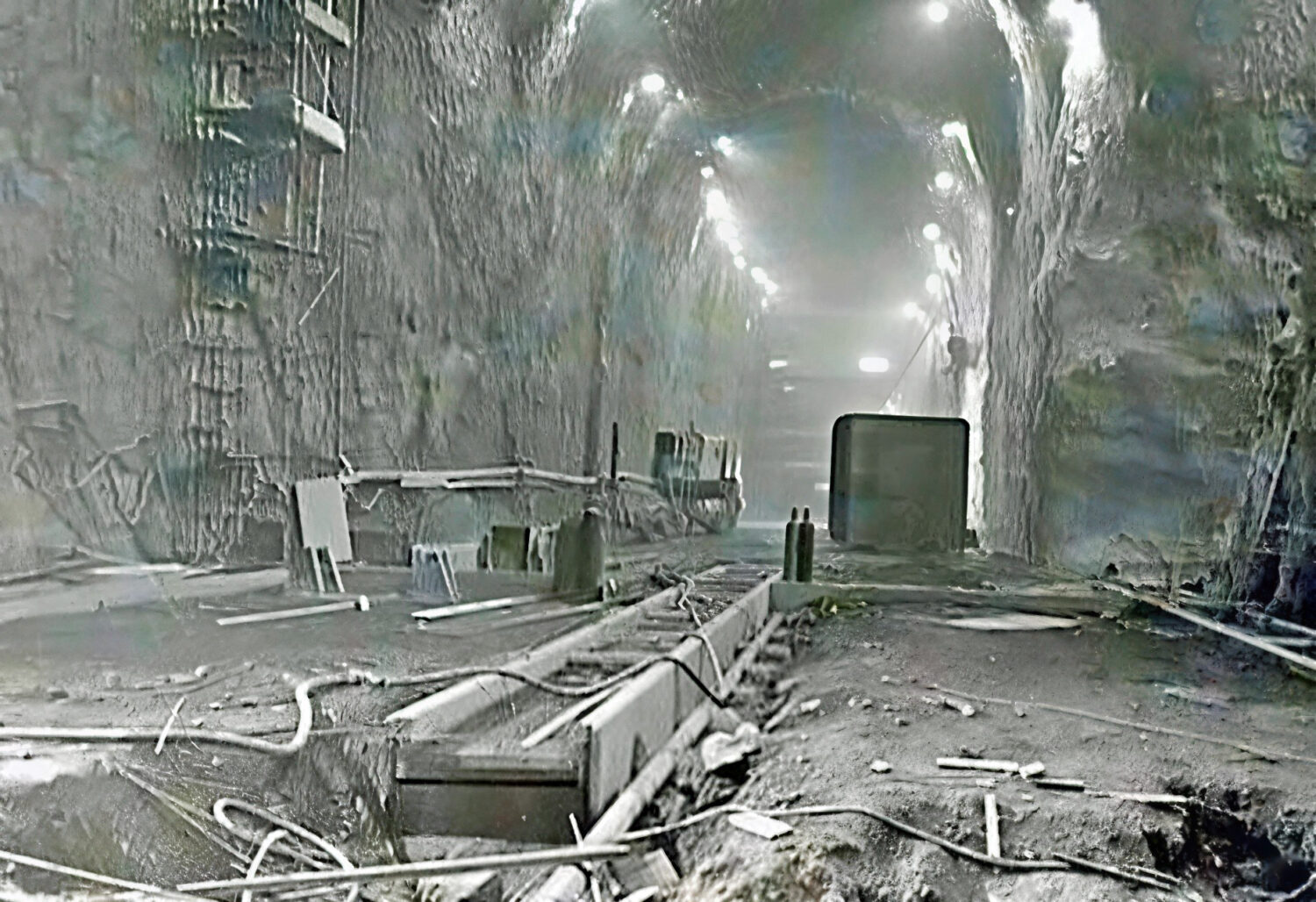
Photo shows construction of Site R
