
Looking Back
By James Rada, Jr.
Jet Crashes East of Emmitsburg
Dr. W.R. Cadle was outside on the evening of August 30, 1950. A storm had come in, and he was heading to his front door to get out of the rain. Around 9:00 p.m., he saw a red flash in the sky, and then a few seconds later, he heard a large “boom.” Later reports said that the sound could be heard several miles away. Cadle, at the time, was over three miles away.
He suspected he knew what it was, and that his services would soon be needed. Residents in the area had seen a jet flying over the area, and, like Cadle, many of them had seen it apparently explode midair.
“Some said the plane appeared to be on fire in midair,” The Emmitsburg Chronicle reported. “Others said it exploded while in flight. A depression in the ground at the crash scene indicated that it might have exploded after hitting the ground. Some speculated lightning had hit the craft since it crashed during a thunderstorm.
Many people headed out toward where they thought the plane had crashed to see if they could help or just see what had happened.
Maryland State Trooper Kenneth Bond also heard what had happened and called for assistance from the Frederick Barracks. He drove out to the crash site and began closing it off from the public because he expected the military would want to conduct an investigation.
The crash site was identified as being on the north side of Route 32, between Emmitsburg and Taneytown, on the Roy Sanders Farm.
Mrs. Hilbert, a tenant on the farm, told The Gettysburg Times, “There was a storm coming up, and I heard what I thought was a terrific wind coming. I ran to the door to close it; before I got there, I heard a terrible roar. I thought lightning had hit the house and went upstairs to get the children up. When we went outside, we found the house all right, but three fires were burning in the corn field, and there were sparks all over the place.”
Lt. Joseph Kent, information officer at Andrews Field in Washington, D.C., informed the public that the plane was one of two F-84 Republic Thunderbolts that had taken off from Andrews Field at 7:12 p.m. for a routine weather flight check. The jets were part of the Washington National Guard Air Squadron 121, sometimes known as the White House National Guard.
Meanwhile, emergency responders and volunteers started scouring the Sanders farm, searching for parts of the jet and the body of the pilot, who was later identified as 22-year-old 2nd Lt. Michael E. Alkire. He was newly married and the son of Air Force Col. Darr H. Alkire, who was stationed in Japan.
A 10-acre area was searched, and Bernard V. Hiller, one of the searchers, said that they had found “enough of the pilot to fill a bushel basket and almost enough for the plane to fill a pick-up truck.”
The VFW ambulance crew, which included John Garner, Greta Keilholtz, and Thomas Gingell, was later given a special thank you from Capt. Chas. W. Magaha of the Maryland State Police for their efforts that night. They were among the first people on the scene, and they spent the entire night aiding in the search even after it became obvious the ambulance wouldn’t be needed.
Cadle, who had gone to the site, hoping he could render aid to a survivor or at least identify the body, was unable to do so because the largest part of the body found was the left hand and wrist in a glove. The largest piece of the plane found was a breech lock of a .50-cal. gun.
Some people questioned the time of the crash because an F-84 was seen flying low over Frederick around 9:40 p.m., but that turned out to be the second jet returning safely to Andrews Field.
Alkire had recently completed jet fighter training school and was on a routine training missing with his element leader, 1st Lt. William Hall, who was piloting the second F-84.
“Hall said the two jet planes, which are capable of speeds approaching 600 miles per hour, were on a routine training flight and had been in the air about 45 minutes when the crash happened,” The Gettysburg Times reported. “Hall said that Alkire had not radioed of any difficulty before the explosion.”
He said they were flying at 5,000 feet trying to avoid the storm when they entered a cloud formation. When Hall came out of the clouds, he didn’t see Alkire, but he did see “something burning” on the ground.
It is not known what caused the crash, but a lightning strike was suspected.

Lt. Michael E. Alkire, who was killed in an airplane crash near Emmitsburg in 1950.
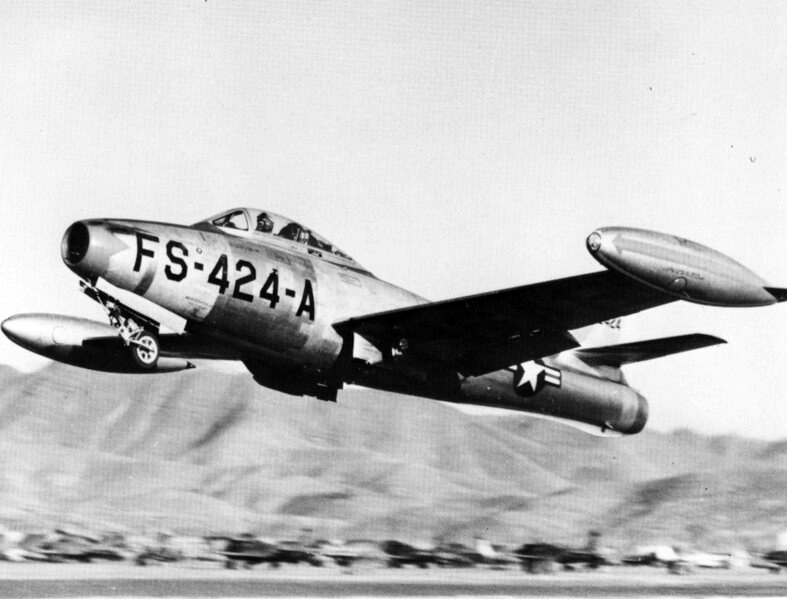
A F-84 Republic Thunderbolt, which is the type of plane Alkire was piloting at the time of the crash.
