
Looking Back
By James Rada, Jr.
The Towns That Would Be D.C.
The first U.S. Congress, which met in 1789, had a lot of decisions to make. It set the benchmarks that other Congresses would be measured against. Each representative and senator also wanted to see federal money spent in their districts.
One prize, if not the largest, was where to locate the nation’s capital. As the seat of the federal government, it would be where a lot of money was spent. Not only that, but businesses would benefit from all of the people who would work and live in the capital city.
The names of well-known cities were suggested: Princeton, New Jersey; York, Pennsylvania (which had served as the capital city for a short time during the Revolutionary War); Williamsburg, Virginia.
The locations were narrowed down when Secretary of the Treasury Alexander Hamilton and Secretary of State Thomas Jefferson were said to have reached an agreement over dinner. Hamilton needed the support of Jefferson and James Madison in order for his plan to have the federal government assume all state debt accumulated during the Revolutionary War. States that had paid off a large portion of their debt did not support this plan because they would be subsidizing the poorer states. Jefferson and Madison wanted to see the nation’s capital located in the South, which the northern states did not support.
Hamilton agreed to help Jefferson and Madison get the votes necessary to locate the capital city in the South, while Madison agreed to help pass Hamilton’s federal assumption of debt plan.
Congress passed the Residence Act in July 1790, which declared the capital city would be somewhere along eighty miles of the Potomac River, from the Anacostia River to Williamsport, Maryland, near Hagerstown. Suddenly, towns in Montgomery, Frederick, and Washington counties, which hadn’t been considered earlier, were now in the running as the location for the seat of the United States Government.
The act granted President George Washington the power to choose the final location. The U.S. Constitution also set the size of the site to be no greater than ten square miles.
This, no doubt, pleased Washington. Not only was his home, Mount Vernon, located on the Potomac, but the river had fascinated him from a young age. He believed it was the key to growing the nation westward.
Although Washington had his own ideas about where the capital city might be located, he set out on October 15, 1790, to listen to representatives from other towns make the case for their location as the best place for the seat of the federal government.
“By moving farther up the Potomac, that thoroughfare to the western region, the situation will be more healthy, it will add to the cultivation of an extensive, fertile, and populous country, and it will be more accommodated to our fellow-citizens west of the mountains and more so to almost one half of Pennsylvania, than if the seat of government was at Philadelphia,” W. B. Bryan wrote in History of the National Capital.
Bryan makes the case that Washington County would have been a good choice because of its central location, its closeness to stores, iron furnaces, and factories.
It is believed Washington reached Shepherdstown, Virginia, on October 19. The residents of Shepherdstown and Sharpsburg had raised pledges of land and money totaling $25,000 to locate the federal city around Sharpsburg and Antietam Creek.
From his visit there, Washington traveled to Hagerstown the following day. According to the National Archives, “The president was escorted into town by the local militia, presented with a welcome address, and honored with a public dinner, followed by the usual thirteen toasts. One, in particular, expressed the tenuous nature of the Residence Act: ‘May the residence law be perpetuated, and Potomac view the Federal City.’ GW is said to have lodged at Beltzhoover’s Tavern, more formally known as the Globe Inn, and proceeded up the Potomac the following morning.”
Washington then traveled to Williamsport to view the land and hear what the town fathers had to say.
By October 24, Washington had returned to Mount Vernon. Soon after, a handbill signed “An Inhabitant” circulated through the county. Titled “The Residence Act and the recent visit of the President,” it sought to “encourage the Citizens of Washington County to hope that the Seat of the Federal Government will be located therein; And while the Citizens of other Counties on the Patowmack, have the same expectations, and will probably contribute considerably toward the construction of the necessary buildings, an inhabitant of Washington County invites his Country-men to make similar exertions. Partial or limited conditions annexed to a Subscription on this occasion, would divide the interest of the County into so many parts, favouring particular places, as to render the amount of any one of the Subscriptions of small consideration; He therefore recommends that the only condition to be annexed be ‘that the permanent Seat of the Federal Government be located by the President in Washington County…’”
By the end of the year, President Washington had made his decision, and although no one knew what it was, many suspected the federal district would be around Georgetown.
On January 24, 1791, President Washington issued a proclamation fixing the boundaries of the new federal district. The capital would be a square, measuring ten miles on each side, although oriented on a map, it would appear in the shape of a diamond. It was also the furthest south location in the range along the Potomac Congress set. Many in Congress had wanted a location further upriver, but what they didn’t realize was that Washington and his family owned thousands of acres in the district. Although no one accused Washington of making his decision for his own self-interest, he certainly benefited from it.
Congress met for the first time in the new capital on November 17, 1800, but the transfer of the federal government from Philadelphia to Washington City wasn’t completed until June 1801.
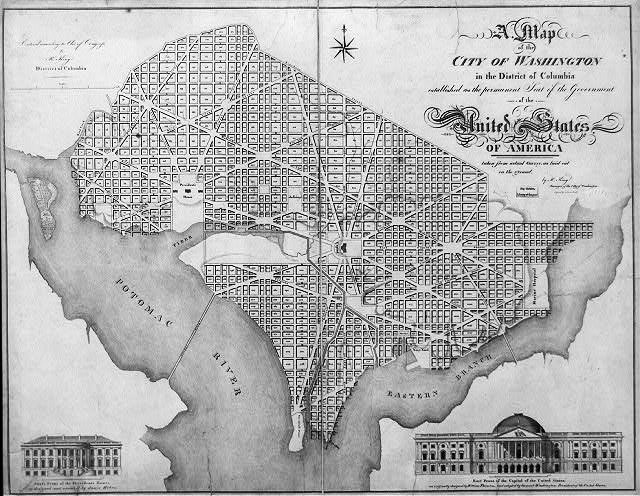
An early map showing the layout of the District of Columbia, which might have been located in Washington County had things gone differently.
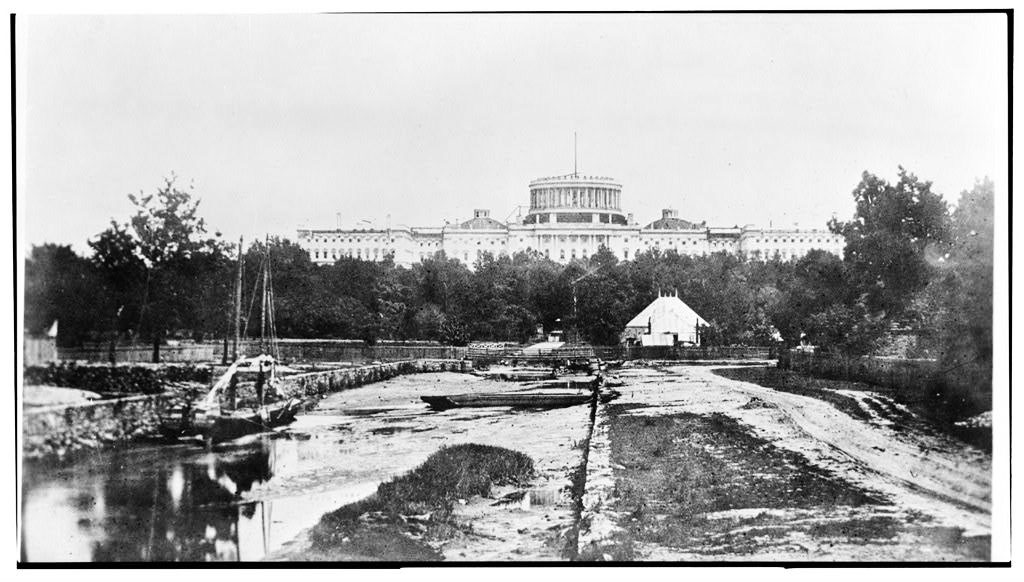
The U.S. Capital under construction.
