
Look-UP

by Mitchell Tester, College Student
space news
For this month’s edition of “Look Up,” I decided it would be fun to cover some recent news in the world of astronomy: a newly discovered type of star and the planet Mars.
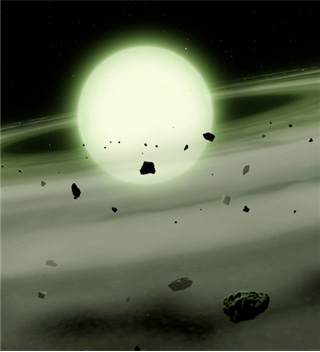
WD J1330+6435
Stars can appear as many different colors throughout space. These colors are dictated by their size, age, and chemical make-up. White dwarf stars are stars that have lived and died. They only emit any light due to residual heat from decades and decades of nuclear fusion. They slowly fade away, figuratively, for the rest of time. They eventually become black dwarf stars, although none exist yet. The residual heat described earlier takes trillions of years to dissipate, and due to the universe only being nearly 14 billion years old, time itself has not allowed for black dwarf stars to exist in present day.
It was thought for quite some time that white dwarf stars can only emit white light, hence their name. Recent discoveries show that they can also glow pink, purple, and even green. An astronomer by the name of Dr. Mark Hollands had this to say, “It turns out these incredibly dense stars can produce colors nobody expected, and some of them genuinely surprised me.”
An important note regarding these colorful white dwarfs is that these colors are only visible within close proximity to them, and any white dwarf is very far away from us here on Earth. To see these colors, astronomers use a method of observation called spectroscopy.
Spectroscopy is the study of how matter absorbs and emits light. The energy that light emits is designated by color. Light emits many colors; the seven colors that us humans can see are the colors of a rainbow. The team behind the studying of these white dwarf colors used the spectra that was emitted by these white dwarfs to see what color the stars would appear to the human eye. As stated before, matter is a huge part of spectroscopy; matter can help determine what colors are emitted. If we think of it here on Earth, we can take the green on an oak tree leaf. The oak tree leaves (when healthy) are green due to their chemical composition and the light that interacts with them. The same logic can be applied to a white dwarf star. For example, purple and pink white dwarf stars are usually rich in the element carbon.
A specific star studied, named WD J1330+6435, has a history of swallowing rocky debris from the planets that orbit it. Due to this, the star has an atmosphere that is abundant in calcium, lithium, and sodium. When these elements absorb light, the light that is left over is a green hue, hence why it appears to us this way. The team behind the research says that there has been no other star like this one found, meaning that it is the first green star ever discovered. These colors of pink, purple, green, cyan, and so on, are incredibly uncommon. The team looked at a total of 151 white dwarf stars, and only 5 of them showed a strange color. Due to this research, it is safe to say around 1 in every 30 white dwarf stars are not white.
The Toxic Dust of Mars
Mars has been visible to the naked eye by humans since the beginning of our species. Ancient civilizations thought of Mars in various ways, it being a planet not being one of them. They referred to Mars, and all our other planets in our solar system, as wandering stars, which the word “planet” is derived from. All stars are fixed in the night sky, but there were a few that would move across the sky at night. These wandering stars sparked intrigue for generations and continue to do so today. Mars, a red dot in the sky, was seen as a symbol for blood and war by many cultures, including ancient Rome, which named Mars after their god of war.
Fast forward to the 18th century, an astronomer by the name of William Herschel discovered that Mars has polar ice caps. Due to this discovery, Herschel theorized that Mars could harbor life of some kind. Due to the 19th century’s rise of popular culture and Herschel’s astronomical discoveries, people began imagining the history and future of Mars. Popular theories and speculation surrounded these topics: what it looks like on the surface, the possible ancient race of the people that lived on it (named Martians), and what life would look like on Mars for us humans.
Now in the 21st century, we see Mars much clearer, through advanced telescopes here on Earth, satellites in low orbit, and even rovers we have sent to the surface of Mars. We now know Mars is a dry, dusty, and frigid planet. We have real hopes of putting humans on Mars, possibly even terraforming the planet to better suit us. With all these hopes and wonders of the Martian surface, roadblocks of all kinds make this goal of discovering all that Mars has to offer very challenging.
The biggest challenge is how toxic the dust is on the surface. When we say dust, we are referring to a powdery, fine layer of eroded rock and minerals that coat the entire surface of Mars. This dust is blown everywhere by Mars’ weather patterns, which means wind reaching up to 100 mph during bad storms. We had an idea of how toxic this dust could be even from our time on the lunar surface. The Moon’s dust stuck to everything. The dust eroded space suits, it overheated equipment, and even irritated the lungs and eyes of the astronauts. Although there are takeaways from the lunar dust, it still doesn’t tell us the whole picture. Mars is home to many other chemical components and minerals that are not found on the Moon, some of those being carcinogenic. One of our biggest goals with having humans on Mars is to eventually terraform the surface, which means making it habitable for humans to live on long-term. For us to live long-term on Mars, we must be able to grow crops, although we have found that the surface of Mars is so riddled with unfavorable minerals and chemicals that it would be impossible to do so. This will make it very difficult to survive for longer than the amount of food we can bring with us, which for long-term residence on the Martian surface, is not very much.
Sending humans anywhere in space, the motto is always to “pack light,” as fuel is a big factor of how far we can go. We do not currently have a sample of this dust found on Mars, but the Japan Aerospace Exploration Agency (JAXA) has a plan to land on one of Mars’ moons, named Phobos. Phobos could give us a very good indication of the chemical make-up of Mars’ surface and the dust that is kicked up. To send a spacecraft to Mars and to have it land is very challenging to begin with. To send a spacecraft to land on Mars, collect a sample, and launch off the Martian surface and come back to Earth is even harder due to Mar’s gravity. Phobos is much smaller, which makes it a lot easier to launch from.
We can only hope that the JAXA is able to pull it off, as that would give a greater understanding of what we would be dealing with when we send humans to Mars in years to come.
