
Look-UP
by Mitchell Tester, College Student
TIME, PART III
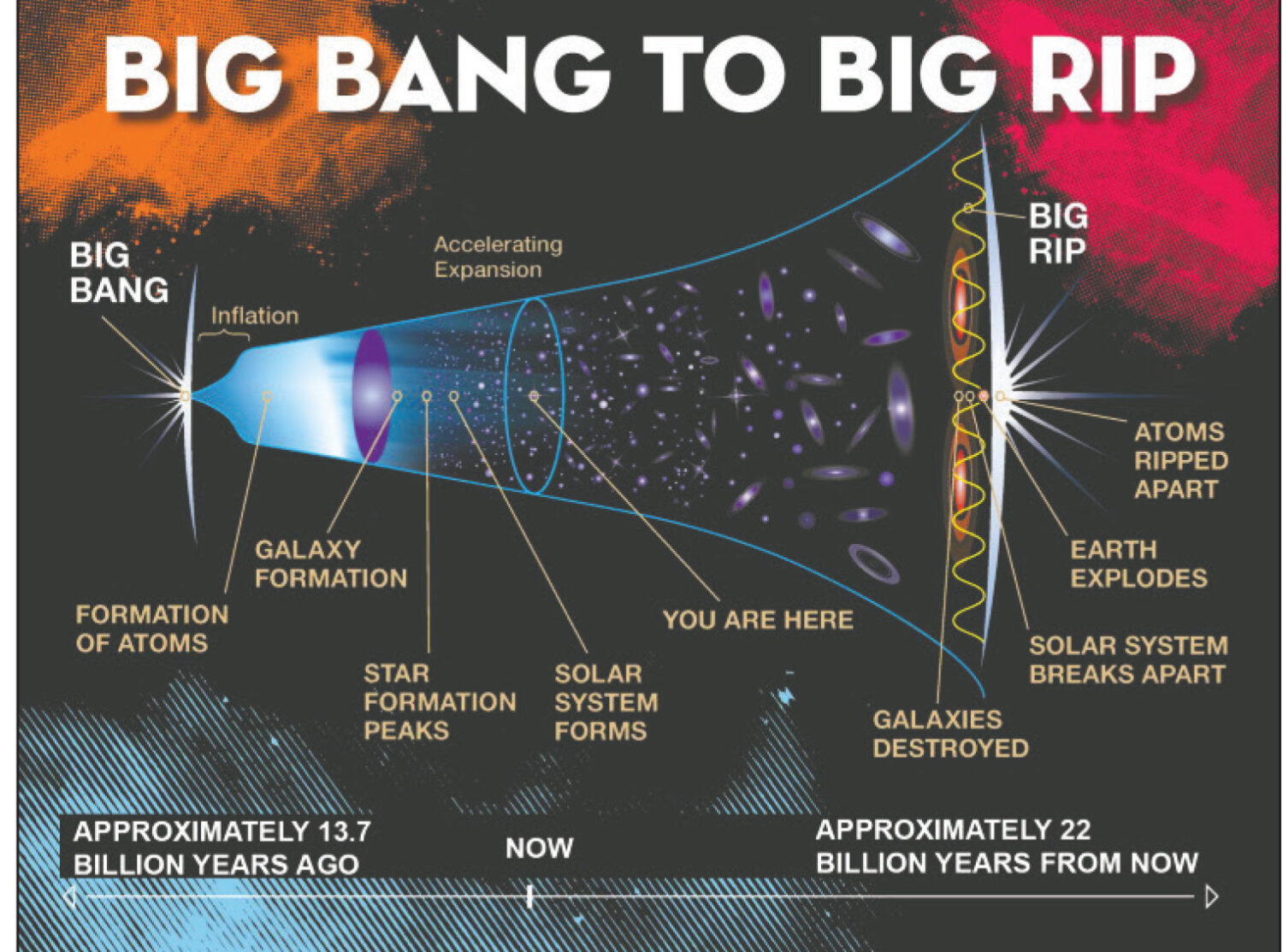
What fascinates me the most about the Big Bang theory—especially in the way that we theorize it now—is that the Big Bang lends to the idea that there was a start of this. Everything we know and love here on Earth, and beyond, is only encompassed in the amount of time since the Big Bang, nearly 14 billion years ago. As I said last month, we are only able to see far enough back to see the Cosmic Microwave Background (CMB), an opaque, dense particle soup that surrounds what we think of as the universe. CMB is direct evidence of the Big Bang, as it helps explain that at one point, there was not, and then at the point we are at now, there just is. We have no idea what is past this point, nor do we know what existed before time existed. Time has a beginning and an end. So, for this last part of “Time,” we will learn about the theories of the end of the universe that are widely accepted in the scientific community.
Big Freeze
We have talked about this before, but it is important that this is discussed again. The Sun, which is just an average-size star, has a finite amount of fuel to keep shining. It will eventually die out in roughly 5.8 billion years. So do not worry, readers; you will be able to read The Catoctin Banner for many, many years to come. Although, stars only existing for a finite amount of time does land us with an interesting question. Will all the stars die out eventually if the amount of matter and energy that is needed runs out? If the supply of gas runs out, then yes. It is true that there will come a point in time when the last star in our sky will slowly die, leaving the universe in darkness. This new dark universe will be covered in black holes from larger stars than our own. But the black holes, too, will eventually disappear. This will leave the universe with nothing, in a certain sense, possibly leaving the universe much like how it was before time as we know it began, before the Big Bang.
Big Crunch
A large part of the most accepted theory of the Big Bang is cosmic inflation. The universe expanded ridiculously fast and is continuing to do so, faster and faster each nanosecond that passes. How it looks in the year 2026, it appears that the universe will not be running out of dark matter (energy that expands the universe) any time soon. This theory, though, states that eventually the universe will start contracting due to the average density of the universe in the future. What average density means in this case is that if this expansion keeps going on for billions and billions of years, the amount of matter in the universe would eventually be so large that the gravity of said matter would cause the space that we exist in to contract and, figuratively, crunch. Due to singularity not being as accepted today, this theory is also not as accepted, but is still considered nonetheless. All we know is that we know nothing.
Hypothetically, though, the Big Crunch states that all of the matter in the universe being contracted to one point would be what caused the singularity that our Big Bang could have come from (again, singularity theory is not widely accepted anymore). This crunch would cause another Big Bang to happen instantly after the crunch, which leads to a cyclic model of the Universe. Meaning that it repeats. But what came first? The Big Bang or the Big Crunch?
Big Slurp (Yeah, I don’t know what they were thinking with these names)
Last month, we discussed what a false vacuum is. To explain again, a false vacuum is basically saying that space is not actually completely empty, as we now have a very good understanding of subatomic physics, learning that there is actually something smaller than an atom. Our own universe is likely a false vacuum.
This theory suggests that this false vacuum could, with a great amount of time, decay and become a true vacuum. This would result in a complete flip of the physics that we have studied since the start of the human race. Matter itself would change vastly. This would result in the universe changing in every conceivable way. The Big Slurp would not be able to reach all of the universe, though, as the rate of decay could not exceed the speed of light. This theory is similar to the Big Freeze in the sense that the bubble that the Big Slurp affects would most likely be chemically dead. Although understanding how our specific kind of physics works, really anything is possible as to what it would look like.
Kind Regards from the Universe
What fascinates me the most about theories of the universe is just how much it actually does not affect us. As said before, the Sun will only continue to live for around 5.8 billion years before it ultimately starts to die out. Whether the human race finds a way to exist in 5.8 billion years or not, we cannot stay here on Earth. Mars is great for right now and for a long time, but just like Earth, it would not be viable when the Sun stops fusing hydrogen into helium, which is what allows us to live. We would need to seek outside the solar system, which is not exactly an easy task. Other planets in neighboring galaxies are incredibly far, taking 80,000 years to get to. Hopefully, we find a way to live in space, always on the figurative “road.” We would live as nomads in space, I guess. Everything that has existed in the human consciousness will end in a very physical sense at some point. But, of course, we do not know when; we can only hope that we can continue to exist outside of what we can physically see and exist in.
Astronomy has really taught me about what exists beyond what I can see. It has ultimately taught me something that my father has always told my siblings and me: “Everything is temporary.” It seems like he may be on to something.
Tune in next month for another edition of “Q’s.” In this one, I will be answering my friend Erin’s question, which is one I think you all will enjoy.
I hope you all have a wonderful October, and thank you, as always, for learning with me.
