
Look-UP
by Mitchell Tester, College Student
Time
~ Part 1 ~
There is something definite that we all live by every day, as we chase the sinking sun for it to come around again. Time. It dictates what we do, when we do it, and how we judge our progress. In a much more trivial way, it is how we know when to leave for work, when to go to bed, when to feed our pets, and when to water our plants. In a cosmological way, time is at the basis of when we know the Sun was created and when the Sun will die. Our understanding of the Sun’s life-cycle is, of course, brought by our observation of similar stars in distant solar systems and galaxies, but our ability to put a finite number of years as to when our Sun will shed its outer layers, evaporating the oceans of the Earth, is given through our understanding of time. Time tells us that in 7 billion years, the Sun will sit as a white dwarf star, a shell of its former hydrogen-fusing self.
For centuries, humans have relied on methods such as the sundial to tell time. These sundials were made of what was available to the people in certain geographical locations. Materials such as marble, bronze, stone, and many others were used. The sundials used the light from the Sun, and as the Earth made its daily rotation, the shadow changed position on the dial. These sundials worked well for the time, but with how fast-paced and time-oriented the world was getting, we had to work to make an improvement. Fast forward to the discovery of atoms. In the late 19th century, two physicists by the names of William Thompson and James Clerk Maxwell theorized that due to the independent nature of a sodium particle in relation to its place in the universe, this could be used to tell time. Nothing in the universe stays still, and an atom plays by that same rule. The particle was found to vibrate repeatedly in the same intervals, and according to Thompson, from his writings, “Its (the sodium particles atom) modes of vibration are known to be absolutely independent of its position in the universe, and it will probably remain the same so long as the particle itself exists.”
When telling time, reliability is the most important factor. Sundials and other forms of telling time were victim to roadblocks such as cloudy conditions, inaccuracy, and so many more. The sundial was dependent on outside factors that could cause inaccuracies, which is why Maxwell and Thompson pointed toward the independent atom, specifically its consistent interval vibrations. Despite Maxwell’s and Thompson’s discoveries, the atomic clock would not exist till many decades later. These two physicists planted the seed, and in the decades following 1879, much work had to be done.
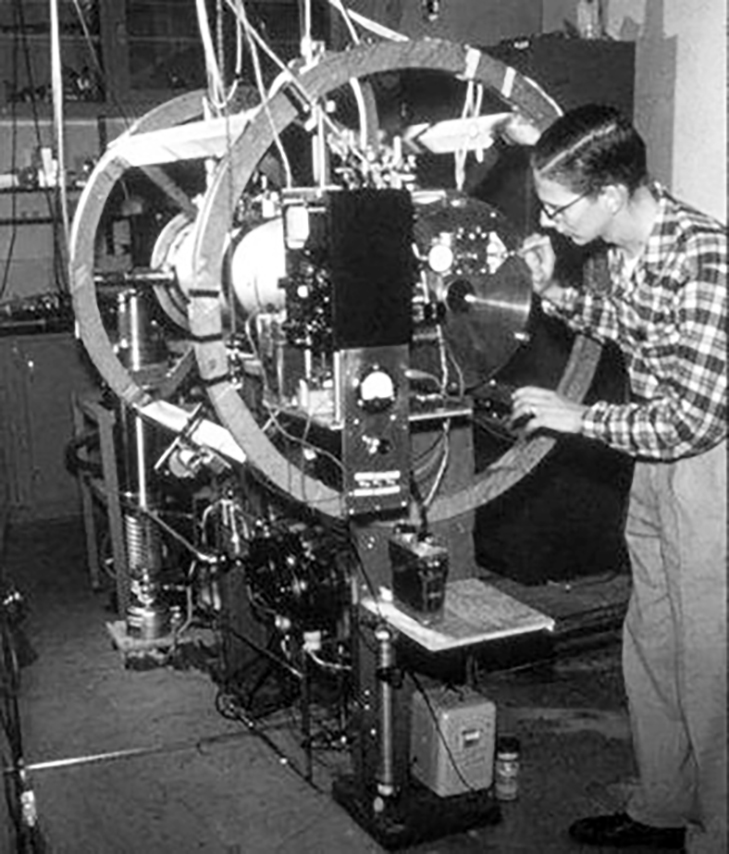
Atomic clocks in today’s time are billions of times more accurate than any other form of clock. These sophisticated clocks are used for timekeeping, navigation, telecommunications, and astronomy, being used in our phones, computers, and many other devices. Maxwell and Thompson were correct in their prediction; instead of sodium, an atom called Cesium is usually used, wherein we measure the time intervals of the atom vibrations when exposed to specific microwave frequencies.
The atomic clock has helped us in our daily lives, but what about the bigger picture? What is the origin of time itself? For there to be an end, there must be a beginning. Such as our Sun, we know that there will be an end, and we know that there was a beginning 4-and-a-half billion years ago, where our solar system sat as a mere swirling cloud of dust and gas. The name for our baby solar system, or any solar system before it becomes one, is called a “solar nebula.”
The universe, like our own solar system, has had phases in its life. It is most likely that it has had a beginning, and much more ominously, will have an ending. To speak on the origins of the universe, in a scientific sense, most point toward the Big Bang Theory. The theory is a huge catalyst for controversy, as to many, it discredits or contradicts religion. Although I feel as if it is a misconception about the point that the theory is trying to prove. The Big Bang and religion both answer different fundamental questions: the Big Bang Theory explains how the universe forms, while religion explains what or who created it and why. Both can coexist.
Is it true that the Big Bang states that our universe was created by nothing, a void of empty space? How does something come from nothing? Tune in next month to learn with me all about the Big Bang Theory, to answer the most common questions about the theory, and to try to get a better understanding of how our universe may have looked nearly 14 billion years ago and why it looks the way it does now.
