
Look-UP
by Mitchell Tester, College Student
The evergreen state
In April, I got the opportunity to go on a trip with my good friends to a place I had never been before, somewhere that I did not know much about.
At four in the morning, we all wake up at my friend, Jake’s. We grab our bags, say goodbye to the cats, and head off to the airport. We buy our overpriced drinks and food once we’re in the airport, waiting for boarding to start. Although I have flown quite a few times, the $10.00 bottled water still seems to surprise me. I hear the crackling of the speaker when my two friends and I decide to perk up, excited that we may finally start boarding, as the flight was delayed 20 minutes or so. “Hello, ladies and gentlemen, on behalf of Alaska Airlines, we would like to invite our first class to start boarding for flight 301, Dulles, Washington D.C., to Seattle, Washington.” After letting those who have a bit more spending money than we do go first, they finally called our group, group F, the last group. We all file into the cabin of the plane, packed like sardines. For the next five hours, we are greeted with turbulence, crying children, lukewarm soda, peanuts, and beautiful views out the window of the airplane.
We arrived in Seattle, Washington, in the morning, jet-lagged and hungry. Spending time in Seattle was only temporary, as we planned to rent a sprinter camper van and head out into the wilderness as soon as possible, the coast first to be exact. Our Uber driver, a Somalian immigrant, welcomed us to Seattle. He gave us the lowdown on Washington State, a place that was very much foreign to us. After talking for a bit on the way to the rental, he inquired where we were from. “Maryland,” we answered. His eyes lit up. Excitingly, he told us that he has never been to the East Coast. New York City was the place he wanted to visit next. Our conversation was cut short when we arrived at the rental place. We said our goodbyes and wished him luck, as he did the same. Familiarity plays a big part in traveling, since the less familiar something is, the more breathtaking it can be, and the more it catches your attention. Meeting someone who lives in such a beautiful place, evergreens as far as the eye can see and snowy mountain peaks looming over the city, it made me realize that, although I have seen the same East Coast landscapes my whole life, there is still very much beauty and wonder here in the place I call home, so much so that even our Seattle Uber driver wants to travel across country to see our home, just as we did to see his.
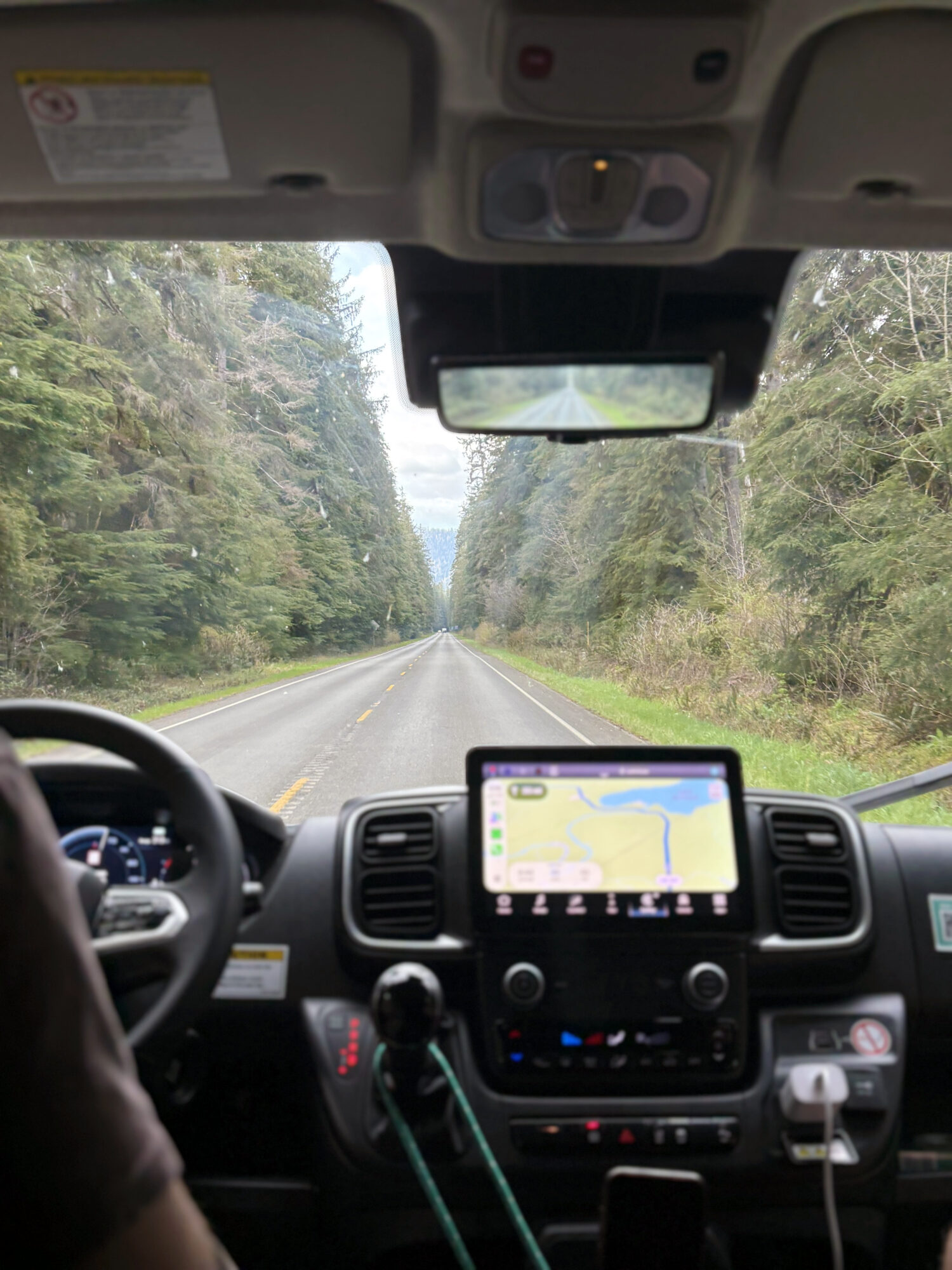
van, on the way to Hoh
Rainforest
The camper van rental was equipped with a shower, a sink, a stove top oven, and many more utilities that practically made it a home on wheels. For the next four days, my friends and I traveled around the most northwestern part of Washington State, and technically, the most northwestern part of the United States. We saw the coast, the rainforest, and the alpine lakes of snow-capped mountains in Olympic National Park. The landscape is so vastly different from anything I have ever seen, different from the desert outside of Las Vegas, different from the cliffsides of Zion, different from the San Juan and Rocky Mountains of Colorado, and even more different than our home National Park, Catoctin. The sands of Kalaloch Beach are gray like ash, the evergreens looked like skyscrapers, and the Hoh Rainforest is so thick that, at times, the greenery, shielding the sun overhead, turned day into night.
My friends and I had a ritual of spending time by the campfire when we wound down for the night, as most campers do. When we were not talking, I would sit reflecting on the day and what I saw. One thought always came back to me: Why is the landscape here the way it is? As an individual who has a love for astronomy, I spend a lot of time learning about the history of why planets, some very distant, are shaped the way they are. It can be thought of as the history of their life. Take the planet Uranus, for example. Why does it have such strange rings, oriented vertically, while most rings are horizontal (such as Saturn)? This can be explained by the planet’s history, a violent one at that. Uranus was most likely hit by something very large many years ago, which left its orbit changed and its rings as well. While sitting by those fires, I knew what I was doing once I got home, and it was answering the question of why the West Coast is so vastly different from the East Coast.
Geology is the history book for why and how Earth looks the way it does. One stark difference between the East Coast and the West Coast—or more specifically, the Pacific Northwest (where Washington State resides)—is that the mountain ranges differ vastly in age. Our mountains, the Appalachian Mountains, are much older than the mountains that exist out there, called the Cascade and Olympic Mountains. Our mountains are some 480 million years older than the mountains my friends and I climbed out in Washington State.
The Appalachian Mountains are so ancient, in fact, that they predate land animals, even the dinosaurs. Due to our mountains not experiencing plate collisions, there is no significant tectonic uplift to help combat the erosion that naturally occurs. Over years and years of time, the erosion continues, while geologically, the tectonic plates underneath our mountains have stayed quiet. Now fast forward to any human’s lived experience of Appalachia; these mountains stand much shorter than what is found out west or in some other regions outside of the United States. In fact, it is said that many years ago (remember many millions), our Appalachian Mountains stood as tall as the Himalayas.
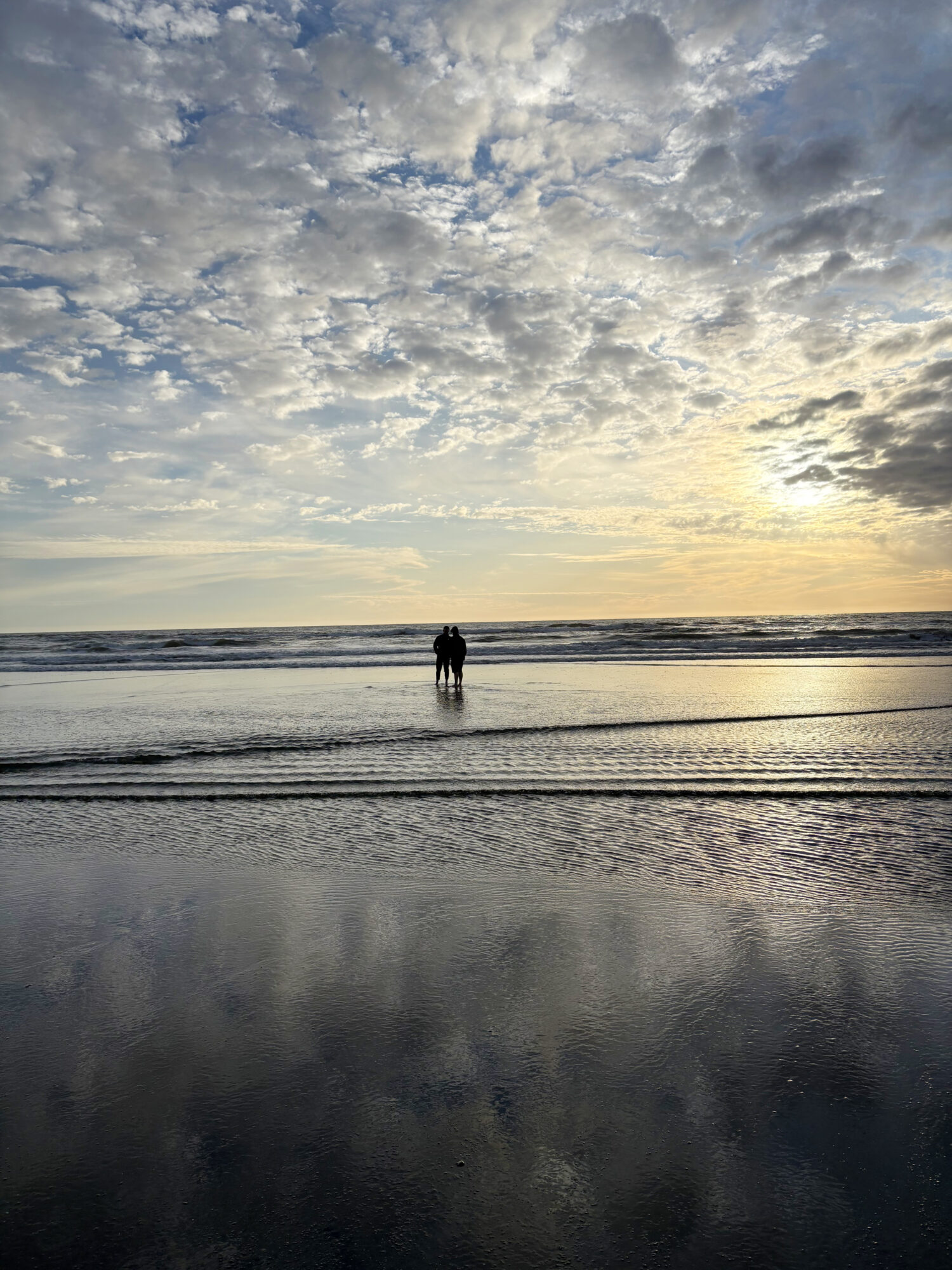
What stood out to me the most during my trip—primarily the time spent on the coast—was the ash gray sand that covered the beautiful cliffside beaches. The Pacific Northwest is much younger than the landscape we roam. The gray sand can be explained similarly to the rocks that reside in the state, by its geological composition, a land that is rich in volcanic basalt.
My whole goal with this column is to have people look up to the stars, learning about the world that exists just out of our reach. I believe that we can learn much about ourselves when we look up to the heavens. Sometimes, though, it is easy to take for granted what your eyes see every day, the landscape you see while driving to work, walking your dog, and taking out your trash. Traveling to me is not only seeing what is foreign to me—landscapes vastly different than what I call home—but traveling is also a way that you can gain a new appreciation of what you are used to seeing. Realizing that just like the places we spend traveling to are unique, our home is just as much so. Thank you for joining me this month, where we took a break from looking up to the stars and spent some time appreciating what is right in front of us.
