
Look-UP

by Mitchell Tester, College Student
titan
Moons are known to not have any significant atmospheres, largely due to their inability to hold one. Their lack of a magnetic field, low gravity, and overall size leaves them vulnerable to solar winds. Most moons are also geologically dead, meaning that they lack any active volcanoes or plate tectonics. This deadness leaves them to never replenish the gases that would make up an atmosphere when they either escape or are blown away by the Sun’s radiation.
Up until 1944, we believed that this deadness and lack of atmosphere is true for all moons, including Saturn’s moon, Titan. Although, astronomers theorized that Titan may have an atmosphere due to its haziness around the moon.
Dutch-American astronomer Gerard P. Kuiper found something fascinating the year of 1944. Through using spectroscopic techniques, he discovered that Titan has a substantial amount of gas on it.
Spectroscopy is a commonly used as a way for astronomers and astrophysicists to see the genetic makeup of all the objects in space. All physical objects react to electromagnetic radiation (light) differently. How something absorbs, emits, or scatters light will tell us its composition.
Since the confirmation of an atmosphere by Kuiper, astronomers were in a hurry to discover more of this mysterious moon of Saturn.
In 2005, the European Space Agency (ESA) landed a craft named Huygens on Saturn’s moon, Titan. The probe was carried all the way from its departure on Earth in 1997 alongside NASA’s Cassini spacecraft. Huygens separated in December 2004 to study Titan’s atmosphere and surface.
Huygens took nearly three hours to descend through the atmosphere of Titan, which would roughly be the amount of time it would take for a similar landing spacecraft to venture through Earth’s atmosphere and land. This speaks to how thick Titan’s atmosphere truly is, despite being 45 percent smaller than Earth.
During Huygens’ descent, and after landing, the probe took many pictures of this new world. Through the thick atmosphere presented mountain ranges similar to our own rocky mountains, jagged and sharp, towering over any observers on the ground below them. This is where the comparisons stop, though, as Titan’s mountains are made out of water ice, coated in materials such as solid butane and acetylene.
Titan’s surface is also home to ridged channels flowing through it, which indicates some form of liquid is falling from the thick clouds above and flowing down the mountains. Unlike the liquid water that flows through our channels here on Earth, liquid methane does the carving on Titan. The river system named “Vid Flumina” is a significant one on Titan, measuring 249 miles long. This river system flows into Titan’s second largest sea, “Ligeia Mare.” The name of the river system and the sea it flows into are derived from Norse mythology and Greek mythology, respectively.
Compared to our home, Titan does not have plate tectonics in the way that we do. This does not stop it from being geologically active, though. Tidal forces cause Titan’s ice-based tectonics to have slip faults, which release ammonia instead of molten rock. Titan’s geologically violent nature stems from a combination of active surface liquids, a dense atmosphere, internal heat, and intense environmental pressures.
Titan is incredibly cold, sitting at -290 degrees Fahrenheit on its surface. Titan, being one of Saturn’s natural satellites, means that it is very far away from the Sun. The circumstance of distance from the Sun and its very thick atmosphere means that it (1) doesn’t get much sunlight, and (2) reflects a lot of sunlight that does reach it. Unlike our Moon and all the others that reside in our solar system, Titan’s atmospheric gases do not escape into space due to just how cold it is there, which is just one of the reasons why Titan keeps its atmosphere.
Titan, like here on Earth, has diversity within its landscapes. Way down from the peaks of Titan’s mountains exists its dunes (among many other geographical features). These dunes are large, dark, and rich with organic materials. Waves of electrostatically charged particles lay through on the surface to create Titan’s dunes, most likely mimicking the feeling of wet sand you may find at the beach or in an oasis, rather than the dry sand we are used to in our deserts here on Earth.
There is still a lot of mystery surrounding Titan. It has long been debated if Titan has subsurface liquid water (H2O) oceans, which very well could be home to microbial life. More recently, though, scientists have theorized that life on Titan could be quite difficult, especially in its possible subsurface ocean, as any nutrients to help sustain life would have a very hard time making it through Titan’s thick, icy surface crust. Whatever the case may be, Titan stays as one of the most mysterious objects in our solar system.
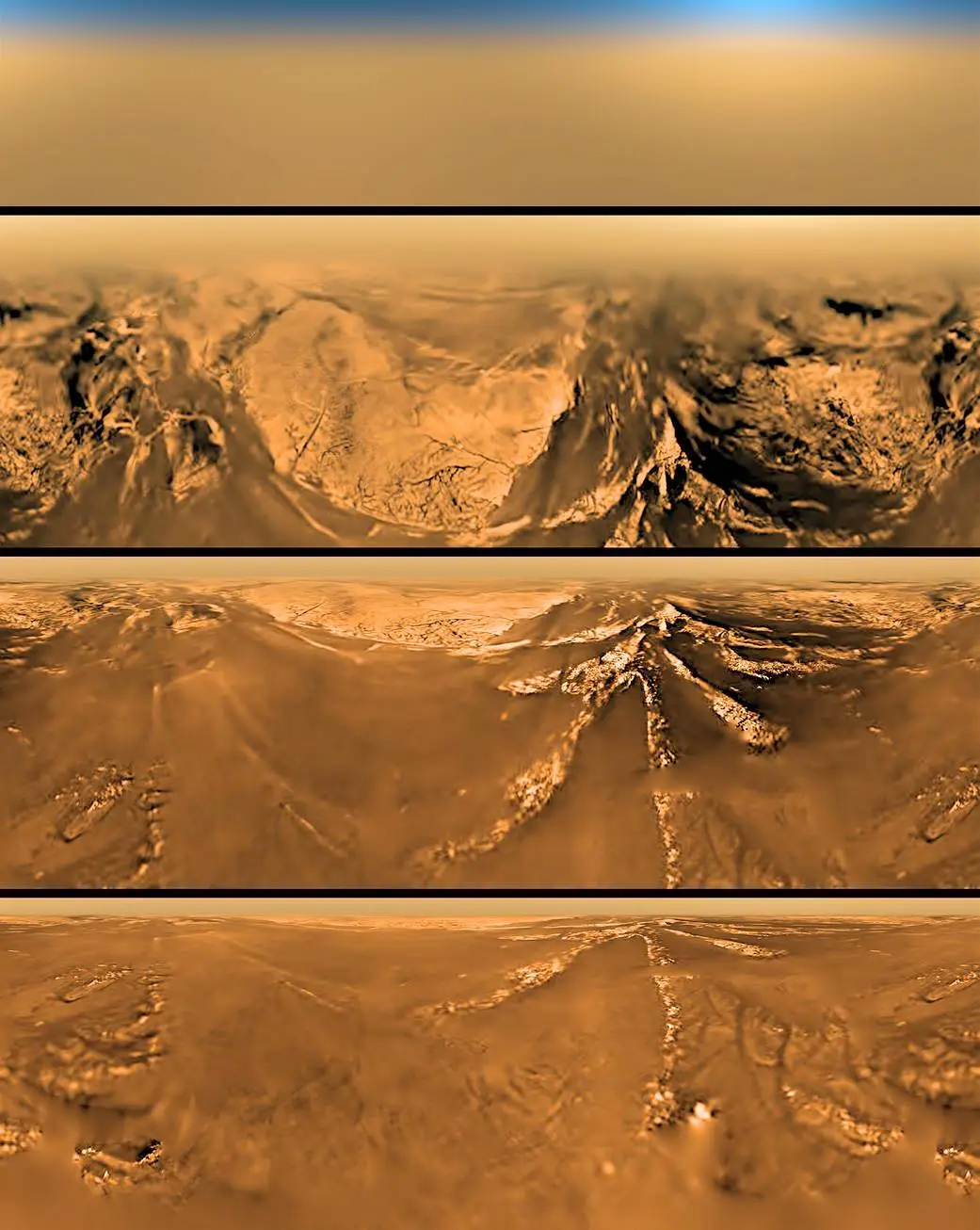
In 2005, the Huygens probe takes these images of Saturn’s moon, Titan, at four different altitudes as it descends to the surface. Source: nasa.gov
