
Look-UP
by Mitchell Tester, College Student
Saturn
The Ringed Planet
When looking through a telescope, our sixth planet, Saturn, is one of the most breathtaking. As we know now, Saturn is not the only planet in our solar system that has rings. Planets such as Jupiter, Uranus, and Neptune all have rings, although they are much less noticeable. This is why Saturn holds the title of “The Ringed Planet.”
A day on Saturn’s non-solid gaseous surface would last about 10 hours and 39 minutes. Similar to the other gas giants of our solar system, Saturn has no solidity to it. Despite this, Saturn’s volume is nothing to ignore. Its volume is the equivalent of 1,000 Earths. Although, its density is the lowest of any planet in the solar system.
Saturn has been known by humans for centuries, as it appears to be a bright star in the night sky. Saturn and other visible planets helped coin the name planet, which means wandering star. Galileo, in 1610, observed Saturn with his telescope, although he was unable to make anything from the rings as his (or any other telescope at the time) was not advanced enough. It was not until 1659 that a man by the name of Christiaan Huygens, a Dutch astronomer, discovered the rings, and one of Saturn’s most intriguing moons, Titan, which will be discussed next month.
One billion dollars and thousands of hours of preparation, testing, and hard work led us to our closest look at Saturn in the year of 1980 and 1981, revealing what was thought to be an incredibly complex system of rings. The discovery of how long Saturn’s rotation is can be credited to NASA’s Voyager I and and Voyager 2, which collected bursts of radio emissions periodically that allowed us to calculate the rotation period.
Two processes are known to occur in Saturn, which are the slow shrinking and expanding of the core. Due to it not being solid like Earth’s core, Saturn’s core can be described as “sloshing” around.
Saturn’s rings are 240,000 or so miles across, although they are incredibly thin, averaging only about 30 feet in thickness. Interestingly enough, waves can even form from mutual gravitational pull from the natural satellites of Saturn, which is home to 274 of them. These waves in the rings appear like ripples of water in a pool. The spaces between these ripples/waves help us calculate the thickness and density of the matter that makes up the rings. Collisions do happen in the rings, which can cause particles to stick together, just like how accretion leads to planets, it can sometimes form satellites. More rarely, though, collisions can cause objects to break apart. This is how we theorize the rings came to be, that many, many years ago a couple of larger satellites suffered detrimental collisions, which laid out the foundation of the rings.
Saturn’s rings are home to some very rare occurrences. The satellites Janus and Epimetheus have an almost identical orbit. They get close to each other but never touch. They switch, and the one in the front begins to trail behind the other until they switch back. Forever in this dance. Another satellite, Hyperion, has a chaotic rotational state, which means that it “tumbles” around, rather than spinning on an axis. The particles that make up the rings are mostly ice, which on satellites can be as strong and thick as the rock here on Earth. This is due to the great distance that Saturn and our other outer planets sit from the Sun. Enceladus, another one of Saturn’s moons, reflects about 90 percent of the sunlight that hits it. This is due to the surface most likely being made up of fine crystals. Our home, Earth, only reflects 30 percent of sunlight.
Saturn, named for the god of time, has been a timeless object for the curiosity of humans since the beginning of us looking up and observing the night sky. Saturn’s largest moon, Titan, is a world that sparks curiosity for us in today’s age. Its thick atmosphere—which, before its discovery, we did not think it possible for a moon to have one—clouds us from looking at its surface. The atmosphere here on Earth, among other things, allows us to breath, it allows us to live. Does Titan harbor life? What does it look like on its surface, does it have oceans of water, or mountains that rival our mountains here on Earth? Tune in next month as we attempt to answer some of these questions.
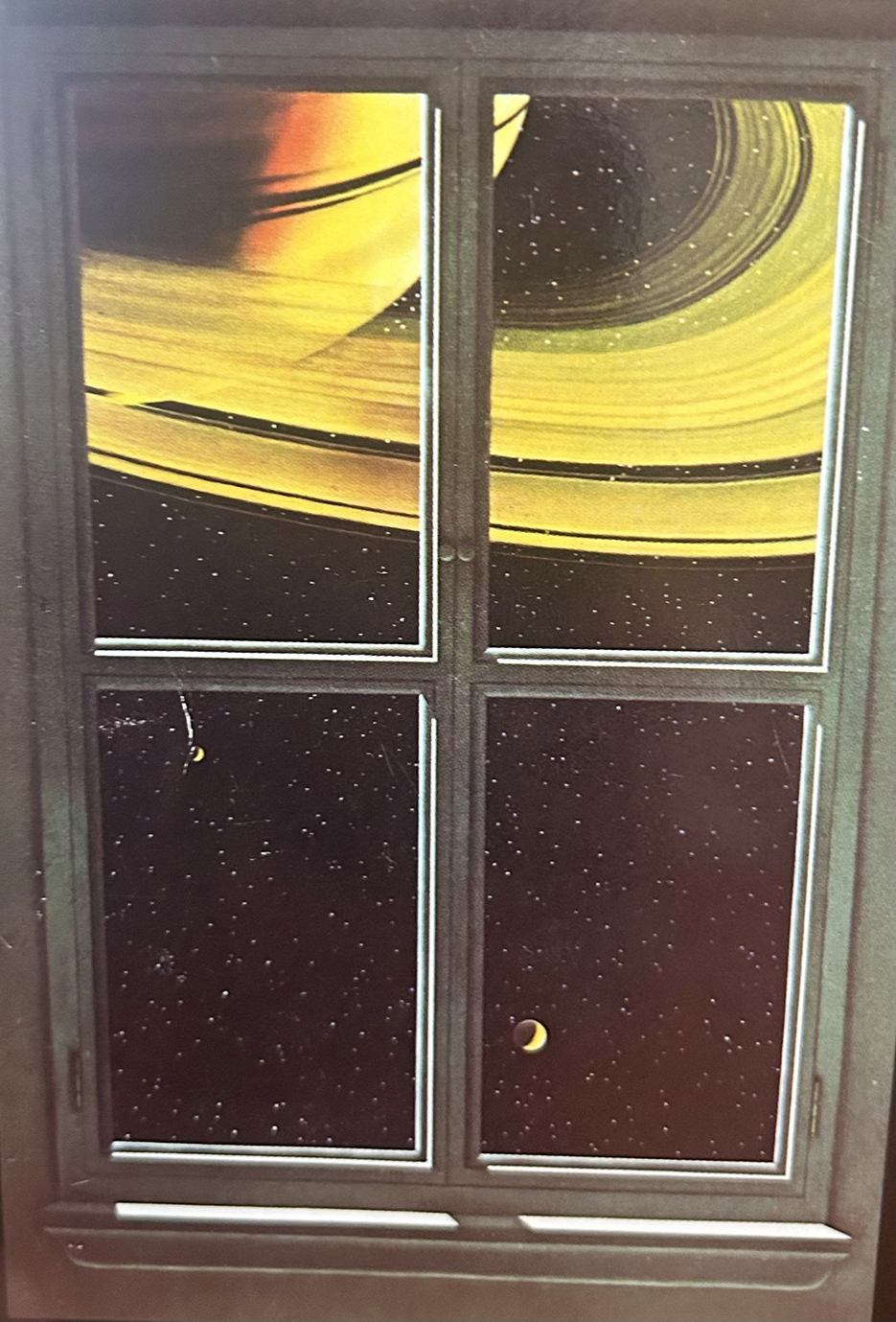
Fictional image depicting Saturn and its rings through a window. Source: The Planets by Bryon Preiss
