
Look-UP
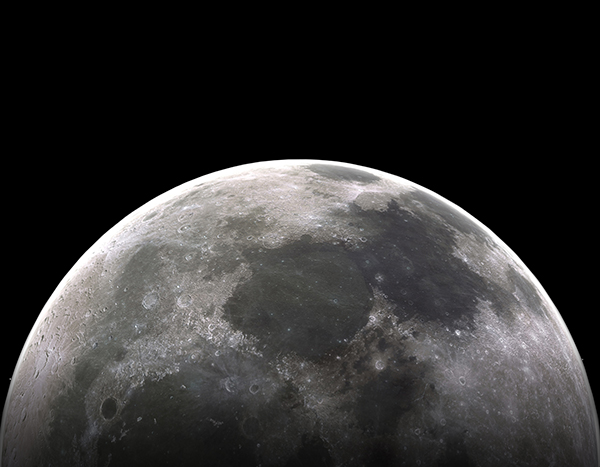
by Mitchell Tester, College Student
How our moon came to be
“The Capture Theory”

In last month’s column, I talked about the origin of the Moon and how it came to orbit us. I mentioned the two theories I would be discussing: the Giant Impact Theory and The Capture Theory.
To recap from last month’s column, the Giant Impact theory is the leading theory today and states that the Moon formed from debris ejected into orbit after a Mars-sized planet, named Theia, collided with the early Earth around 4.5 billion years ago. The gigantic impact ejected a large amount of molten rock and debris from Earth’s mantle and crust into orbit around the Earth, along with some of Theia’s core. The orbiting debris began to clump together under gravity, forming the Moon.
This month, we will discuss the The Capture Theory, which I mentioned last month is the theory my fiance leans more toward. As I said in my last column, neither of us is 100 percent correct, as our gravitation toward each theory is very subjective. The origin of the Moon still very much remains a mystery; although, at this point in time, the Giant Impact Theory remains the current leading model. One of the reasons for this is that The Capture Theory struggles to explain the very similar composition of the Earth and Moon.
Now, let’s get into The Capture Theory, first proposed in 1909 by astronomer Thomas Jefferson Jackson. The theory suggests that our Earth’s gravitational field drew in the Moon (which came elsewhere in space) close and has kept it in orbit ever since.
In this theory, it is believed that this “capture” occurred during the early history of the Earth. When we look at other planets in our solar system, we have evidence of the capture theory, while looking at our eighth planet, Neptune.
There is evidence that Neptune’s largest moon, Triton, was pulled into orbit from the Kuiper Belt, which is just outside of Neptune’s orbit. The Kuiper Belt is most notably recognized for being the home to the dwarf planet Pluto. Our neighbor planet, Mars, also has two moons that most likely originated from Mars “capturing” them. So, it makes sense that if it can happen elsewhere in the solar system, who’s to say it cannot happen here on Earth.
A researcher by the name of Robert Malcuit from Denison University has been pursuing The Capture Theory since the 1980s. His work involved thousands of computer simulations to demonstrate that a pre-existing planetary body, which he called “Luna,” could have been gravitationally captured by Earth. Malcuit’s computer simulations have shown that it is actually possible for Earth’s gravitational pull to capture an object such as the Moon.
Malcuit said this about The Capture Theory, “It’s really a David and Goliath thing, and the giant impact model is the Goliath. I don’t think people will get all stirred up about the capture model until nothing else works. It has to kind of crumble, and capture to be the only good theory left, really a default model.”
Malcuit also compares The Capture Theory to the theory of continental drift, which was very ridiculed when it was first brought up in the scientific community. Although later research on the idea led to the concept of plate tectonics, which is a cornerstone in Earth sciences. He describes that for the leading researchers to get people to support continental drift and plate tectonics, he said, “had to prove every little point to get people to believe them—every little point.”
Although the Giant Impact Theory is most accepted at the present time, Malcuit continues his research to support what he believes in, which is what scientific pursuit is all about.
