
Look-UP
by Mitchell Tester, College Student
How our moon came to be
The “Giant Impact Theory”
I want you to imagine for a moment that you are an Arab explorer in the 7th century. Talk of an abundance of gold across the Sahara Desert has convinced you and your fellow explorers to take a caravan across the vast desert. You make your way across the Sahara, in search of something more. You meet traveling merchants as you make your way across. Sharing stories with them, they share dye of a color you have never seen before and spices you’ve never had the pleasure of smelling. You move along, though, as the day is short, saying farewell to your new friends.
As you move further and further into the desert, you start to realize how hot that sun feels. Wiping away the sweat that has now accumulated on your brow, you stop for a moment. You’re an explorer after all, and a good one at that. You grew up in this hot desert. You and your caravan haven’t made this particular long journey, but you have notable experience in the Sahara. As you look back, you see the merchants you met before dropping under the horizon. You shake your flask. You take a small sip, saving the rest for later. You think to yourself that you have to be close to your nightly destination, as you race against the Sun.
You start looking down at your feet as you make your way through the sea of sand, hiding your face away from the blaze of the Sun. You and your fellow travelers move further into the desert. As the Sun goes down and the Moon comes up, your caravan thankfully makes it to a Caravanserais, a trans-Saharan truck stop of the 7th century. You and your caravan rest for the night by the fire. As you are gazing up, you notice it is a full Moon tonight. To you, the Moon brings peace and comfort to settle down for the night and get some sleep. The Moon is also a symbolism of fate, representing the changing tides of fortune and destiny. The Moon, in a modern sense, is scientifically understood and explained. Although back at this time, it was unknown, and not a source of scientific curiosity for ancient people, as it was much more seen as a deity.
To you, a 7th century Arab merchant, the Moon is unknown and mysterious, similar to the foreign land you and your colleagues are traveling to. In roughly 50 days, you will have a new understanding of this unknown land, as you finally make it through the Sahara. As for the Moon, though, it would not be until many centuries later when it was understood for what it truly is.
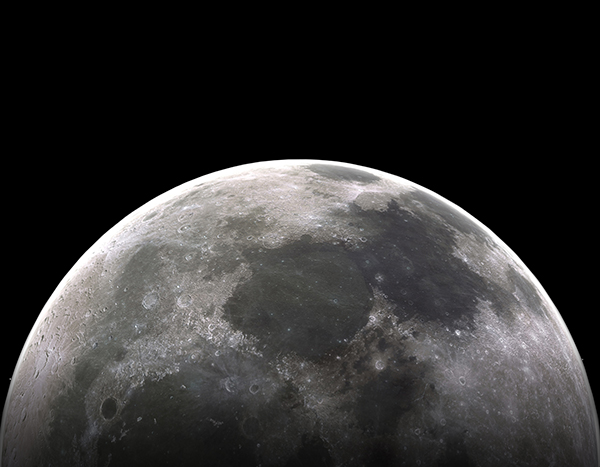
The Moon is a celestial body as is our home, the Earth. It exists in space, orbiting the Earth. The Moon is a big part of our tides, due to how gravity affects what is around it. The Moon pulls and pushes our oceans. This natural satellite, as they call it, is mostly made up of silicate rock, with an iron-rich core. It’s dead though, figuratively. As I talked about during one of my previous columns, there are tunnels on the Moon. The Moon, at one point, had lava flowing through it. The biggest evidence of this is those previously mentioned tunnels.
Much like the unknown nature of the Moon to a 7th century Arab traveling merchant, the origin of the Moon, to put it simply, is actually unknown. Due to this, there exist many theories as to how our Moon came to be. I am very excited this month to discuss one of these theories. The second theory will be discussed next month. Although my column is usually a solo project, my beautiful fiancé, Trista, will be discussing the theory she prefers, which is called the “Capture Theory.” I will be discussing the theory I lean toward more, which is called the “Giant Impact Theory.”
I want to make it clear, though, that neither of us is 100 percent correct, as our gravitation toward each theory is very subjective. The origin of the Moon still very much remains a mystery at the time of writing this.
The Giant Impact Theory. At 4.5 billion years ago, the Earth stood as quite foreign to its current self. It was hell. The Earth was being overwhelmed by asteroids, and on it, existed a magma ocean. At that time, it is theorized that a Mars-sized protoplanet by the name of Theia made violent contact with the Earth. Proto being derived from the Ancient Greek word “protos,” which means first. Think of a protoplanet as a pre-planet, a spherical celestial object that has not yet become a full-on planet. The shattered pieces of this object, Theia, caused the Earth to have rings for a little bit of time. This ring system—unlike the long-lasting rings of Saturn—was not stable. The remnants of Theia would be quickly pulled back to Earth or ejected. This ejection, and accretion by way of gravity, would eventually form the Moon.
The evidence that leads to this theory is much more of what is inferred than what is absolute truth, as this is only a theory. The Moon is known to lack volatile materials, so think water, hydrogen, carbon dioxide, and so on. These materials are easy to vaporize, unlike a rock for example. A giant impact such as Theia would cause the vaporization of these materials, which may explain the Moon’s lack thereof. In addition to this, a giant impact may also explain the relationship of the Earth-Moon system and its unusually high angular momentum, the combined rotational motion of the Earth on its axis and the Moon’s orbit of the Earth. It is unusual, because when searching elsewhere in the universe, this type of relationship is commonly not found. The last evidence I want to touch on is the Earth’s and the Moon’s similar oxygen isotope compositions, which were found during the collection of lunar material during the Apollo missions. The thought is that if the Moon was captured from Earth’s gravity while wandering space, you would think that they would not share such similar compounds. The Giant Impact Theory was proposed by William Hartmann and Donald Davis in a paper published in 1975 in the journal Icarus, after presenting the idea at a 1974 conference—and it has been a center of discussion and debate ever since. Although evidence points to the Giant Impact Theory, causality does not mean causation, which means it will stay as a theory.
Trista and I spend a lot of nights sitting outside with my telescope, looking at what is above us. The Moon, as it is relatively close to us compared to some of our other celestial neighbors, stays as one of our favorites to gaze at. It is a beautiful site, and one that greets us most nights. To the curiosity of the Arab traveler in 7th century trans-Saharan, to the curiosity of the origin of the Moon that we hold today, the Moon has long been a spectacle for humans. I hope that we can one day figure out the true origin of our one and only natural satellite, the Moon.
Thank you for reading. Look for the “Capture Theory” in next month’s issue.
