
Look Up
Mitchell Tester, College Student
With the recent news of the Soviet-era spacecraft crashing back to Earth from our friends on the other side of the world, I thought it would be fitting to talk about one of my favorite planets: Venus.
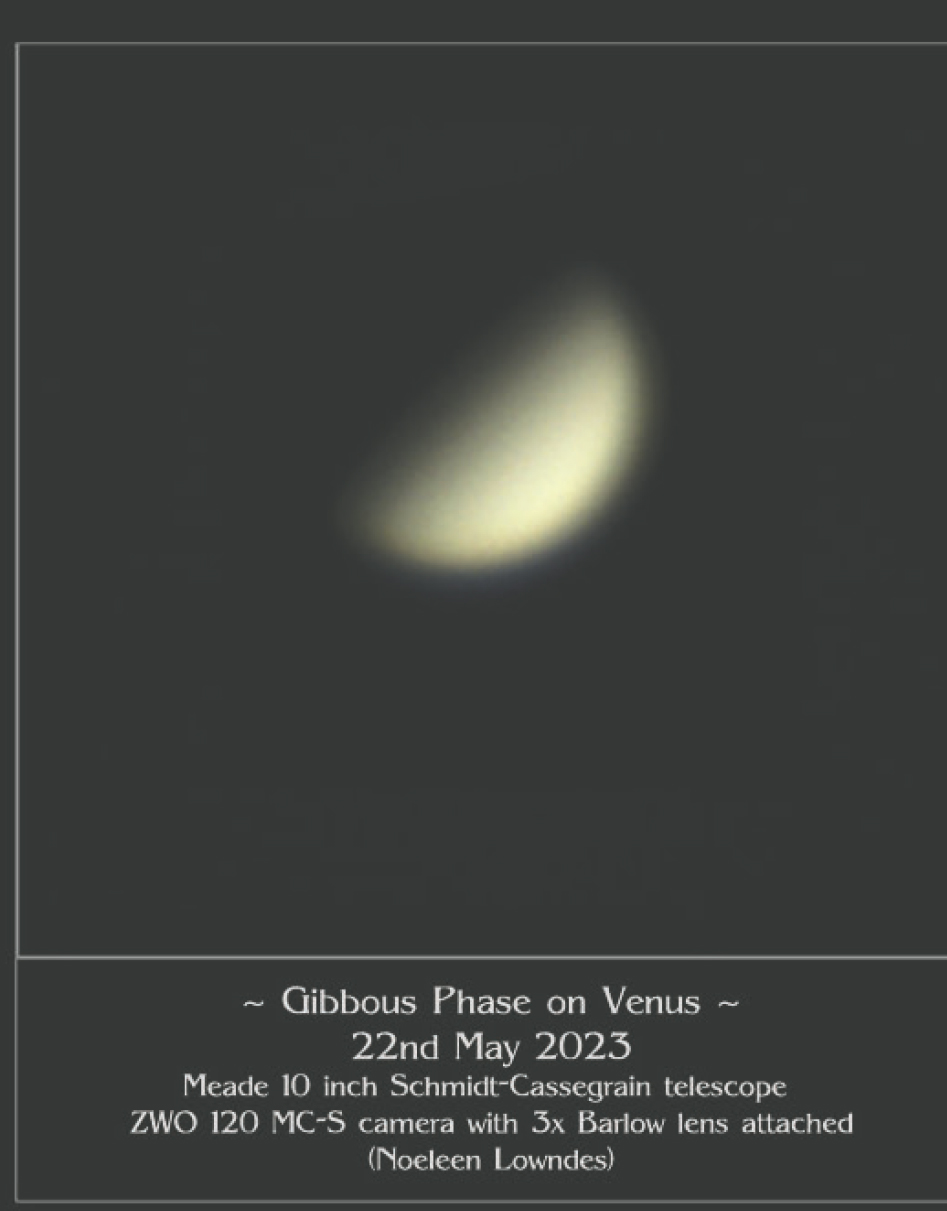
Venus is the second most inner planet, roughly the size of the Earth. Often, when I am outside with my telescope, I can capture a glimpse of Venus, a crescent shape, off in the distance—white with a sulfur-tinged green. The reason Venus is usually seen as this crescent shape is because, similar to our Moon, it has phases when observed from Earth. The first phase, and the one I seem to end up observing the most for whatever reason, is the New Venus phase, a slivered crescent. The phases that follow go from crescent to eventually Full Venus, which is not observable because the Sun is blocking it, onto eventually the Last Quarter Venus, observable as a half-lit disk through your telescope.
Similar to the Moon, and its phases indicating a spherical-shaped Earth, Venus and its phases have a large part to play in the history of astronomy.
Galileo, an astronomer from the 1500s, used the phases of Venus as a way to fight for the heliocentric model of our solar system—heliocentric meaning a solar system where the Sun is at the center. Uranus, Venus’s distant neighbor, is unique in the way that it orbits almost horizontally on its axis. Similar to Uranus, Venus orbits clockwise—only these two planets hold that characteristic.
Venus also holds the name for the hottest planet in our solar system, reaching a blazing temperature of 867 degrees Fahrenheit. You may be asking: With Venus being the second most inner planet, how is it hotter than Mercury, our most inner planet? Think about it for a moment: Mercury is 49 million kilometers closer to the Sun. Well, Venus is hotter for one major reason: its incredibly dense atmosphere.
Venus’s atmosphere is mostly made up of carbon dioxide, a greenhouse gas that keeps the surface of Venus “hellish.” It was previously believed that Venus had oceans many years ago; in recent news, though, this is believed to be not true, as Venus’s interior is very dry. Venus, in simple terms, is a sulfur-acidic hellscape. A human would survive mere seconds if teleported to the surface of Venus, a place no human has ever, or will ever, be. Venus was a mystery for a long time, due to its close proximity to the Sun and its thick atmosphere that clouds the surface for any viewer of it.
The Soviet Union, in the years of 1961 to 1983, sent various probes to the planet of Venus. After nine years of trial and error, the Soviets landed an actual probe on the surface of Venus. This probe went on to record the sounds of Venus’s surface, which unsurprisingly enough, sounded like a hellscape; it also went on the get the first pictures of any planet’s surface besides Earth.
I suggest you take the time now or after you finish reading to look up a picture of Venus’s surface. It’s honestly one of the most breathtaking pictures I have seen of space. The mission that made its way back to the surface of Earth in recent news is the Kosmos 482, a mission that started more than 50 years ago, with the goal of reaching Venus, only to be foiled by an engine malfunction soon after entering outer Earth. Kosmos, sadly, never made it out of Earth’s orbit, wandering aimlessly around Earth for many years, although being sure to slowly drift back to the surface.
Kosmos entered back into Earth on May 10, 2025, where it crashed straight into the Indian Ocean, west of Jakarta, Indonesia. Thankfully, no one was hurt by the spacecraft entering back to Earth; most times, space junk does not end up hitting anything “important.” This fact makes me ponder just how big the Earth really is—a vast expanse of ocean and wide-open space.
If you have access to a telescope and a clear night sky, I suggest you take a look at Venus and take in how strange and fascinating our universe truly is.
