
From Calf to Show Ring
Makayla Comer is a junior at Catoctin High School and a member of the Future Farmers of America (FFA). She is serving as the 2025-2026 Thurmont & Emmitsburg Community Show Ambassador and currently serves as Social Media Coordinator. In this monthly series, Comer will take readers behind the scenes of what it takes to raise both market and breeding cattle, sharing her journey as she prepares to show at the Carroll County Fair and the Thurmont & Emmitsburg Community Show in 2026. Comer and her family own and operate a cattle farm in Rocky Ridge, Maryland. Readers are invited to follow along as she shares the dedication, responsibility, and hard work involved in raising cattle.
For my 2026 Market and breeding projects, all animals were born and bred on my farm. The steer I plan to take to the Thurmont & Emmitsburg Community Show in September is a Maintainer named Fort Worth.
Fort Worth was born on March 25, 2025, and was the last calf born on my farm in 2025. I also plan to bring two heifers to the Community Show: my Maintainer heifer, Montana, and my Shorthorn Plus heifer, Daytona.
We have had a second calf born at the end of February. Sadly, this calf came out dead, and we were able to get a replacement calf in time for the mother. The calf we got came from a dairy farm and is a Holstein-Angus mix. The way we were able to make sure the mother would accept this calf was by rubbing her old calf’s scent on the new calf. We took a calf blanket and made sure to get that scent all over the blanket, so the mother wouldn’t be able to smell the other calf as well. Many people will skin the dead calf and put it on the replacement, but we tried a different way. And our way ended up being a success, and both of them are happy and healthy.
As I have two more shows coming up, I will wash my cows very often to make sure they are clean and that they have healthy hair.
First, I will blow off all the dust and hay that they have on them to help the washing process. With extra dirt and junk on them, the dust will get into my brush and won’t clean as well. I will then wash them with Dollar Tree soap. We like to save the expensive stuff for shows. With any of my cows that have white on them, like Daytona, I will use purple shampoo to get all their stains out. Once all the soap and dirt are washed off, I will blow-dry them. You want their hair to be completely dry, so you can put all the conditioners in. Once they are dry, I like to add Revive conditioner. There are two different kinds: a green and an orange can. The orange can is Revive Lite, which should be used during the summer since it has a lighter formula. The regular Revive is a thicker formula, which is used during the colder months.
Conditioning should be done every day, but you should not wash your calf every day, as it will dry out the hide. The conditioner will be sprayed all over the cow and then brushed in with a rice brush. The rice brush makes sure that all the product gets to the skin. After, I will blow-dry in the product, but you want it to be on a low setting and not a powerful one.
After the hair is all dry, I’ll put in some ProHair from Weaver or Sure Coat Max. Those sprays will help the hair grow, so the cow looks fuller. Or if you have a short-haired calf, it will help make the hair grow faster. You will want to brush in the spray with a comb, then you can lightly blow-dry the animal or put them under a fan, so the spray can work its magic.
Depending on how dirty your cow is, it can take over an hour to clean. Having a clean calf and washing them will make you spend less time at the wash rack and more time learning new things. Your cow will also have very healthy hair.
Showing season has officially started for us, and I can’t wait to travel with Fort Worth and his sisters and see how they will improve over time.
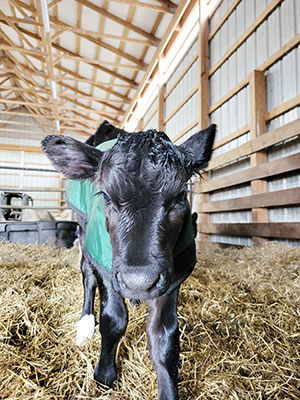
Pedra, the adopted calf.
