
Businesses Past...
by Richard D. L. Fulton
Taneytown Garage
The Taneytown Garage (also known as the Taneytown Garage Company) was established in 1914 on West Baltimore Street, selling Ford vehicles and Goodrich tires, according to Images of America, Taneytown.
John J. Hockensmith (died 1955) had served as the manager of the company for 38 years until the business closed in 1955. Daniel J. (D.J.) Hesson (1861-1941), who had been engaged in the general merchandise business for 55 years, had served as the “head” of the Taneytown Garage, according to the March 6, 1941, copy of The (Hanover) Evening Sun.
Ulysses H. Bowers received honorable mention in the February 16, 1927, edition of The (Hanover) Evening Sun, wherein he was identified as a master mechanic at the Taneytown Garage, and it was noted that he had just concluded “a course of training last week at the Ford Motor School of Instruction at Washington, D.C.” It was further noted in his obituary in the June 28, 1955, Evening Sun, that Bowers had been employed at the garage “for many years.”
The edition of the December 2, 1925, Evening Sun, identified George Harry Bornie, in his obituary, as having been a treasurer for the Taneytown Garage, and identified G. Walter Walt in the July 21, 1933, Evening Sun, as having served as treasurer and secretary for the garage, which had been positions he had held up to the time of his death in 1933.
The Taneytown Garage also owned a bus line, described as the Taneytown and Westminster bus, which the garage company had acquired from Ralph Sell on March 17, 1919, according to the March 21 Evening Sun. However, the garage company sold the bus line to the Conway Motor Company, “who made their first trip from Taneytown to Westminster on Sunday (November 1) and will hereafter conduct the business,” according to the November 8, 1924, Evening Sun.
The garage operation was not without its challenges.
The Fringer boys, Roy and Harry, had achieved notoriety during July and August in 1918, when they were tied to two garage thefts, one of which had occurred at the Taneytown Garage, which suffered a loss of $100 in tools and supplies, the other having occurred at the garage of Ray Fogle, which suffered a loss of $150 worth of tools and tires.
According to an article published in the August 30, 1918, copy of the Adams County Independent, “The robberies were tracked to the home of Jake Fringer,” resulting in the arrests of Roy and Harry. Harry Fringer made bail and subsequently fled to Ohio, while Roy Fringer had been detained in jail but escaped on July 13.
According to an article in the August 31 issue of the Adams County Independent, Harry Fringer had returned from Ohio, robbed the Taneytown Garage, and then fled back to Ohio, leaving evidence at his father’s farm.
To make a rather longer story a bit shorter, both were apprehended in Ohio, and both consented to return to Maryland to face a grand jury. Apparently freed until a November grand jury hearing, the duo was once again arrested on June 20 for having stolen tires and a car and were re-incarcerated, and were then finally convicted for their accrued crimes.
World War II had also impacted the Taneytown Garage, courtesy of a mandatory fuel and tire rationing system, managed by the Office of Price Administration (OPA).
According to the National Park Service (nps.gov), “The government stopped the sale of tires in mid-December 1941, and rationing began January 5, 1942. Tires were the first item that were rationed and remained rationed through the end of December 1945.”
Gasoline rationing began on the East Coast in May 1942. Owners of vehicles were provided with windshield stickers, indicating how much gas could be purchased for an individual vehicle per week, which, for most drivers, amounted to two to four gallons per week.
The Taneytown Garage ceased operation on April 1, 1955, according to the August 16, 1955, issue of The Gettysburg Times.
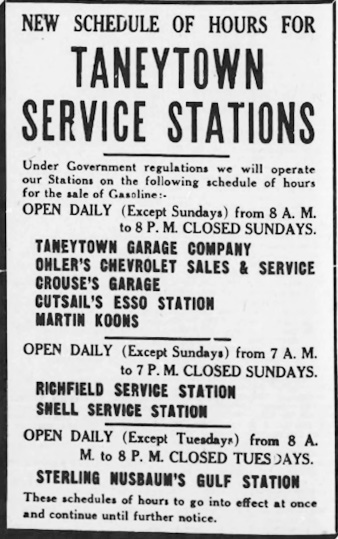
Taneytown Garage advertisement placed during WWII rationing. Source: March 28, 1942, The (Hanover) Evening Sun
