
Businesses Past...
by Richard D. L. Fulton
The CG&W Railway
The Chambersburg, Greencastle & Waynesboro Street Railway (CG&W) was a rural trolley line that operated within the areas of its namesake, while adding on some additional communities during its development.
According to an article “Memorable Experience: Trolley Service Kept County Connected in the Early 20th Century (by M.L. Marotte III), published on November 10, 2017, in the Public Opinion, CG&W was chartered on June 17, 1901, and operated until 1932.
Although some online accounts stated that the first tracks of the CG&W were laid in late-1903 (without specifying where), The (Waynesboro) Daily Record and Blue Ridge Zephyr reported on October 4, 1907, that CG&W officials were busy securing rights-of-way for their trolley-line.
If any rails were laid in late-1903, they must have been installed within Greencastle and sat idle, as, according to the above-mentioned article, the newspaper had further reported that it was expected that the directors of the CG&W “would take some definitive action… as to the beginning of operations (of the CG&W).”
Additionally, by the dateline of the 1907 article, CG&W acquired the Chambersburg and Southern Railway Company (C&S), and was also reviewing the rights-of-way they had acquired, along with C&S. Something must have changed regarding the relationship between the C&S and the CG&W after July 27, 1906, when the Franklin (Chambersburg) Repository had reported that the C&S was merely proposing “making (a) connection with the CG&W.”
CG&W was also faced with two other major decisions in 1906 for entering Chambersburg and where to build the electric powerhouse, which was necessary for providing power to the trolley-line.
The Daily Record and Blue Ridge Zephyr reported in 1907 that another newspaper, which they did not name, had stated that the directors of the CG&W had yet to decide if the line from Greencastle would enter Chambersburg via Allison Street or Washington Street. As to where the powerplant would be located, the newspaper had reported that it would more than likely be in Chambersburg.
Managing to negotiate whatever it took to progress the creation of the CG&W, the trollies finally rolled into Chambersburg on June 18, 1908, according to M.L. Marotte III. Other connections were ultimately made to Shady Grove, Pen Mar (Park), Blue Ridge Summit, and Waynesboro.
The CG&W initiated a major overhaul of its electric infrastructure beginning in April 1910, according to the Public Opinion. The pre-existing system was subject to risking power outages from overloads. The newer system employed some additional 24,000 feet of wiring but essentially eliminated or reduced the possibility of outages.
The CG&W also had its share of legal issues.
In August 1918 alone, according to Franklin (Chambersburg) Repository, the company had five lawsuits before the Court of Common Pleas, a couple of which included a lawsuit filed for injuries having been sustained when a man stepped down to exit the trolley and the trolley started up, thereby throwing him to the ground and dragging him for some distance, as well as an incident in which one of the trolleys struck a vehicle, killing two of the occupants and injuring several of the others.
CG&W began shutting down its operations during July 1928, with the final remaining service, regarded as the Rouzerville-Chambersburg portion of the line, terminated on January 13, 1932.
One aspect of the construction of the CG&W involved the width of the tracks, the rails having been laid too wide to haul conventional railroad cars on, which deprived the company of hauling standard railroad freight cars into the towns, depriving the company of any additional income that may have generated.
But the two main contributions to the demise of the trolley-line were those which doomed many of them: (1) the increased ownership of automobiles; and (2) the proliferation of bus-lines. Trolley services were limited to having to rely on the overhead-wires, whereas, obviously, automobiles and buses were not so restricted.
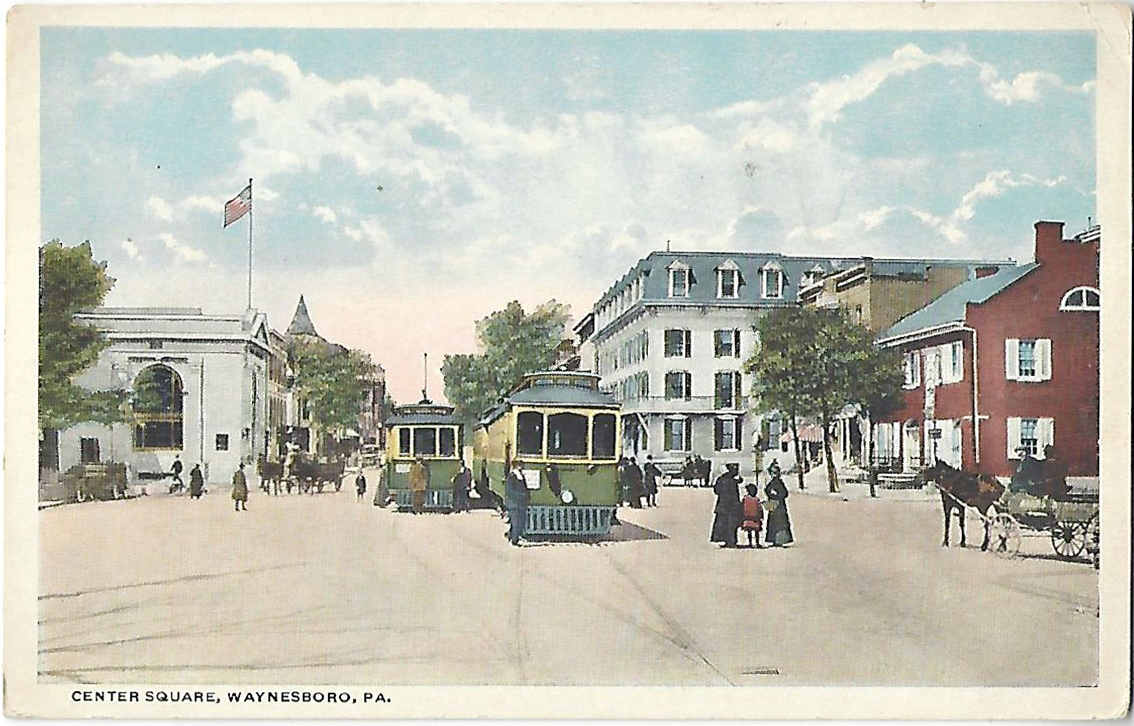
Trolleys at Waynesboro Center Square, circa 1920s.
