
A Change of Scenery

by Jeff Yocum
“A Change of Scenery” focuses on day trips from Thurmont that are within 150 miles (give or take). These trips will not include “Disney-level” destinations, but rather, lesser-known points of interest. The purpose of the article is to suggest venues for folks seeking a short, easily accessible change of scenery. In the process, hopefully something will be learned. Some will be historic, some cultural, and others just plain quirky. I confess an ulterior motive for writing this article:
I have a wanderlust addiction.
A Trip Back to the 50s: The Eisenhower Farm
Along the southern edge of the Gettysburg Battlefield is a 189-acre time capsule. It was the only home the Eisenhowers ever owned after a lifetime of service to the United States. The farm was gifted to the government in 1967, with the agreement that the former president and first lady could live out their lives on the farm. President Eisenhower passed away just two years later in 1969. What a visitor to the farm sees today is pretty much how the first lady, Mamie, left it after her passing in 1979.
For many Boomers, “Ike” Eisenhower was our first president. He came into office in January 1953, inheriting the war in Korea. Ending the war was his top priority, and within six months, the warring factions entered into a truce that has held to this day. For the remainder of his presidency, only two service members would be killed in action. Both died in an Asian country called Vietnam.
Prior to his presidency, Eisenhower was most well-known as the Supreme Commander of the Allied Expeditionary Forces. Tasked with the objective of defeating the Axis powers in Europe, Eisenhower had to organize and focus the efforts of more than 30 allies—some of whom were governing in exile. All responsibility for the success or failure of the “Great Crusade” to free the world of tyranny rested on him. On the eve of arguably the most important single day of the 20th century—D-Day—Eisenhower wrote out a press release claiming sole responsibility for the failure of the invasion of Fortress Europa, should it come to that.
Fortunately for humanity, it was not a failure.
Eisenhower’s presidency existed in the presence of two dueling worldviews. The GIs of World War II were keen to get on with living. They had lived through the Great Depression and survived the deadliest war in human history. A coal miner’s kid from West Virginia could use his GI Bill benefits and could actually go to college. The future had no limits.
Popular culture hinted at the other worldview. The end of World War II was the dawn of the nuclear age. End-of-the-world drama and science fiction movies filled the movie houses. Schoolchildren did duck-and-cover drills. Homeowners built fallout shelters in their basements.
In 1950, Eisenhower bought a farm adjacent to the Gettysburg Battlefield. The main house presented a real challenge. The exterior brickwork hid the rotting log structure underneath. The house required major demolition.
As a visitor and a child of the 50s, what the farm became seemed to be a refuge of a man who had borne the weight of command and responsibility for the lives and freedom of millions.
One wonders if the purchase of a farm adjacent to a battlefield known for claiming more than 51,000 casualties was a conscientious or subconscientious act of an old soldier wanting to be near the fallen. It was easy to envision the President finding solace in the mundane affairs of farming or reading by the fire on a winter evening.
We were fortunate to tour the farm as it was decorated for Christmas. The furnishings and feel of the house took me back to my grandparents’ home. For a moment, I was a five-year-old kid again, looking at a Christmas tree with great anticipation.

Eisenhower Christmas tree.
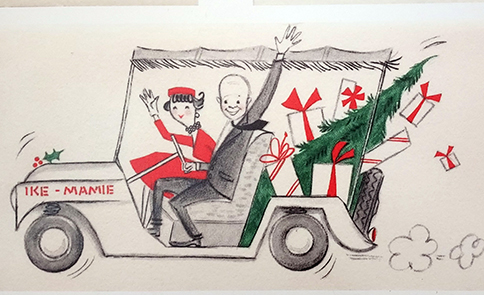
Christmas card from Ike and Mamie.
