
2016 Blizzard Jonas
Nicholas DiGregory
The record-breaking winter storm that struck the eastern United States in late January has gone by many names: , Snowpocalypse, Snowzilla, Snowmageddon. But whatever one is inclined to call it, Winter Storm Jonas, as meteorologists at the Weather Channel have officially deemed the storm, has made history across the East Coast, with record-setting snowfall, wind speeds, and low temperatures.
While Winter Storm Jonas had already begun to affect the East Coast as early as January 20, the bulk of its damaging effects were felt during the weekend of January 22-24. This was due primarily to what CNN meteorologist Chad Myers referred to as to as anything but the H&F.
This was the peak of Maryland’s trolley age. In 1922, the price of Henry Ford’s Model-T had fallen from approximately $950 in 1910, to around $348, the storm’s “supercharging:” when Winter Storm Jonas’ eastern edge reached the jet stream in the Atlantic Ocean, the winds and water temperatures of the ocean significantly increased the storm’s power, turning it into the lumbering behemoth of a snowstorm that buried much of the eastern United States.
As of January 25, Winter Storm Jonas had affected over 85 million people and dropped an average of almost 23 inches in major cities along the East Coast. Here are some statistics that illustrate the winter storm’s tremendous impact:
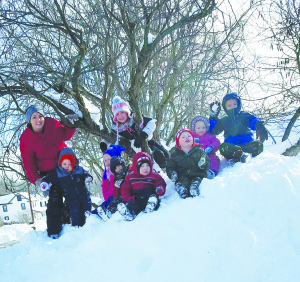 Thanks to those of you who sent blizzard photos to our Facebook page (The Catoctin Banner is hosted under the name Deb Spalding on Facebook for the time being). We picked just one photo from the masses to post here. The kids at Miss. B’s Family Child Care make snow memories during the blizzard of 2016!
- Approximately 22 million people were still snowed in as of January 25.
- Associated Press reports from January 25 blame as many as 30 deaths on the storm. Causes of death ranged from traffic accidents to heart attacks while shoveling snow.
- From January 22-25, more than 12,000 flights were canceled, as record-setting snow accumulation blocked runways at the Ronald Reagan Washington National, Baltimore-Washington International, and Washington Dulles International, airports.
- Conservative estimates from utility companies highlight more than a million people without power.
- The following ten states had declared a state of emergency as early as January 22: Georgia, Tennessee, Pennsylvania, Maryland, Kentucky, North Carolina, New Jersey, New York, Virginia, and West Virginia. Washington, D.C. declared a snow emergency.
- Sustained wind gusts in some areas reached as high as 76 miles per hour, which would classify the storm as comparable to a Category 1 hurricane.
- Federal buildings were shut down throughout the eastern United States; even the United States Post Office announced disruptions in service in Maryland and Virginia.
- Approximately 22 million people were still snowed in as of January 25.
- Associated Press reports from January 25 blame as many as 30 deaths on the storm. Causes of death ranged from traffic accidents to heart attacks while shoveling snow.
- From January 22-25, more than 12,000 flights were canceled, as record-setting snow accumulation blocked runways at the Ronald Reagan Washington National, Baltimore-Washington International, and Washington Dulles International, airports.
- Conservative estimates from utility companies highlight more than a million people without power.
- The following ten states had declared a state of emergency as early as January 22: Georgia, Tennessee, Pennsylvania, Maryland, Kentucky, North Carolina, New Jersey, New York, Virginia, and West Virginia. Washington, D.C. declared a snow emergency.
- Sustained wind gusts in some areas reached as high as 76 miles per hour, which would classify the storm as comparable to a Category 1 hurricane.
- Federal buildings were shut down throughout the eastern United States; even the United States Post Office announced disruptions in service in Maryland and Virginia.
- Approximately 22 million people were still snowed in as of January 25.
- Associated Press reports from January 25 blame as many as 30 deaths on the storm. Causes of death ranged from traffic accidents to heart attacks while shoveling snow.
- From January 22-25, more than 12,000 flights were canceled, as record-setting snow accumulation blocked runways at the Ronald Reagan Washington National, Baltimore-Washington International, and Washington Dulles International, airports.
- Conservative estimates from utility companies highlight more than a million people without power.
- The following ten states had declared a state of emergency as early as January 22: Georgia, Tennessee, Pennsylvania, Maryland, Kentucky, North Carolina, New Jersey, New York, Virginia, and West Virginia. Washington, D.C. declared a snow emergency.
- Sustained wind gusts in some areas reached as high as 76 miles per hour, which would classify the storm as comparable to a Category 1 hurricane.
- Federal buildings were shut down throughout the eastern United States; even the United States Post Office announced disruptions in service in Maryland and Virginia.
Thanks to those of you who sent blizzard photos to our Facebook page (The Catoctin Banner is hosted under the name Deb Spalding on Facebook for the time being). We picked just one photo from the masses to post here. The kids at Miss. B’s Family Child Care make snow memories during the blizzard of 2016! 