
The Rise & Decline of the Baltimore Oriole
by Richard D. L. Fulton
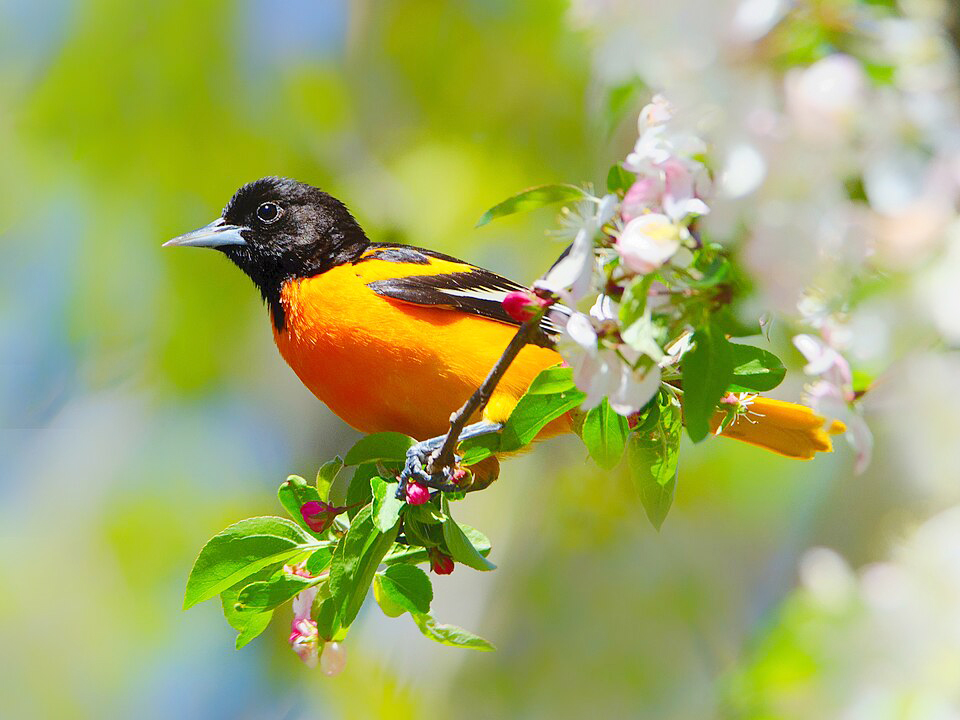
Arguably, the Baltimore Oriole ranks as one of the most attractive and distinctly “attired” of the 50 state birds.
As is fairly typical among the birds, the male is brightly colored with its stark black head, back, and wings, along with its brilliant golden-orange underpart and white wing bars. The female, on the other hand, is a bit more subdued in coloration, patterned with brownish-olive, dull orange, and yellow-brown.
But the full story of the past, present, and future of the Baltimore Oriole spans millions of years.
Dinosaurs of a Feather
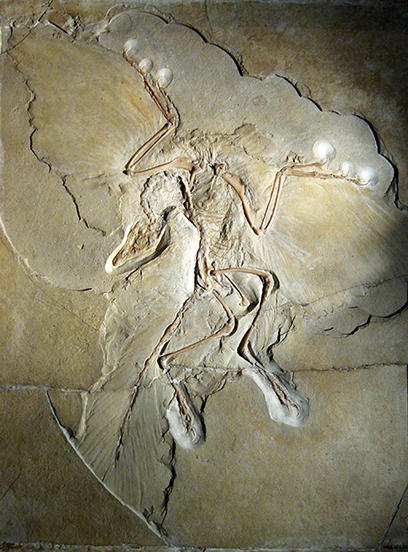
The beginning of understanding the prehistoric roots of the Baltimore Orioles—and, in fact, all birds—occurred in 1861, with the discovery of a fossil that was found in a 150-million-year-old limestone quarry, located near Solnhofen, Germany.
For all intents and purposes, the fossil animal appeared as a nearly complete, 20-inch-long fully feathered bird, with a couple of exceptions… the possession of a mouth full of sharp teeth, claws on its “fore wings,” and a long bony tail.
From that point on, what exactly the animal was—dinosaur or bird— was debated for decades. Even with the growing acceptance of evolution in the 1860s, few were ready to admit to the obvious: the animal was both.
But as the creature, dubbed Archaeopteryx, eventually became recognized for what it was—a “missing link” between dinosaurs and birds—all remaining doubts were cast aside when, in the 1990s, a windfall of feathered dinosaurs was discovered in and around China’s Liaoning Province.
To date, more than 40 different species of “feathered dinosaurs” have been recovered. Amazingly, one of the animals even had four wings, two forewings and two hind wings. No longer was there any doubt about the biological placement of these animals, which are now technically classified as avian dinosaurs, including modern birds.
The “Baltimore Bird”
The scientific name of the Baltimore Oriole, originally called the “Baltimore Bird,” is Icterus galbula, icterus meaning yellow in Greek, while galbula means small yellow bird in Latin.
The Baltimore Oriole is a member of the Icteridae Family, a group that also includes blackbirds, grackles, and cowbirds.
Because the colors of the male orioles resembled those of the Calvert family (Lord Baltimore) and thus associated with the Maryland proprietors, countless Baltimore Orioles, then called the “Baltimore Bird,” were captured and added to grace the royal gardens in England, according to the Maryland Manual On-line.
The Baltimore Oriole was designated as the Maryland state bird in 1947, but even before that, efforts were made to protect the colorful birds.
In 1882, state legislators passed legislation (Chapter 154, Acts of 1882) aimed at protecting the future state bird, stating, “No person in this state shall shoot or in any manner catch, kill, or have in possession any bird of the species known as the ‘Baltimore Oriole Icterus,’ or molest or destroy the eggs of said bird in this State.”
Violating any of the above prohibitions carried a penalty of up to $20.00 for each count, the non-payment of which could fetch the offender up to 60 days in jail per count.
The Baltimore Oriole received further protection in 1918 with the federal Migratory Bird Treaty Act.
In 1975, Maryland further adopted the Nongame and Endangered Species Conservation Act (Chapter 27, Acts of 1975) geared to protect and conserve wildlife species, plants, and nongame animals, which included the Baltimore Oriole.
Under the act, violators could face a fine of not more than $1,000 or imprisonment for not more than one year, or both, “along with the seizure of any equipment used…”
The Baltimore Oriole is a migratory bird and begins to head south as fall approaches, “waving goodbye” to Maryland, and migrating to Florida, Central America, the northern tip of South America, and the Caribbean. They return from April to May for the warmer weather breeding grounds, which stretch way beyond just the borders of Maryland, even encompassing states as far south as Louisiana and as far north as Central Canada.
As for their main diet, they tend to prefer a wide variety of insects (during breeding season), as well as soft fruits, and flower and tree nectar (heading into the migratory months).
The reason for the switch in food sources is that during breeding season, the birds prefer protein-based foods for their hatchlings, and pre-migratory, they turn to fruits to build up sugar for the sometimes more than 1,000-mile migratory flights.
Just for the record, there are six other types of orioles besides the Baltimore bird: the Orchard Oriole, the Bullock’s Oriole, the Scott’s Oriole, the Hooded Oriole, the Audubon’s Oriole, and the Altamira Oreille, each identified by distinguishing characteristics which differ from those of the Baltimore Oriole.
The Baltimore Oriole is capable of breeding with some of the other oriole types, ultimately producing hybrids, particularly among the Baltimore and Bullock’s orioles, the two apparently sharing what are called “flexible mating standards.
And on that note…
Where Have all the Orioles Gone?
The numbers of Baltimore Orioles in Maryland have been diminishing since 1966, and at an increasing rate since 1980, according to the Maryland Manual On-line.
In an article entitled “The Decline of Lord Baltimore’s Orioles,” by Susan Shea, and published on June 13, 2020, on the New York Almanack website, it was noted that, “According to the North American Breeding Bird Survey, there was a 42 percent decrease in (among all) breeding orioles in North America between 1970 and 2014.”
In Maryland, the loss of preferred tree types, such as elm trees (via the Dutch elm disease), has exacerbated the loss of trees overall. Apparently, the elm was preferred as it provided a perfect, defensive setting in which the orioles can create their “hanging basket” type of nests, as the thin, twisting branches make it difficult for predators to ascend.
“From 1999 through 2019, Maryland’s forested acreage shrank by 118,000 acres, an annual loss of nearly 6,000 acres, as per a survey conducted by the U.S. Forest Service,” according to an article, “Maryland is still losing forests and trees, though at a slower rate,” by Timothy B. Wheeler, published November 18, 2022, on the Bay Journal website.
But orioles prefer not to nest in deep forest environments, meaning their preferred nesting areas are in trees in more open areas…the areas most subject to development. So, the Baltimore Oriole is not only losing the preferred tree types and locations during breeding months, but forests are also being subject to deforestation in the areas involved within their winter habitats in Central and South America.
Another adverse impact is the use of toxic pesticides to eliminate the insects that the orioles ingest in the quest for protein during their breeding months.
So, what can be done to prevent further loss of the Baltimore Oriole population in Maryland?
Minimize deforestation, especially in forest edges and open forest areas.
Avoid employing toxic pesticides on flowers and fruit trees.
Create birdfeeders geared towards preferred Baltimore Oriole food, including mealworms.
For additional information regarding saving the Baltimore Orioles, refer to “Bringing Baltimore Orioles Back to the Ballpark,” by Jen Mihills, located on the National Wildlife Federation blog at blog.nwf.org.
