
Maryland on Stamps & Covers
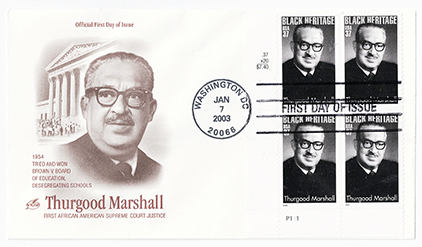
thurgood marshall
by Richard D. L. Fulton
The Ku Klux Klan never dies. They just stop wearing sheets because sheets cost too much.
~ Thurgood Marshall, December 4, 1978, TIME magazine.
The United States Postal Service (USPS) issued a 37-cent stamp commemorating the services rendered by Thurgood (Thoroughgood) Marshall, the first African American United States Supreme Court Justice, on January 7, 2003.
The stamp, featuring a portrait of Marshall, was issued as part of the USPS Black Heritage series, and the first-day-of-issue covers (FDCs) were canceled at the Washington, D.C., Post Office.
Marshall was born on July 2, 1908, to William Canfield and Norma Arica Marshall, under the birth name of Thoroughgood Marshall, in an apartment located at 543 McMechen Street in Baltimore. He had one brother, William, who was two years older.
Marshall spent his first five years of age in New York City, and subsequently, he and his family moved to an Upton neighborhood, marble-stooped row home, at 1632 Division Street in Baltimore, according to the Maryland Historic Trust (MHT).
Marshall legally changed his first name to Thurgood around the age of six or seven, while in the second grade, reportedly stating that he “got tired of spelling all that out,” according to Afro.com, which also reported that he was given the name of his paternal grandfather, Thoroughgood, “who had chosen the name ‘Thoroughgood’ when he’d enlisted as a private, in the Union Army during the Civil War.”
According to the MHT, the specific unit in which Marshall’s grandfather had enlisted was with the all-Black 24th Infantry Regiment. Afro.com further noted that Marshall’s grandfather had also owned the largest Negro grocery store in Baltimore, known as T.G. Marshall’s.
Thurgood Marshall attended the Colored High and Training School in Baltimore, graduating in 1925, the same year in which the name of the school was changed to the Frederick Douglass High School.
Marshall attributed his interest in law to his father’s routine of attending court hearings with his sons, and then debating the various cases with them upon returning home.
According to Biography.com, Thurgood reportedly recalled, “Now you want to know how I got involved in law? I don’t know. The nearest memory I have is that my dad, my brother and I had the most violent arguments (over court cases that he and his brother and father had attended) that you ever heard about anything. I guess we argued five out of seven nights at the dinner table.”
Following Marshall’s high school graduation, he attended Lincoln University in Pennsylvania, where he studied American literature and philosophy, thereby obtaining a Bachelor of Arts degree upon graduation in 1930, with honors. He then attended Howard University Law School, resulting in his graduating first in his class in 1933, with a Bachelor of Laws degree.
Marshall established a private law practice in Baltimore following his graduation, where he then began to establish a career fighting for civil rights and equality. In 1934, he also became involved with the Baltimore branch of the NAACP. However, his landmark cases are far too numerous to include in this article.
President John F. Kennedy nominated Marshall to the U.S. Court of Appeals for the Second Circuit in 1961, a position he held from 1962 to 1965.
President Lyndon B. Johnson then appointed Marshall as the United States solicitor general in 1965. In 1967, Johnson nominated Marshall to the United States Supreme Court. Marshall’s confirmation to the Supreme Court resulted in his becoming the first African American and non-white Supreme Court Justice in United States history, a position he held from 1967 until 1991, when he retired.
Marshall died on January 24, 1993, at age 84, from heart failure in the National Naval Medical Center in Bethesda, and he was interred in the Arlington National Cemetery.
On November 30, 1993, President William J. Clinton posthumously awarded Marshall the Presidential Medal of Freedom.
In October 2005, the Baltimore/Washington International Airport was renamed the Baltimore-Washington International Thurgood Marshall Airport in his honor.
