
Maryland on Stamps & Covers
by Richard D. L. Fulton
Meade Takes Command
Major General George Meade was assigned command of the Union Army of the Potomac during the Great Rebellion of 1861-1865 on June 28, 1863, after former commander General Joseph Hooker had resigned.
Meade was officially placed in command of that Union army while encamped at Frederick, after having been awakened from his sleep in his tent around 3:00 a.m. on June 28 by a courier who had been dispatched by President Abraham Lincoln to inform Meade that he was to immediately assume the command of the Army of the Potomac, according to “Frederick, Maryland – Meade Takes Command,” as published at stonesentinels.com.
Meade “instantly” rose from commanding the 12,000 troops of the Union Fifth Corps to now commanding an army of some 100,000… this having taken place only three days before his then newly acquired army would collide with that of Confederate General Robert E. Lee’s army, at Gettysburg.
A commemorative cover was issued denoting the change of command during the Civil War Centennial on June 28, 1963. The covers were canceled at the Frederick Post Office. In the example depicted, the images of Hooker and Meade are shown, along with their names, with the legend “1861-1865, 1961-1965 Civil War Centennial,” and “Serious-minded General Meade takes command of the Army of the Potomac at Frederick, Maryland, after Hooker is relieved.”
The stamps used to “frank” the cover, in the example depicted, were the four-cent commemorative stamp issued regarding the Battle of Shiloh, and two ½ cent Benjamin Franklin regular issues (postage had been increased to 5 cents after the Shiloh stamp had been issued).
Meade was born on December 31, 1815, in Cádiz, Provincia de Cádiz, Andalucia, Spain, to parents Richard Worsam and Margaret Coats Meade, and had 11 brothers and sisters, including brothers Robert, Richard, and sisters unnamed infant (died at birth), Catherine, Henreita, Marianne. Elizabeth, Charlotte, Margaret, Maria, and Salvadora.
Meade’s father was described as having been a wealthy Philadelphia merchant and had served as a military agent for the United States government, passing away in 1828, leaving the family facing serious financial straits, according to American History Central’s website.
Meade enrolled in the United States Military Academy (West Point, New York) in 1832, graduating in 1935, ranking 19th in his class, and then subsequently enrolled in the 3rd U.S. Artillery, which was deployed to Florida in order to participate in the Second Seminole War.
He had resigned for a short time due to illness, but rejoined the Army in 1842 as a second lieutenant in the Corps of Topographical Engineers, while the Army was then engaged in the Third Seminole War.
However, before re-entering military service, Meade married Margaretta Sergeant in 1840. The couple subsequently gave birth to four children: sons John, George, and Spencer, and one daughter, Margaret.
Meade gained further military experience during the Mexican-American War, where, in 1845, he served as a staff officer and was subsequently promoted for gallantry to the rank of first lieutenant.
From there, he continued as a military engineer, designing Barnegat Lighthouse on Long Beach Island, Absecon Lighthouse in Atlantic City, and Cape May Lighthouse in Cape May, and in Florida, according to the thelatinlibrary.com, and he remained in that position until the opening shots of the Great Rebellion in 1861.
Until his appointment as the commander of the Army of the Potomac, he led troops in the battles of the Peninsula Campaign, the Northern Virginia Campaign, Antietam. Fredericksburg, and Chancellorsville.
After being placed in charge of the Army of the Potomac, he led his forces in the Battle of Gettysburg, the Bristoe Campaign, the Mine Run Campaign, the Overland Campaign, the Richmond-Petersburg Campaign, and, finally, the Appomattox Campaign.
However, in 1864, when Lieutenant General Ulysses S. Grant was placed in command of all Union armies, Meade was still in charge of the Army of the Potomac, under the overall command of Grant.
Meade passed away on November 6, 1872, in Philadelphia. He was then buried in the Laurel Hill Cemetery in Philadelphia.
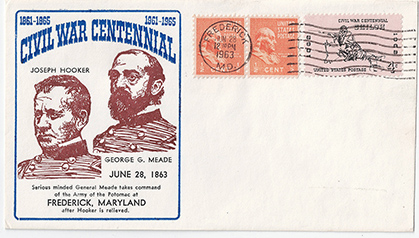
June 28, 1963, commemorative cover denoting the change-of-command during the Great Rebellion. Source: Collection of Richard D. L. Fulton
