
Veteran Spotlight
PFC Annon C. Shriner
KIA on D-Day
by Richard D. L. Fulton
Annon C. Shriner was born on November 13, 1909, in Frederick County, to parents Cornelius “Neale” and Fannie Shriner. His first place of residency was recorded as having been in Emmitsburg.
Shriner had eight siblings. Four brothers: Harry (or Charles, depending on the source used), Carl, Maurice, and Emanuel (also listed as Manuel), and four sisters: Bruce Irene, Mary, Edith, and Vada.
In 1920, his residence was listed as being in Mechanicstown by Ancestry, an odd town designation for 1920, being that the name of Mechanicstown had been changed to Thurmont in 1894.
His enlistment records indicate that he had only completed grammar school, and at the time of his enlistment, he was recorded as being single and without dependents.
According to an article published on August 16, 1944, in The (Frederick) News, several interviewed by the newspaper stated that Shriner had been employed “as a farm laborer in the vicinity of Thurmont” before entering the military service.
Shriner enlisted in Company A of the 115th Infantry Regiment of the Maryland National Guard in October 1940, which subsequently became Company A, 115th Infantry Regiment in the 29th Infantry Division in World War II in 1941.
His rank at the time of his enlistment, up until the time of his death, was private first class (PFC).
According to U.S. Army Divisions’ website (armydivs.com), the 115th Infantry Regiment had trained in Maryland, Virginia, North and South Carolina, and Florida, before being deployed from New York to England in October 1942, where the division had spent more than a year before being deployed to Normandy Beach on D-Day, June 6, 1944.
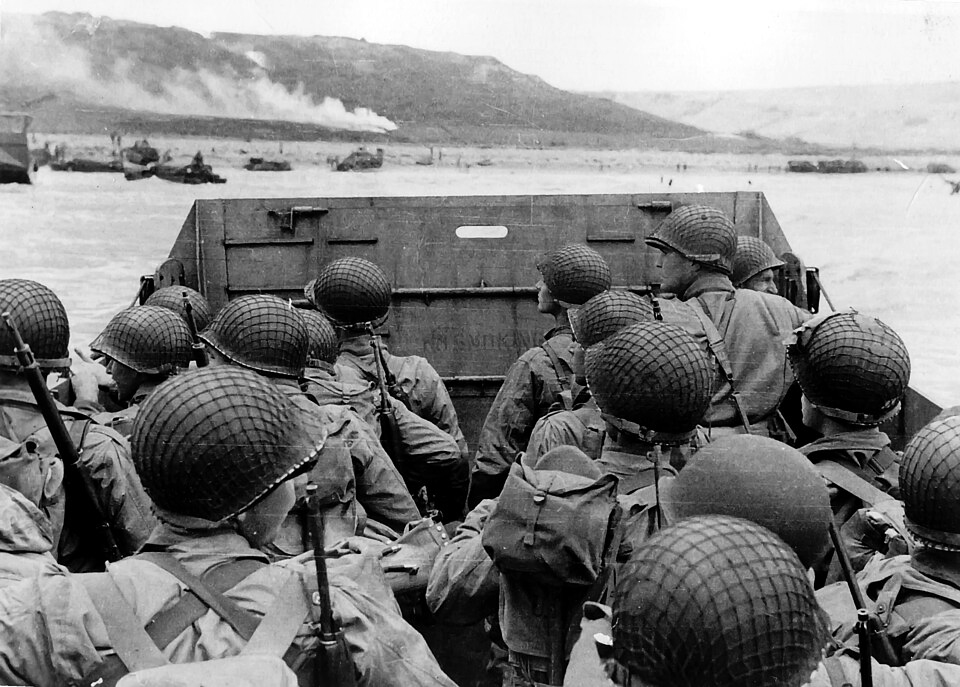
The website noted, that the 29th Division was ordered to serve as the follow-up infantry to the main assault, and “Its companies landed amid the confusion east of St. Laurent, moved inland after the first assault waves, and began pushing toward the Longueville area.”
According to various records, Shriner was killed on Omaha Beach amid the initial landings, along with eight other Frederick County soldiers with the 115th Infantry Regiment.
The 115th Infantry Regiment landed at Normandy Beach with 3,327 troops, suffering some 103 casualties on Omaha Beach, which included 33 killed in action. The 29th Division had sustained 743 casualties (killed and wounded) by their having stormed the beaches and adjoining high ground.
Combined with the other United States units involved in taking Omaha Beach, the military had suffered a total of 2,400 troops (included killed, wounded, and missing in action) of the 34,250 troops involved, resulting in the beach being called “Bloody Omaha.”
The News reported on August 16, 1944, “Another Frederick County man who left here in 1941 with Company A, 115th Infantry, was reported having been killed in action (on D-Day, July 6) Tuesday night.”
The newspaper noted that his mother had been notified of her son Shriner’s death, at her home “near Apples’ Church Road” near Thurmont. On August 25, 1944, the newspaper further reported that she had been quite ill at his home near Thurmont, when she had received word of her son’s death.
Shriner’s father had previously passed away in 1941.
Shriner’s funeral service was held on April 3, 1949, at a funeral home in Thurmont, with services conducted by the Reverend Ivan G. Naugle and the Reverend William E. Fox, and attended to, among others, by former members of the Company A, according to a story published in the April 11, 1949, edition of The Frederick Post.
No official records were located by this writer as to where Shriner’s body had been deposed prior to 1949, but clearly, he had more than likely been buried in one of the Normandy cemeteries, until his body could be returned to the United States, as his interment in Thurmont was referred to as a “re-interment.”
Burial took place in the United Brethren Cemetery (Wellers United Brethren Cemetery) in Thurmont.
Shriner was awarded the Purple Heart, posthumously.
