
Looking Back
Woman In Black Scares Gettysburg
As the chill of the winter nights settled into Gettysburg in 1909, many people shunned being outside if they could. Not only was it preferable to remain warm inside, but the Woman in Black couldn’t get you if you were in your house.
The Woman in Black wasn’t just another of Gettysburg’s multitude of ghost stories. She was a real person who quickly became a myth. Imagine going about your life, cooking, reading, washing, all in the privacy of your home. The hairs on the back of your neck begin to tingle. You look around and see nothing at first. Then outside your window, a shape takes form. It is a head. The features are indistinguishable as they are cast in even more shadows than the night provides. And then the face moves off, leaving you wondering whether you’ve seen a ghost or a prowler.
The Woman in Black first appeared in the summer of 1909. People talked about her, but it wasn’t a story that rose to the level of being considered news. However, when she returned again in late November, people began to get worried.
“Many women and children have refused to leave their homes after dark and each new rumor made their fears more intense. Not only were the female members of various families alarmed but many men are reported to have remarked that they would not care to meet her alone in the dark,” the Gettysburg Times reported.
The woman was described as being 5 feet 10 inches tall with broad shoulders. She wore a heavy black veil and black dress. She would walk down the street, pausing to peer into windows.
“In every house, women saw her and all were afraid to say anything or to investigate. Houses were locked a little more securely but nothing else done,” the newspaper reported.
When the Woman in Black was seen in the summer and in late November, she was seen only on North Washington Street. Then, at the beginning of December, she began prowling South Washington Street.
“Her conduct this time is exactly the same as at the time of the visit a few months ago. No clue whatever has been obtained showing her identity and she remains as mysterious a personage as ever,” the Gettysburg Times reported.
As rumors grew, it became difficult to be a woman wearing black in Gettysburg. On December 1, the Gettysburg Times reported that a woman matching the scant description of the Woman in Black had been accosted on Lincoln Avenue, but it turned out to be a “domestic” from a North End home.
Another time, two men saw the Woman in Black on Chambersburg Street and began pursuing her.
“She turned South on Washington Street and soon realized that she was being followed for she zig-zagged back and forth across the street in an effort to follow the dark places,” the Gettysburg Times reported.
The woman eluded her pursuers, but the men who pursued her swore that the Woman in Black was actually a male.
On December 2, the Gettysburg Times reported on the front page that the Woman in Black had been identified. Though not named, the Woman in Black was the domestic who had been accosted on Lincoln Avenue. It was also noted that she “is said by those who know her to be somewhat mentally deficient.”
Besides working as a domestic in a North End home, she had also performed similar duties at some of Gettysburg’s hotels. In the course of her work at one of the hotels, she “is said to have become infatuated with one of the employees, in search of whom she now wanders the night.”
It is not noted whether the Woman in Black ever found where the man she loved lived, but she apparently stopped peeking in windows to find out.
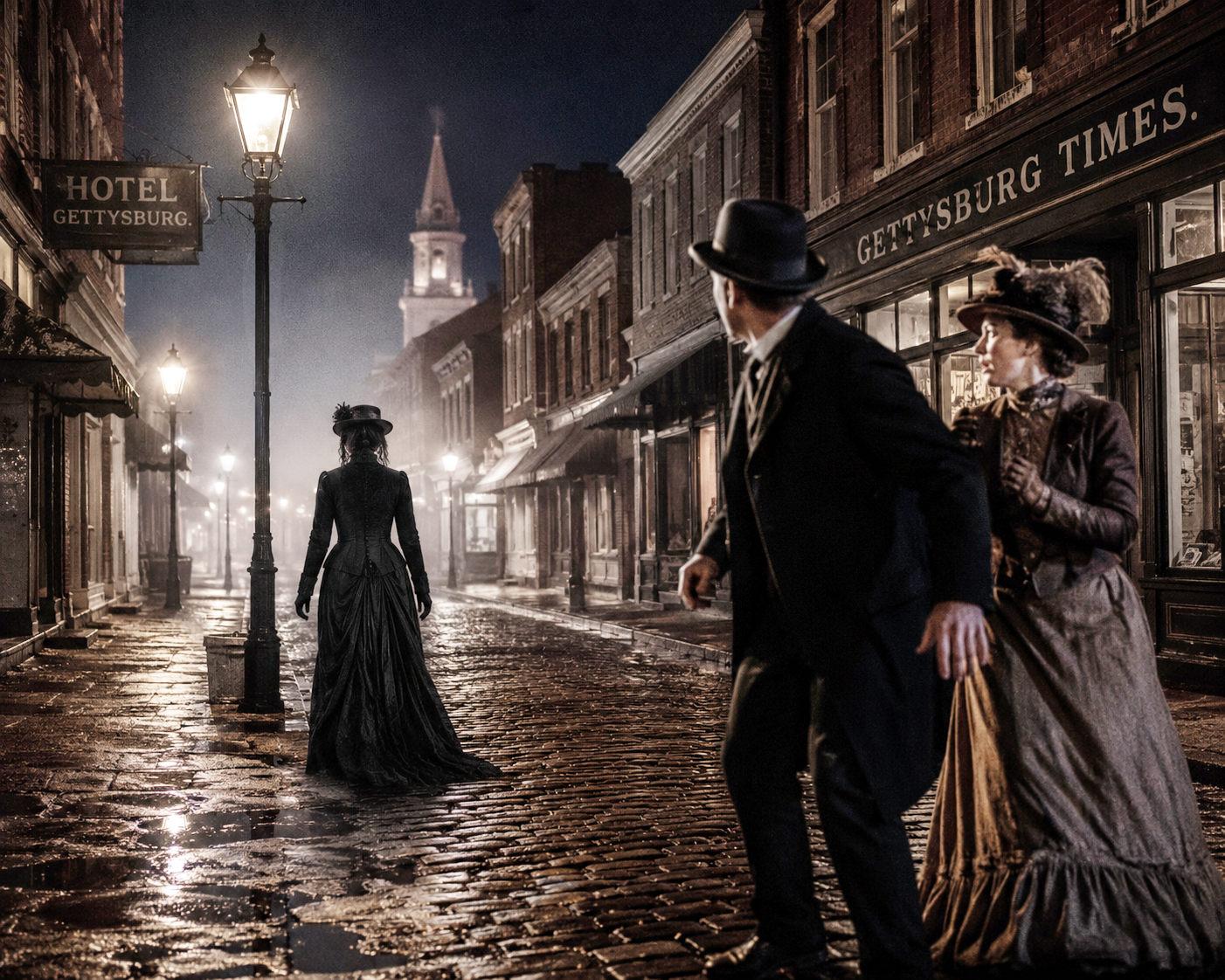
A mysterious woman dressed in black had residents of Gettysburg reluctant to be on the street at night in 1909.
