
Businesses Past
Glade Valley Milling Company
The Glade Valley Milling Company, Woodsboro, is the only “identified” flour mill structure remaining in Woodsboro, according to the Maryland Historical Trust (MHT).
The mill was also referred to as the Glades Valley Milling Company in a state archive document, dated March 29, 2007, and entitled Frederick County Mills. The plurality of Glades was not encountered in any other documents or newspapers accounts. However, this same document contained other errors as well.
The operational Glade Valley Milling Company Mill and the associated mill house were located at 100 and 102 Creagerstown Road and, according to the MHT, were in the early 20th century one of the town’s most important industries.
According to the MHT, the flour mill was initially founded in Troutville by Daniel P. Saylor, “but was subsequently purchased by Anderson Etzler and moved from Troutville in the 1890s to Woodsboro (a trip of about two miles)” to take advantage of the proximity of the Woodsboro site to the West Maryland Railroad.
Only one reference was encountered regarding the Troutville mill and the move to Woodsville, which suggests the move may not have been simply to take advantage of gaining access to a nearby railroad, that being the A Historic Context for the Archaeology of Industrial Labor in the State of Maryland by Robert C. Chidester (heritage.umd.edu), which stated, “The Glade Valley Mill in Troutville burned in the late 19th century and subsequently moved to Woodsboro, leaving Troutville in decline…” The mill was then a two-and-a-half-story structure and had been named the Etzler Mill (Etzler also purchased the J.M. Powell and Company mill in Thurmont in 1912, according to the October 04, 1912, edition of The News).
Around 1904, the Glade Valley Milling Company acquired the Etzler Mill, as per the MHT. Etzler served as the company’s president. Etzler was also serving at the time as the vice president of the Woodsboro Savings Bank, according to the September 30, 1904, edition of The (Frederick) Citizen, Historical and Industrial Edition. Although frequently cited as a flour mill, The Citizen stated that the mill produced roller process flour, corn meal, and chops, and additionally dealt in grain, feed, and bituminous and anthracite coal.
In 1904, not only did the company add an additional story and a half to the top of the Woodsboro mill, making it a four-story structure, but it also initiated a quest for space for additional production, resulting in the Glade Valley Milling Company obtaining the facility in 1904 in Walkersville. The Walkersville plant was also equipped with more modern machinery, according to The Citizen.
The Frederick News-Post reported in an article in the February 22, 2014, edition that an associated four-bedroom, two-story framed mill house was built around 1900 and was located on 5,250 feet of land and consisted of 1,150 square feet of living space.
Flour production ceased in the late 1950s. The last advertisement placed in the newspapers that mentioned the Woodsboro mill was placed in 1968, which offered feed and coal. Apparently, after milling flour and cornmeal had ceased, milling feed continued into the 1970s (at least until 1976, according to a 1976 article in the June 25, 1976, The Frederick News-Post).
The mill was offered for sale again in 1987 when the building was occupied by the Glade Valley Mill Antique and Furniture Stripping Business (also known as the Circuit Rider Stripping and Antique Shop) and the associated house, with an asking price of $360,000 (later, by 1990, it decreased to $239,900), according to an advertisement placed in The News. The antique shop was established within the Glade mill sometime in 1973.
According to an article published in the February 22, 2014, edition of The News Post, the historic mill house was sold at auction in 2014 to resident Jason Boyer, who currently uses the mill space for his woodworking business, JSB Woodworking, Inc.
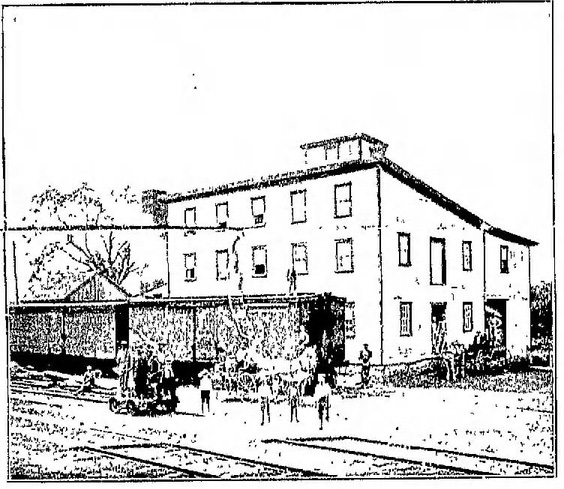
Sketch of Glade Valley Milling Company as it appeared in 1904., Source: Unattributed sketch published in the September 30, 1904, edition of The (Frederick) Citizen.
