
Maryland on Stamps & Covers
by Richard D. L. Fulton
50th Anniversary Lindbergh Flight
“Our messenger of peace and goodwill has broken down another barrier of time and space.”
~President Calvin Coolidge, regarding Charles A. Lindbergh’s solo transatlantic flight in 1927
A full-scale operative replica of Charles Lindbergh’s The Spirit of St. Louis landed at College Park on October 24, 1977, as part of a nationwide celebration of the 50th Anniversary of Lindbergh’s 1927 history-making first nonstop solo-flight across the Atlantic Ocean.
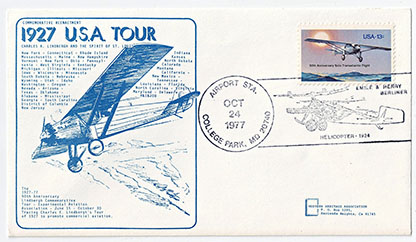
Various celebratory postal covers were created to celebrate the event. The example depicted was printed by the Western Heritage Association, Hacienda Heights, California.
The version shown here was canceled at Airport Station, College Park, while the plane sat on the tarmac at the Maryland airport.
In addition to an illustration of The Spirit of St. Louis, as well as a commemorative cancellation depicting Emile & Henry Berline’s 1924 helicopter (the first test flights of which occurred at College Park), the cover was also “franked” with a 13-cent United States Postal Service’s stamp, commemorating the 50th Anniversary of Lindbergh’s flight.
Lindbergh’s introduction into aviation began in 1922 when he attended the Nebraska Aircraft Corporation to study aeronautics. Up into 1924, he flew a plane engaged in “barnstorming (performing aerial acrobatics)”—the term “barnstorming” was originated by pilots flying their planes through barns via the opened doors.
According to the Smithsonian’s National Air and Space Museum’s (NASM) website, in 1924, Lindbergh enrolled as a flying cadet in the Army Air Service, and subsequently, became an airmail pilot, flying mail between St. Louis and Chicago.
Airmail pilots at that time faced a dangerous and even deadly task in the old bi-wing airplanes they were operating, resulting in the airmail pilots of the 1910s and 1920s being dubbed “the suicide club,” according to the United States Postal Museum.
Early in 1927, he obtained financial backing to compete for a $25,000 prize offered by Raymond Orteig for the first nonstop flight between New York City and Paris. In today’s money, that prize would be equal to more than $481,000.
Lindbergh ordered a modified (for the proposed trans-oceanic flight) Ryan airplane produced by Ryan Airlines, San Diego, which, among other details, included the ability to carry a greater fuel load. In April 1927, the work on the aircraft was completed and was painted silver with black numbering and lettering, according to the NASM.
Lindbergh took off from New York on the morning of May 20, 1927, landing in 33 hours and 30 minutes at Le Bourget Field, near Paris, thereby representing the completion of the 3,610-mile trip.
According to the NASM, “On April 30, 1928, The Spirit of St. Louis made its final flight—from St. Louis to Washington, D.C, where Lindbergh presented the aircraft to the Smithsonian Institution.”
The replica differed from the original in several respects: the length was a few inches longer, the wingspan was three feet shorter, the replica was about 1,000 pounds lighter, the replica had consumed about 130 gallons of fuel as opposed to 450 gallons consumed by the original, and the replica had a cruising speed of 95 miles per hour, as opposed to the cruising speed of the original at 100 to 105 miles per hour, according to the Experimental Aircraft Association (EAA).
During 1977, the replica of The Spirit of St. Louis made a total of 92 stops in 48 states during its 1977 national tour from June to October, landing in College Park on October 24.
“In 1987, the replica was shipped to France and flew into Le Bourget Airport in Paris to commemorate the 60th Anniversary of Lindbergh’s 33-hour flight across the Atlantic,” according to EAA.
The replica was then retired and honorably placed in the Oshkosh EAA Aviation Museum.
As per the EAA, “…construction of the second flying replica, beginning in early 1990… it was completed by May 1991 and has made many appearances throughout the country since that time.”
