
August 27, 1776
The Maryland 400
by Richard D. L Fulton
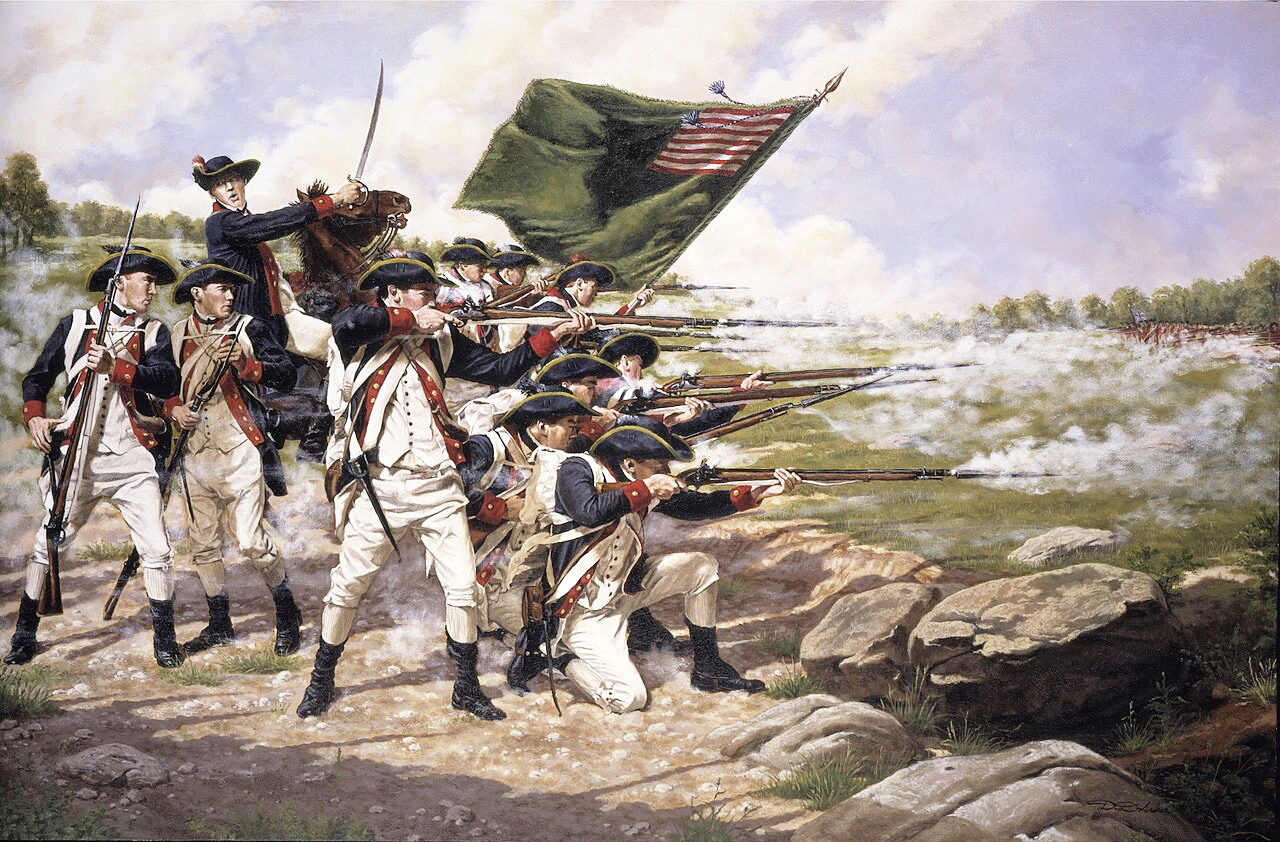
Colonel Henry “Light-Horse Harry” Lee, a hero of the Revolutionary War and father of Robert E. Lee, once commented that during the war “the state of Delaware furnished one regiment only; and certainly no regiment in the army surpassed it in soldiership.” At the Battle of Long Island, the actions of the Delaware Regiment kept the American defeat from becoming a disaster. Fighting alongside the 1st Maryland Regiment, the soldiers from Delaware may well have prevented the capture of the majority of Washington’s army – an event that might have ended the colonial rebellion. Organized in January 1776 by Colonel John Haslet, the Delaware Regiment was noted as the best uniformed and equipped regiment of the Continental Army. Delaware’s blue jackets with red facings and white waistcoats and breeches would later become the uniform for all the Continental troops. During the Battle of Long Island, the Delaware and Maryland troops were positioned on the right of Washington’s line. They defended the most direct route from the British landing site in south Brooklyn to the American fortifications in Brooklyn Heights. Though the troops faced the fiercest fighting of the day, they held their ground long enough to allow the remainder of Washington’s army to safely retreat to the fortifications. However, the Delaware regiment was outflanked and forced to retreat, taking 23 prisoners with them, through marshland and across the Gowanus creek. Two nights later, Washington entrusted his Delaware and Maryland soldiers to be the rear guard as he secretly withdrew his army from Brooklyn to Manhattan. Today, the 175th Infantry Regiment, Maryland Army National Guard, preserves the legacy of the 1st Maryland Regiment. The 198th Signal Battalion, Delaware Army National Guard, perpetuates the proud lineage of the Delaware Regiment.
“Here … two hundred and fifty out of four hundred brave Maryland soldiers … were killed in combat.”
–1897 plaque placed near the Vechten Stone Farmhouse
On August 27, 1776, a torrential thunderstorm and heavy rain, followed by cold from a nor’easter and a thick morning fog, greeted the morning around Long Island.
Just after midnight, the flash of gunfire shot from muskets and rifles echoed among military skirmishers, had joined nature’s thunder and lightning, thereby marking the opening shots of an imminent collision of two forces of armed men—one fighting for freedom, and the other to preserve British domination within the American colonies.
Without regard to the inclement weather, the engagement quickly grew to include more than 10,000 British and Hessian troops confronting 10,000 American troops. At daybreak, 30,000 Brown Bess muskets and country rifles, and more than 100 cannons faced each other, in what would turn out to be the first major battle fought between the British and Hessian (German mercenaries) troops and the American forces in America’s War of Independence, otherwise known as the American Revolutionary War.
As hundreds of paper cartridges were ripped open by teeth, and the encased powder dumped into steel barrels, tamped down by the ramrods, followed by the depositing of lead balls that had also been contained in the cartridge, and again stamped down by the ramrods, and the powder added to the flash pans in order to prepare the flintlock guns to discharge the projectiles, the men firmly stood—thousands of them—waiting for that final command, “Make ready, present (aim)…, “ at which point, for many, time probably seemed to stand still as they then awaited for the command… “Fire!”
First Maryland Regiment
The First Maryland Regiment was formed in January 1776 by the Maryland Assembly and was created the following spring by an assemblage of three infantry companies from Baltimore, six infantry companies from Annapolis, and one light infantry company from northern and western Maryland counties and placed under the command of Colonel William Smallwood.
In July 1776, the First Maryland Regiment was formally inducted into General George Washington’s Continental Army, at which time, according to the National Park Service, the regiment was already considered “Maryland’s most disciplined and well-equipped force,” further noting that, “Many of the Marylanders even had bayonets for their weapons, which others in the Continental Army lacked.”
On August 12, 1776, the First Maryland was attached to Brigadier General William Alexander’s (better known as Lord Sterling) brigade. Other units in Alexander’s brigade in 1776 included the Delaware Regiment, 1st and 3rd Virginia Regiments, and Miles’ Pennsylvania Rifle Regiment.
Be forewarned that various historians have been debating since 1776 up to the present time over the actual numbers of troops and casualties involved in the Revolutionary War during the various battles, including the Battle of Brooklyn.
As far as unit numbers in 1776, the First Maryland Regiment was authorized to recruit up to around 1,000 men. However, by August, through various causes of attrition, around 400 were available for action at that time. (Some estimate the number may have been as low as some 260+). The number of men in Alexander’s brigade, all inclusive, numbered between 1,200 and 1,800. The National Park Service estimated that Alexander had 1,798 men available for the Battle of Brooklyn.
The Battle of Brooklyn
The Battle of Brooklyn (also known as the Battle of Long Island) on August 27, 1776, occurred as a result of General George Washington’s attempt to abandon New York in the face of growing and overwhelming numbers of British and Hessian troops.
Hard-pressed by the advancing enemy and in striving to save his Continental Army, Washington orchestrated a retreat to Manhattan, but in order to accomplish this, a strong resistance was direly needed to be established at the rear of his retreating army.
To achieve this end, Alexander’s brigade was ordered to cover Washington’s retreat by stalling the advancing enemy troops for as long as possible. Colonel William Smallwood, commander of the First Maryland, became involved in processing a court-martial and could not attend to his troops. Major Mordecai Gist was assigned to command the Marylanders.
As the rear action began to unfold, Gist recalled, “We began our march to the right (of the defensive position) at three o’clock in the morning, with about thirteen hundred men (from Pennsylvania, Maryland, and Delaware), and about sunrise… discovered the enemy.”
But things “went south” fairly quickly, when Gist realized the plan was not coming together as had been anticipated, “Being thus surrounded, and no probability of a reinforcement, his Lordship [Lord Stirling, American general] ordered me to retreat with the remaining part of our men, and force our way through to our camp.”
The disintegration of the battle plan and withdrawal of the other rear guard resistance force ultimately found 400 of Alexander’s Maryland and Delaware troops attempting to stall the advance of some 2,000 British and Hessian troops on their own around the Vechten Stone Farmhouse.
The stand of the Vechten Stone Farmhouse of Alexander’s 400 was little more than suicidal, but they held off the enemy and were credited with saving the Continental Army.
An unidentified soldier in the 5th Company of the 1st Maryland wrote, “The main body of their army, by a route we never dreamed of, had entirely surrounded us, and…scattered all our men, except the Delaware and Maryland battalions.”
The battle became so intense that as Washington watched from a distant vantage point, he proclaimed, “Good God, what brave fellows I must this day lose.”
The Aftermath
As the 400 defiant last stand at the Vechten Stone Farmhouse became untenable, Gist wrote, “Being thus surrounded, and no probability of a reinforcement, his Lordship [Lord Stirling, American general] ordered me to retreat with the remaining part of our men and force our way through to our camp.”
Before attempting to fall back, the enraged 400 actually conducted more than a half-dozen bayonet charges against their enemy, suffering heavy casualties in the process.
Of the 400 Maryland and Delaware men who stood the storm of shot and shell, 256 had been killed, while a hundred of their numbers had been captured. Only a dozen escaped either fate. As an aside, Maryland’s 400 realistically consisted of Maryland and Delaware troops by count, of which some 300 were Marylanders. But over time, “Maryland’s 400” seems to have prevailed,
Washington referred to the troops that comprised Maryland’s battle line he had beheld in action as his “old line,” which became the state’s motto, the “Old Line State.”
And so…what became of the dead members of the 400? Quite sadly, it appears no one really knows when and/or how they were interred.
According to maryland400.com, Ambrose Serle, British General Sir William Howe’s secretary, wrote, “putrid dead bodies (remained) in the fields about the country, as the army [had] hardly any time to bury them,” and that “the Woods near Brookland (aka Brooklyn) are so noisome with the stench of the dead bodies of the rebels… that they are quite inaccessible.”
Colonel Henry “Light-Horse Harry” Lee, a hero of the Revolutionary War and father of Robert E. Lee, once commented that during the war “the state of Delaware furnished one regiment only; and certainly no regiment in the army surpassed it in soldiership.” At the Battle of Long Island, the actions of the Delaware Regiment kept the American defeat from becoming a disaster. Fighting alongside the 1st Maryland Regiment, the soldiers from Delaware may well have prevented the capture of the majority of Washington’s army – an event that might have ended the colonial rebellion. Organized in January 1776 by Colonel John Haslet, the Delaware Regiment was noted as the best uniformed and equipped regiment of the Continental Army. Delaware’s blue jackets with red facings and white waistcoats and breeches would later become the uniform for all the Continental troops. During the Battle of Long Island, the Delaware and Maryland troops were positioned on the right of Washington’s line. They defended the most direct route from the British landing site in south Brooklyn to the American fortifications in Brooklyn Heights. Though the troops faced the fiercest fighting of the day, they held their ground long enough to allow the remainder of Washington’s army to safely retreat to the fortifications. However, the Delaware regiment was outflanked and forced to retreat, taking 23 prisoners with them, through marshland and across the Gowanus creek. Two nights later, Washington entrusted his Delaware and Maryland soldiers to be the rear guard as he secretly withdrew his army from Brooklyn to Manhattan. Today, the 175th Infantry Regiment, Maryland Army National Guard, preserves the legacy of the 1st Maryland Regiment. The 198th Signal Battalion, Delaware Army National Guard, perpetuates the proud lineage of the Delaware Regiment.
The Battle of Brooklyn.
Source: Public domain, Wikimedia
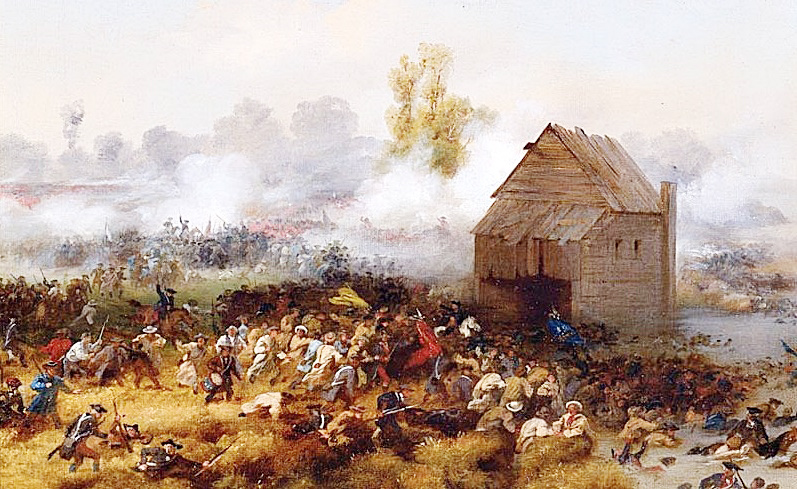
The Maryland 400s last stand at the Vechten stone farmhouse.
Source: Public domain, Wikimedia
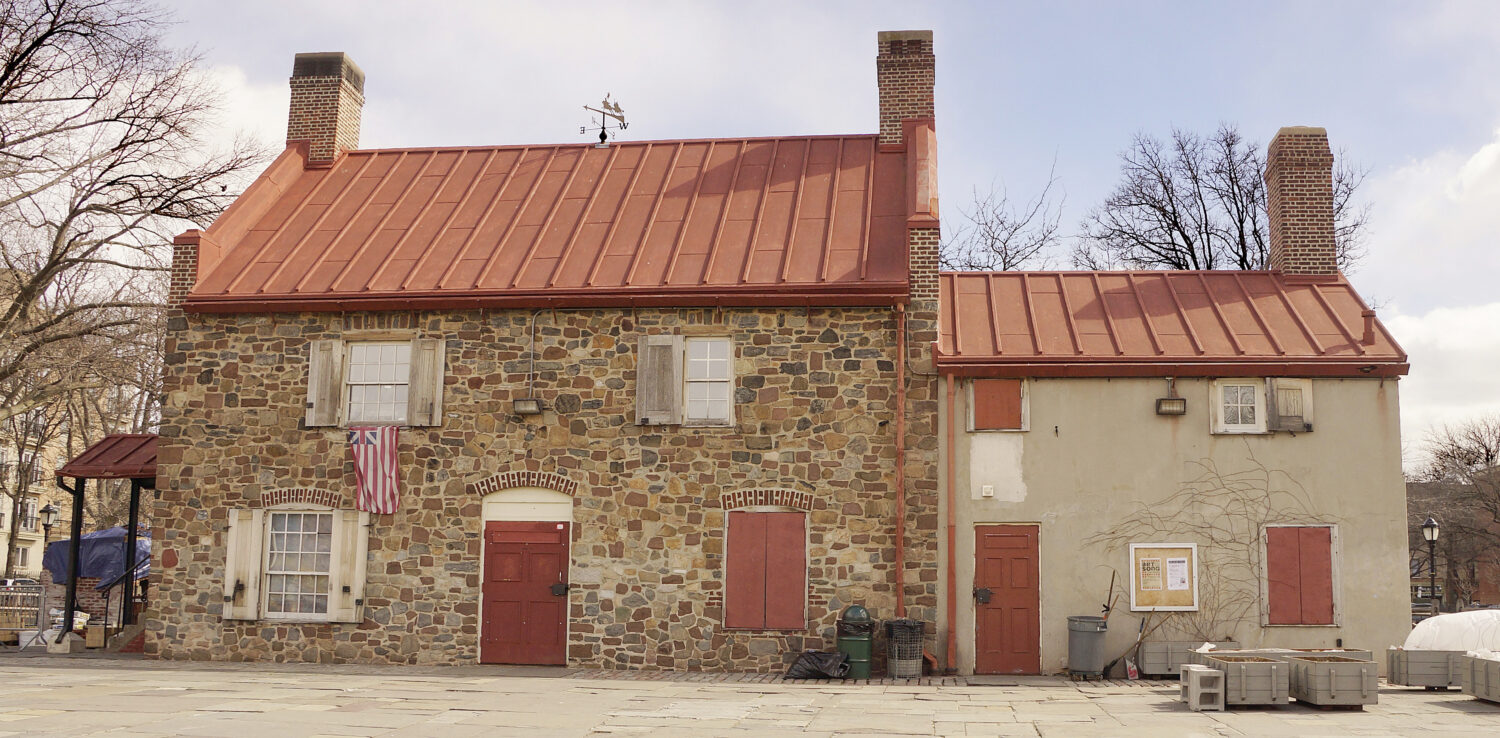
Vechten stone farmhouse as it appears at the present time after restoration.
Source: Public domain, Wikimedia
