
Maryland on Stamps & Covers
by Richard D. L. Fulton
“Welcome to Maryland”
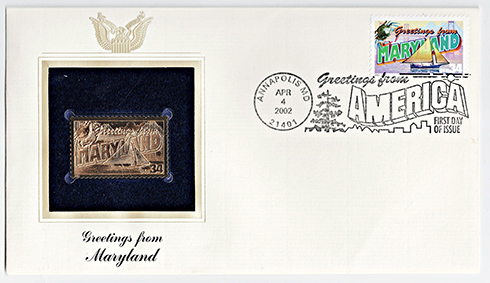
The United States Postal Service (USPS) issued a sheet of 50 different 34-cent stamps on April 4, 2002, essentially commemorating the boom in state tourism, which traced its roots to the 1930s and 1940s, although early examples of tourism in Maryland date back to the 19th century.
An increase in the postal rate also resulted in the USPS reissuing a 37-cent version that was issued later in 2002.
The set of 50 stamps was dubbed “Greetings from America,” and was, according to the USPS, created in conjunction with the Travel Industry Association of America. Each state’s stamp designs were based on the “retro,” large letter postcards that were used to advertise cities, states, and tourist attractions during the 1930s and 1940s, although two of those stamps represented states that did not exist in the 1930s and 1940s: Hawaii and Alaska.
Each stamp read, “Greetings from…” along with the state’s name that the stamp represented. In addition, views and symbols representing the state were detailed in the background. Interestingly, for the first time, according to the Mystic Stamp Company’s website, “the Greetings from America sheet marked the first time that a U.S. postage stamp was issued on the same day, in every state.”
The Greetings from Maryland stamp featured a blue crab, the Bay Bridge, and Maryland’s state boat… “the skipjack” in the background. The First Day of Issue covers (FDCs) were cancelled on April 4 at the Annapolis Post Office.
Tourism in Maryland was essentially launched in the 1800s by steamboat companies that were offering conveyance to popular Eastern Shore beaches and resorts. But steamboat tourism was transcended by the mid-1800s, with the development of the railroads and canals—although steamboat tourism continued (even up into the present day) if only due to their uniqueness and tourist experiences that the railroads and canals could not provide.
In 1900, the first passenger train out of Washington, D.C. arrived at Chesapeake Beach, fueling the tourist industries associated with the town that had already boasted “hotels, bathhouses and beaches, casinos, a racetrack, and a 1600-foot boardwalk,” according to the Chesapeake Beach website. The arrival of that first train has been heralded as having set the stage for coastal tourism.
Concurrent with the rise of the railroads was the establishment and proliferation of the trolley (also known as streetcars) companies, many of which developed amusement parks and resorts, upon which to generate revenue to facilitate income garnered via regular transportation services.
Steam, diesel, and electric-powered rail transportation ruled until the creation of a more developed roadway and highway system appeared, along with the rise of the automobile, beginning in the 1920s, which ultimately produced the tourism boom of the 1930s and 1940s (the decades commemorated by the “Greetings from America” stamps), and beyond.
Highway tourism also spawned “Roadside America,” an explosion of roadside attractions ranging from bizarre—or at least unusual —museums and parks and tourist attractions, which reached its peak during the 1950s and 1960s, having been a class of highway sights, and sounded which was eventually declined with the development of the interstate highway system, which diverted traffic away from, to secondary highways, along which most roadside America attractions had become established.
During 2022, 43.5 million tourists in Maryland spent more than $19 billion, while the tourist industry employed some 187,000 jobs, and the state collected more than $2 billion in tax revenue, according to visitmaryland.org.
Also, via visitmaryland.org, “Visitor-supported employment is a significant part of several industries in Maryland—nearly all lodging employment, 26 percent of recreation employment, and 22 percent of food and beverage jobs are all supported by visitor-spending. Overall, direct tourism jobs accounted for five percent of all jobs in Maryland in 2022.”
The top tourist attractions in Maryland: No. 1—Ocean City beaches; No. 2—C&O Canal National Historical Park; No. 3—Inner Harbor/National Aquarium; No. 4—Assateague Island National Seashore; and No. 5—Fort McHenry National Monument and Historic Shrine, according to tripadvisor.com.
