
Look-UP
The Magma World
by Mitchell Tester, College Student
The universe has been an outlet for curiosity since the beginning of mankind. One thousand years ago, some humans believed that the Sun was either a massive ball of fire or, in some cases, a divine entity.
Fast forward to modern astronomy, and we have a better understanding of the world around us. Despite our technological advances, though, we still make discoveries every day all around the world. A discovery that was made recently and has been on my mind is the discovery of a magma planet. Magma exists on many planets, even on Earth.
Jupiter’s moon, Io, is extremely geologically active, erupting over 100 times as much lava as all of Earth’s volcanoes combined. Over 132 trillion gallons of volcanic magma are dispersed onto the moon’s surface. Despite the large amount of magma, Io would still not be considered a magma moon, or if it were a planet, a magma planet. It was theorized for quite some time that Io had a lava ocean beneath its surface; however, discoveries made by NASA’s Juno mission revealed that Io instead has a solid and rigid mantle with lakes of magma, rather than an ocean.
The moon Io is actually the most geographically active object in our solar system, by a long shot.
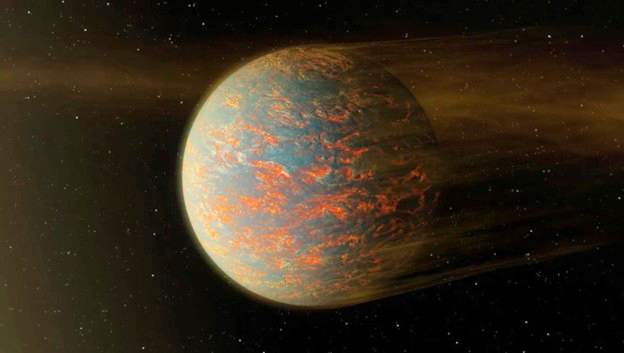
Making our way past Io, traveling 35 light-years away, we can discover an exoplanet (any planet that resides outside of our solar system) by the name of “L98-59 d,” which has been described by scientists as “Io on steroids.” Molten silicate (think rock) exists at the mantle level; below that, though, exists a global ocean of magma. This magma ocean is believed to extend for thousands of miles, deep into the planet. The exoplanet threw off scientists for a long time because of its low density and its large amount of hydrogen sulfide. The magma ocean would explain both of these characteristics of the exoplanet. The recently discovered planet’s new findings also suggest that it was once much larger than it is now. It once existed as a bit smaller than Neptune, around 1.5 to 4 times the radius of Earth. Despite its shrinkage, it is still much larger than Earth.
What is most fascinating in the discovery of this magma planet, when it comes to Earth, is that magma oceans are common in the early life of terrestrial planets. The magma exoplanet can provide information about what Earth’s primordial life looked like billions of years ago. Despite “L98-59 d” being the first of its kind discovered, astronomers agree that many other exoplanets exist like it. Due to exoplanets being light-years away, it makes it difficult to find out the makeup of said planets.
An Oxford University researcher by the name of Harrison Nicholls, who is playing a large role in the new study about the magma super-Earth exoplanet, had this to say about the discovery of a magma planet such as “L98-59 d”: “This discovery suggests that the categories astronomers currently use to describe small planets may be too simple. While this molten planet is unlikely to support life, it reflects the wide diversity of the worlds which exist beyond the solar system. We may then ask: what other types of planets are waiting to be uncovered?”
As Harrison stated, the molten planet is quite unlikely to support life; yet, it is still fascinating, nonetheless.
The most interesting bit of information I learned when researching this magma ocean planet was the fact that, to put it simply, the planet most likely stinks. Hydrogen sulfide is one of the main parts of the planet’s atmosphere. Hydrogen sulfide (think sulfur) reeks of rotten eggs. With that being said, it is not out of the realm of possibilities to say that there may exist many planets in our universe that are smelly. I am sure all of our noses can agree that we’re lucky they are light-years away.
