
The Rise and Decline of Maryland Coal
by Richard D. L. Fulton
The story of Maryland’s vast coal seams began some 400 million years ago when the collision of the African and North American continents had begun to lead to land arising from the tropical seas … seas that had once covered the land that would eventually become Maryland.
Around 320 million years ago, as the continental collision progressed, vast swamps formed on formerly submerged lands that would eventually become Allegany and Garrett counties, both of which fostered a heavy growth of vegetation, comprised primarily of primitive scaled trees, giant horsetail ferns, tree ferns, and seed ferns.
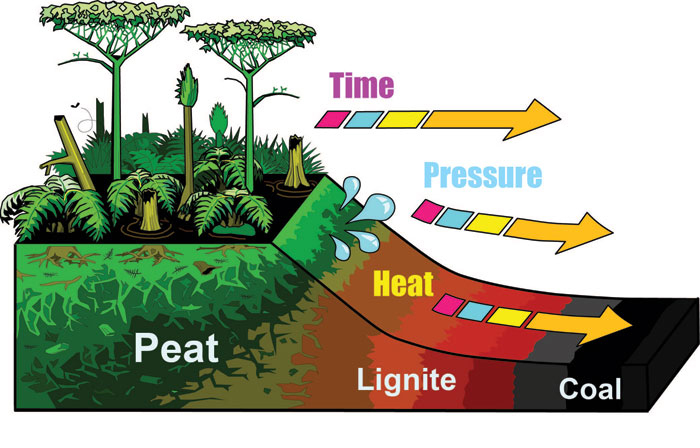
Over literally millions of years, the continuous death, burial, decomposition, and regrowth of generations of these plants accumulated on the swamp floors, thereby ultimately becoming peat (peat moss is formed by the same process) and then lignite (low-grade “brown coal”).
However, as the cycle of burial and regrowth continued, eventually enough pressure, combined with heat produced by the constantly accruing vegetative overgrowth, generated a change in the layer of accumulated peat and lignite beneath… into coal—a process termed as coalification.
The primary coal in Maryland consists primarily of a type called bituminous, or “soft coal,” as opposed to the coal deposits in Pennsylvania, which are primarily comprised of anthracite coal, or “hard coal,” which is the highest grade of coal.
Age & Mining
Geologically, the age of the preponderance of Maryland coal dates back to the Late Pennsylvania Epoch (part of the Carboniferous Period), which ranges in age from 323 to 298 million years.
The Pennsylvania Epoch received its name as the result of the “hard coal” deposits in Pennsylvania, while Carboniferous means “coal bearing,” it being the period of time when much of the world’s coal was formed.
There is some Early Permian Period (298 to 273 million years of age) coal in Maryland, as well as some from the Mississippian Epoch (which preceded the Pennsylvania Epoch), and can be observed in a road cut in Sideling Hill, along Interstate 68, six miles west of Hancock, Washington County. Both contain somewhat insignificant amounts of coal.
The first coal mines established in Maryland occurred in 1782, with another operation commencing in 1804. Improvements in transportation contributed to a surge in the development of coal mines, beginning with the establishment of the National Road, running through Cumberland in 1818.
The establishment of the Baltimore & Ohio Railroad in 1842 (and subsequently the Western Maryland Railroad beginning in 1852), and the Chesapeake and Ohio Canal in 1850, all provided ample transportation for coal from the rapidly expanding number of coal mines, according to a 1981 document of coal mining in Maryland, in the files of the US Geological Survey (USGS).
In the late 1799 era and early 1800s, coal was recovered in Maryland through drift mines (digging mines directly into hillsides) and pit mines (small pits dug into near-surface coal deposits). With the advent of the 20th century, the primary processes utilized in removing the coal from the coal deposits included surface mining (also known as strip mining), sites, and underground mining.
Among the primary coal fields of Maryland, sites have been designated as the Georges Creek Basin, the Upper Potomac Basin, and the Castleman Basin, along with the Lower Youghiogheny Basin and the Upper Youghiogheny Basin.
The Georges Creek Basin is five miles in width and is about 18 miles long, and has the longest history of commercial mining in the state, according to the USGS. The less-grandiose Upper Potomac Basin, and the Castleman Basin, the Lower Youghiogheny Basin, and the Upper Youghiogheny Basin apparently tended to be out-produced by the Georges Creek.
Rise & Decline
The labor force that mined the coal in Maryland depended to some degree on slave labor until 1865, when labor was further provided for, as the result of English, Welsh, Scottish, and occasionally German immigration, according to coalcampusa.com. During the peak periods of coal production in Maryland, the mines employed some 5,000 miners. By 1972, that number had been reduced to 637, according to the Maryland Geological Survey (Coal Reserves in Maryland – Potential for Future Development by Kenneth N. Weaver, James M. Conforth, and Jonathan Edwards, Jr.).
Fueled by the industrial revolution, coal mining in Maryland increased from 1782, peaking in the early 1900s when the coalfields yielded some 5 million tons of coal. In 1906, “the average Maryland miner worked 250 days a year, for an average annual income of $489.97,” according to the Western Maryland Historical Society’s website.
The most productive period of coal mining occurred between the early 1900s and the 1920s. According to the Global Energy Monitor (GEM) website, coal mining in Maryland in 1865 produced 1 million tons, which increased to 4 million tons by 1895. Coal mines generated 5.5 million tons by 1907, which has been generally regarded as the peak year for coal production in the state.
However, after the mid-1920s, Maryland coal production began to decline, which has been attributed to the increased use of petroleum instead of coal. During the Great Depression of the 1930s, production had fallen back to 1.5 million tons per year, and then plummeted down to 500,000 tons, according to GEM and the USGS.
And so, how much coal remains in Maryland to be potentially mined? According to a 1976 report published by the Maryland Geological Survey, based on the 1976 estimates, “Remaining recoverable reserves” (the estimated number of tons remaining to be recovered), included: 354,100,000 tons in the Georges Creek Basin, 223,500,000 tons in the Upper Potomac Basin, 116,000,000 tons in the Castleman Basin, 107,000,000 tons in the Lower Youghiogheny Basin, and 54,300,000 tons in the Upper Youghiogheny Basin, for a total of (by 1976 numbers) 854,900,000 in “remaining recoverable reserves.”
The report further stated, “At the present yearly rate of mining, this total recoverable reserve of coal would last for approximately 342 years, and if mined at a rate equal to that during the peak production year of 1907, it would last for 150 years.”
However, the report concluded, “A related problem is how to extract the energy present in the coal (fields) with a minimum waste, but yet to provide an environmentally acceptable product. Two of the basic problems generally associated with the use of coal are that it is dirty to mine… and dirty to burn.”
Down, but not out from its initial-peak period, Maryland coal, as of 2022, constituted about 12 percent of the energy produced in the state, with 44 coal mines still in operation. In addition, as of 2023, Maryland coal mines have been producing 1.4 million tons of coal annually.
The Castleman (Basin) Mine remains Maryland’s largest active, underground coal mine. As was reported in Maryland’s largest underground coal mine changes hands (by Paul Kiefer) on May 16, 2025, in the Capital News Service. The mine changed ownership in April 2025. In 2023, the mine produced 660,000 tons of coal.
According to the article, Allegany Coal & Land Company’s President, Steve Jenkins, reportedly stated that although coal in Maryland’s coal seams is far from expended, “It’s just a matter of how much is accessible in the regulatory environment.”
Conclusion
Today, coal has become a tug-of-war subject between “green energy” advocates… and proponents of fossil fuels.
A statement issued by the White House in April 2025 had stated “It is a national priority to support the domestic coal industry by removing Federal regulatory barriers that undermine coal production, encouraging the utilization of coal to meet growing domestic energy demands, increasing American coal exports, and ensuring that Federal policy does not discriminate against coal production, or coal-fired electricity generation (whitehouse.gov).”
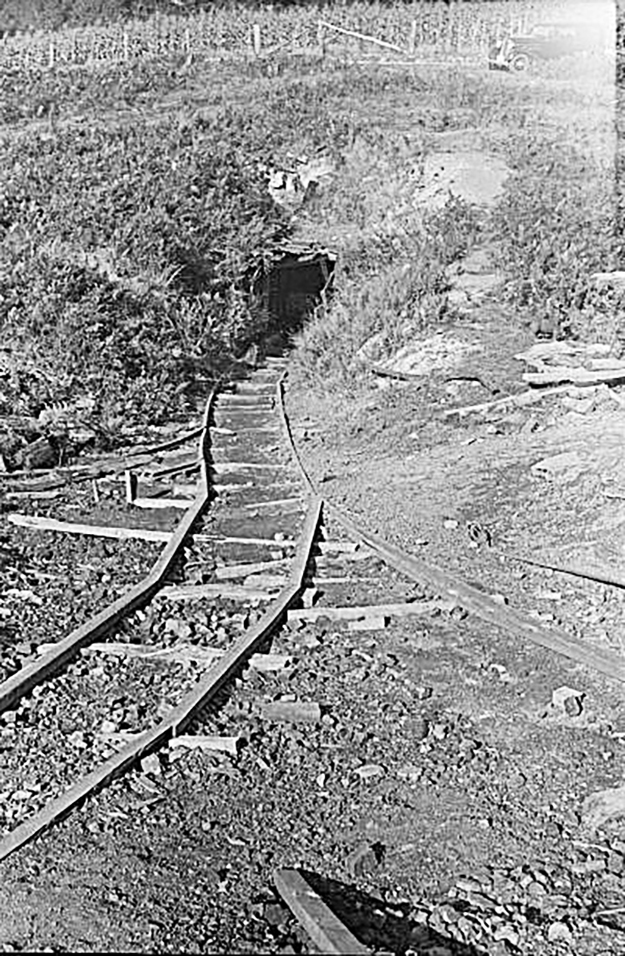
Abandoned mine in Garrett County, Maryland, Source: Library of Congress
Source: Maryland Department of the Environment
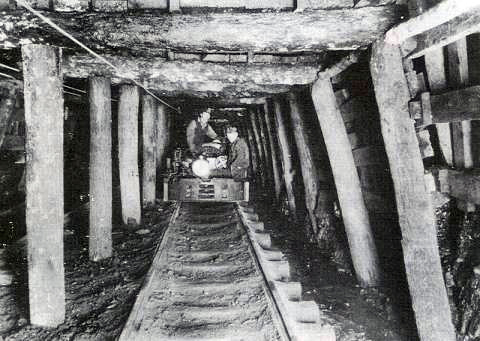
Workers in George’s Creek Mine in Lonaconing, Allegany County. Source: Source: Un-sourced photo via miningartifacts.org
