
Wings Over Maryland
by Richard D. L. Fulton
Maryland has been the scene of numerous “firsts” in the annals of aviation, beginning with the first “manned” hot air balloon in America (see “Balloons Over Maryland,” by Richard D. L. Fulton, in the February 2026 issue of The Catoctin Banner) to the first airplane built in the state and flown by a Maryland doctor.
The few notable aviators noted below are those dating back to the pre-1920s, when the risks were great but the rewards even greater.
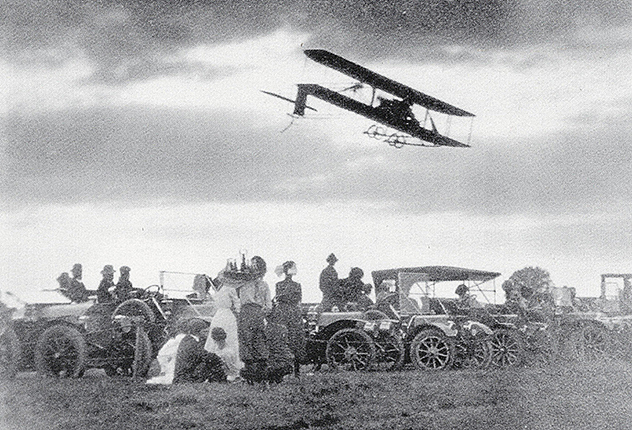
The first successful flight of Orville and Wilbur Wright in 1903 touched off a global deluge of wannabe aviators, and Marylanders were quick in their attempt to make their mark on the world of aviation.
From Charles F. Elvers’ first failed flight, resulting in his dubbing his repeatedly crashing first aircraft, the “Undertaker’s Pet,” to one woman’s daring venture to become the first female airplane passenger in America, to attempting to launch an airplane from a catapult, all of these early aviators had one thing in common: they were not faint of heart.
Charles F. Elvers
Baltimore resident Doctor Charles F. Elvers has the honor of being remembered as Maryland’s first aviator.
At age 21, while residing at 1618 Westwood Avenue in Baltimore, Elvers designed and completed the construction of his bi-wing airplane, which bore a likeness to the first successful airplane developed by Orville and Wilbur Wright in 1903, and which was first flown in Kitty Hawk, North Carolina.
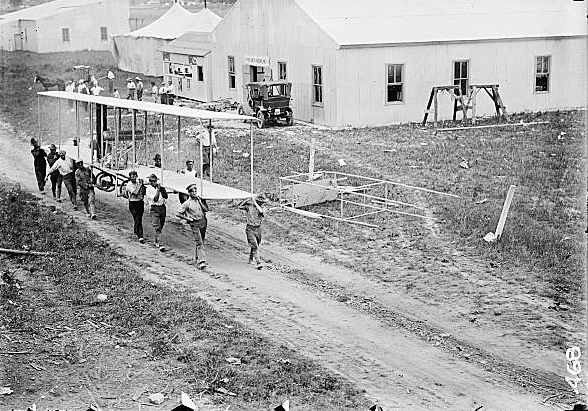
Elvers’ first attempt at developing a winged aircraft was rather humorous, though. According to Up, up and away: Maryland’s First Birdmen, published on the Maryland Center for History and Culture’s website (mdhistory.org), Elvers first converted a glider into a plane by adding a motorcycle engine, skids, and a small propeller. It was probably one of those “it seemed like a good idea at the time” moments. The airplane repeatedly crashed, resulting in Elvers nicknaming it the “Undertaker’s Pet.”
However, his next effort paid off. The (Baltimore) Sun newspaper described Elvers’ new airplane in the newspaper’s February 25, 1910, edition as having been “steered by an automobile steering wheel” and controlled by “elevating and lowering plane… the latter is in front of the machine and looks a little like a chicken coup.”
On October 22, 1909, Elvers’ improved airplane took off for its inaugural flight from a pasture on his father’s farm in Owings Mills, thereby deeming him the first Maryland aviator flying the first airplane constructed in Maryland.
Sarah Van Deman
Sarah Van Deman (sometimes misidentified as Irene Van Deman, which was the name of her husband’s second wife) is considered to have made not only a mark in aviation history in Maryland, but also in national aviation history, when she became the first female passenger on October 27, 1909, to fly in an airplane. Her pilot… Wilbur Wright.
According to an article published in the October 28, 1909, edition of The New York Times, “For the first time in the country, a woman went up as a passenger in the Wright aero-plane… and with Wilbur Wright at the tiller (controls), and her husband (then Captain, later Major General, Ralph Henry Van Deman) looking calmly on from below, she circled the field at College Park, Md., for four minutes.”
Van Deman reportedly had said, “Now I know why birds sing. It was wonderful. There is no earthly sensation I can compare with it.” Her husband (subsequently ex-husband) later became known as the “Father of Military Intelligence,” after having established the first professional intelligence organization—The U.S. Army Military Intelligence Section—in 1917.
It’s not certain as to whether or not the flight was approved by 1st Lieutenant Frank P. Lahm, who was in charge of the College Park Aviation Station where Van Deman’s flight took place, but what is certain, is that after reports of Van Deman’s flight made the front pages of a number of newspapers on the following day, Lahm had then ordered that no one but military personnel were allowed to participate in any of the flights from that point on, according to the National Archives.
John Henry Towers
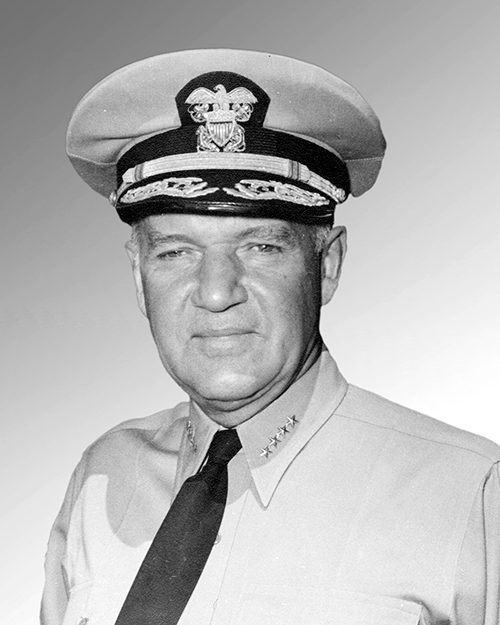
John Henry Towers, of Rome, Georgia, had studied civil engineering at the Georgia School of Technology, and was subsequently appointed to the United States Naval Academy in Annapolis in June 1902. While at the academy, he had achieved the rank of cadet petty officer 1st class.
In 1911, Towers co-founded the first official Naval Air Station and flying aviation unit at Greenbury Point, Maryland. During that same year, he had set a long-distance flight record by flying 112 miles in 122 minutes from Annapolis to Old Point Comfort, Virginia, and additionally, he had established several more speed and altitude records.
Throughout 1913, according to the Naval History and Heritage Command’s website, Towers was flying in a two-seater, open-cockpit aircraft being piloted by Ensign W.D. Billingsley, when, at about one thousand, seven-hundred feet, the plane was caught up in a severe downdraft, and plummeted downward into the Chesapeake Bay.
Both aviators were thrown from the cockpit, but Towers managed to grab and hold onto a strut and plummeted into the waters with the plane.
Billingsley fell into the Chesapeake and was killed, thereby becoming the first naval aviation fatality, after his plane had crashed into the Chesapeake.
Towers continued to have a long and illustrious military career, but soon after the near-death incident, he never again served in Maryland.
John Rogers & Theodore Ellison
Rogers received his aviation training from the Wright brothers in Dayton, Ohio, in 1911, becoming qualified as a pilot.
On September 7, 1911, Rogers was assigned to the Naval Academy, and according to Hawaiian Aviation (hawaii.gov), piloted a Wright brothers biplane, taking off from Farragut Field at the academy, his flight thereby constituting the first naval aviation flight.
Ellison made Maryland history in July 1911, when he became involved in an effort by the Navy to develop a means of launching airplanes by employing the use of catapults—no doubt with it in mind, to then find a means of launching airplanes from naval ships.
However, his effort to pilot a land-based, catapult-launched aircraft in July was not exactly a success. Once launched, the plane stalled and fell into the water, but the experiment represented the first attempt by the Navy to launch an airplane by employing the use of a catapult.
However, a second attempt was made on November 12, 1912, in which the redesigned catapult was mounted on a barge at the Washington D.C. Navy Yard, and it worked quite well, according to Images of Aviation, Maryland Aviation by John R. Breihan, and the Naval History and Heritage Command website (history.navy.mil).
Conclusion
Maryland aviation and aviators have been on the cutting edge of aviation technology from the early 1900s, up to NASA rocket launches from Wallops Flight Facility, often visible from Assateague Island and Chincoteague, Virginia.
For more information on Maryland aviation, Images of Aviation, Maryland Aviation by John R. Breihan is recommended, as well as the Maryland Aviation Administration website at marylandaviation.com.
