
Look-UP
by Mitchell Tester, College Student
Mercury
Millions of miles away from our home here on Earth sits the smallest planet of our solar system, the planet Mercury. Mercury is incredibly hot, with it being only an average of 36 million miles away from the Sun. For reference, here on Earth, we are roughly 93 million miles away from the Sun. Although Mercury can be extremely hot, it can also be very cold. At night, Mercury sits at -290 degrees Fahrenheit, while during the day it can reach temperatures of 800 degrees Fahrenheit. Mercury’s surface is riddled with craters from impacts with meteoroids and comets. This leaves the planet looking quite similar to our Moon. Mercury and the Moon are very similar in size, with Mercury being only slightly larger.
One of the most interesting facts I have learned about Mercury is what occurs at its poles. “Permanently shadowed regions” (PSRs) are locations on planets that the Sun never hits. Due to the Sun never reaching these areas, Mercury has large amounts of water ice. Astronomers theorize that there are between 100 billion and 1 trillion metric tons of water ice; this is enough to bury a city like Richmond, Virginia, twice.
Mercury is not an easy planet to spot with a telescope due to how close it is to the Sun. To have the best chances of seeing the tiny planet, it is best to wait until Mercury is in “greatest elongation.” This simply means that Mercury is the farthest away from the Sun.
Missions such as “Mariner 10” and “Messenger” helped us understand the innermost planet. We were surprised to find that Mercury is not geologically dead, as it was theorized that the smaller planets cooled very quickly. What we found is that Mercury has experienced relatively recent geological activity, and most likely still has a molten core. Despite this, Mercury is still cooling down. Similar to our Moon, both are cooling down from a violent birth and past. This causes their inner core to shrink, which causes their surfaces to “wrinkle.” This shrinking can cause what we call earthquakes; although for Mercury and the Moon, they are called Mercuryquakes and Moonquakes, respectively. Specifically for the Moon, these quakes could make it hard for humans to explore it, especially when trying to set up a permanent camp on the Moon. As for future exploration of Mercury, we have the BepiColombo mission from the European Space Agency (ESA) and the Japan Aerospace Exploration Agency (JAXA). This mission will be orbiting Mercury, collecting information on the planet’s geology and composition.
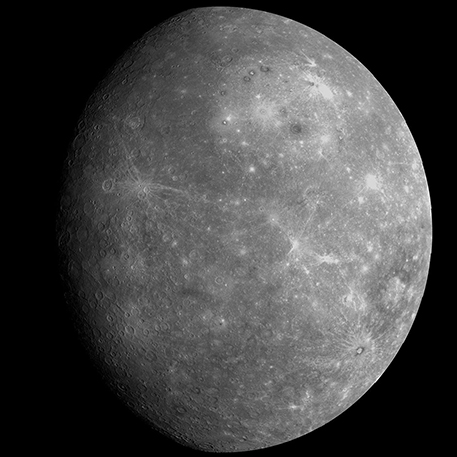
Image shows Mercury as it appeared to NASA’s MESSENGER as it sped away from the planet following its first flyby on January 14, 2008.
