
Maryland Caves and Caverns
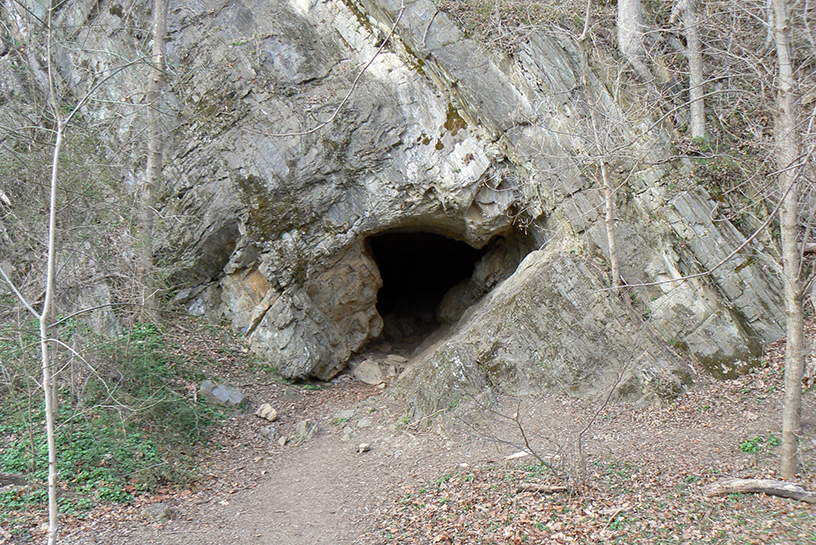
by Richard D. L. Fulton
“Wherever he saw a hole, he always wanted to know the depth of it. To him this was important.”
~Jules Verne, Journey to the Center of the Earth
For over a million years, and even in modern times, caves and caverns have often provided humans with places to live, to practice religious or ceremonial rites, or to seek shelter from weather or war.
A myriad of wildlife has employed caves and caverns, dating as far back as 200 million years ago, for shelter and dens, for safety from predators, for protection against the elements, for breeding and hibernation habitats, and for predators to hide their kills from other predators. The oldest known cave and cavern dwellers, whose bodies had actually become modified through time, specifically to live underground, were 100-million-year-old cockroaches, according to nature.com.
However, the fossilized skin impressions and bones of a reptile that lived approximately 290 million years ago, found in the context of a prehistoric cave, suggested that the animal may have been a cave dweller.
There is indeed a definite difference between what is considered a cave and what is considered a cavern.
A cave can be any naturally occurring underground cavity that is deep enough that some portion of it never receives sunlight. A cavern is basically a large cave that was formed as the result of water passing through water-soluble rocks, such as limestone (and which commonly results in the development of formations such as stalactites, stalagmites, cave onyx, and many other such attractive, natural features).
There are more than 50 caves and caverns that have been discovered in Maryland. Those listed below are a few of the more interesting ones, although not all of them remain accessible.
The Lost Cavern of Cavetown
One of the classic caverns of Maryland no longer exists. The author visited this cavern in the 1960s, wherein he was able to collect numerous specimens of “cave onyx (banded, lapidary quality, chalcedony)” and other cavern formations. The cavern had once become so famous that a town was ultimately named after it.
This would have been Bishop’s Cave or Bushey’s Cave (depending on who owned the cavern for a period of time), which gave rise to the name of Cavetown in Washington County.
The cavern formations were readily collectible, as the cavern was in the process of being destroyed by quarrying operations, and one had but to hunt the piles of “spoils” for specimens. The cavern was even visited and described by Charles Mason and Jeremiah Dixon in 1767, the duo who had established the Mason-Dixon Line. The cavern was opened for tourism by James Camp in 1823 for a fee of six and a half cents, according to the Herald Mail (heraldmailmedia.com).
Quarrying operations began to destroy that cavern—as well as the underground lake it had once contained—in 1925 and continued into the 1960s.
Monocacy River Cave
The Monocacy River Cave is a small cave located northwest of Walkersville, off Route 15 in Frederick County, according to the Maryland Geological Survey.
The cave (not a cavern) is a wild cave (non-commercially developed), specifically located east of Hansonville (just above the powerline), approximately 20 feet above the east bank of the Monocacy River, according to the Maryland Geological Survey (MGS), and is located in the 485-500-million-year-old Frederick Limestone.
The MGS further stated on its website that the “entrance is 4-feet wide and 2-feet high, at the base of a small cliff. The cave extends for 25 feet to the southeast as a crawlway and continues as a 10-inch tube.”
The state does not note ownership, which should be determined by any intended visitors, and permissions, if necessary, be obtained.
Killiansburg Cave
One of Killiansburg Cave’s claim to fame is that it was in this cave that residents of Sharpsburg and army deserters had sought shelter outside of town during the 1862 Battle of Antietam.
The cave (also a “wild cave”) is located at mile marker 75.61 (or 75.7) of the C&O Canal, and roughly one mile downriver from Snyder’s Landing Road, near the Potomac River, about two miles west of Sharpsburg, according to crossroadsofwar.org.
Reportedly, Killiansburg Cave is still accessible to the public.
Several other small caves (referred to as the Snyder’s Landing caves) can be spotted from the canal near the Killiansburg Cave, according to theriverbendretreat.com.
Cumberland Bone Cave
Potentially one of the most significant of Maryland caves is the Cumberland Bone Cave due to the immense amount of remains of prehistoric animals that were recovered from it.
The Bone Cave was discovered in 1912 when the Western Maryland Railway was clearing a right-of-way for proposed trackage.
The discovery resulted in the recovery of the bones of some 40 species of prehistoric mammals, including those of saber-tooth cats, cave bears, woolly mammoths, mastodon elephants, pumas, badgers, wolverines, wild pigs, and bison, to name a few. Of the 40 species, 28 were extinct animals.
“Today, very little of this cave is still exposed. Remnants may be seen on the south wall of the railway cut at the level of the roadbed,” notes a historical marker located at the site, which had been erected by the Mountain Maryland Trails and Maryland State Highway Administration’s National Recreational Trails Program.
For more information on this cave and to find out what the remains of the prehistoric animals were that were recovered from within, refer to “Maryland’s Atlantis” in the December 2025 edition of The Catoctin Banner, which is accessible in the newspaper’s online archives.
Crystal Grottoes Caverns
Crystal Grottoes Caverns is a family-run, commercially-operated cavern complex located along Maryland Route 34, between the town of Boonsboro and the Antietam National Battlefield, at 19821 Shepherdstown Pike, in Boonsboro. It is also the only cavern system open to the public in Maryland.
The cavern complex was initially discovered by construction workers in 1920, who were engaged in quarrying limestone for road work. The cavern was opened to the public in 1922.
The underground complex was created by subsurface waters flowing through 500-million-year-old limestone, creating a myriad of impressive rock cavern formations. The sections open to the public comprise some 900 feet of passageways, according to the Crystal Grottoes Caverns website (crystalgrottoescaverns.com). The cavern staff offers guided tours. For additional information and rates, visit the website.
Conclusion
In addition to providing educational experiences, commercial cavern tours generated, worldwide, $1.42 billion in 2024, and are projected to generate $2.67 billion annually by 2033, according to dataintelo.com.
For a list of identified caves and caverns in Maryland, visit the Maryland Geological Survey website at mgs.md.gov and search for online copies (available via the Maryland.gov website) of The Caves of Maryland by William E. Davis.
“Wild caves” can be dangerous. When exploring “wild caves,” never explore alone, and make sure you have any applicable permissions needed. Also, be sure to refer to the U.S. Department of Agriculture Forest Service website on cave safety at fs.usda.gov/visit/know-before-you-go/cave-safety.
Case in point: CBS News reported on January 25, 2012, a story headlined “20-Year-Old Hopkins Student Rescued After Becoming Trapped in Washington Co. Cave,” in which the victim was pinned by their knee in a hollow in the cave, 250 feet from safety. The operation to free the individual took over two hours.
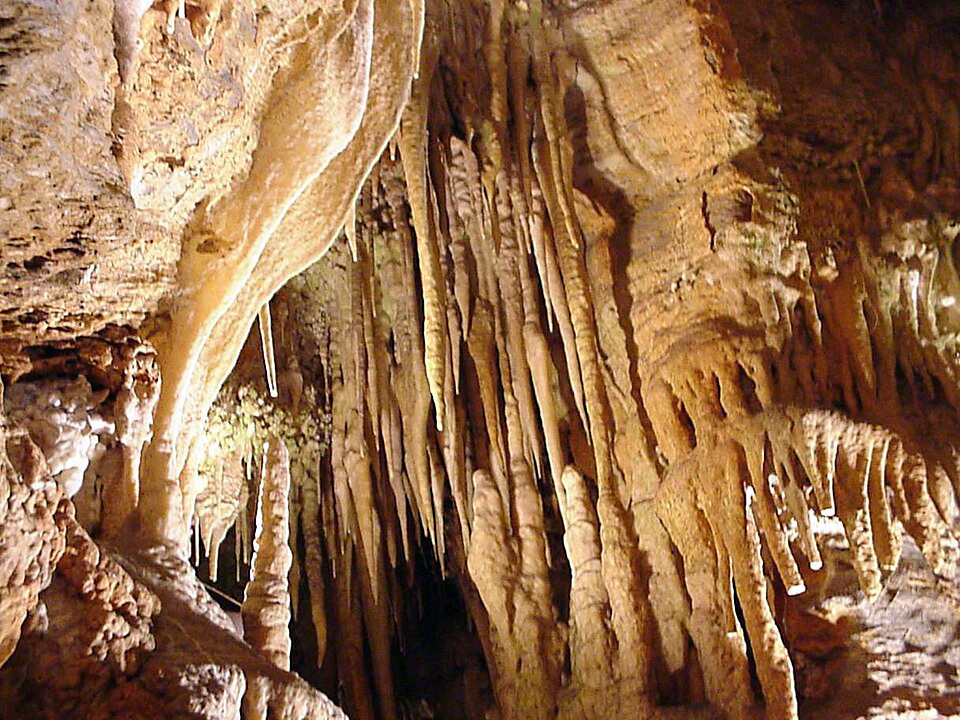
Cave formation in Crystal Grottoes Caverns, near Boonsboro and Sharpsburg.
