
From Calf to Show Ring
Makayla Comer is a junior at Catoctin High School and a member of the Future Farmers of America (FFA). She is serving as the 2025-2026 Thurmont & Emmitsburg Community Show Ambassador and currently serves as Social Media Coordinator. In this monthly series, Comer will take readers behind the scenes of what it takes to raise both market and breeding cattle, sharing her journey as she prepares to show at the Carroll County Fair and the Thurmont & Emmitsburg Community Show in 2026. Comer and her family own and operate a cattle farm in Rocky Ridge, Maryland. Readers are invited to follow along as she shares the dedication, responsibility, and hard work involved in raising cattle.
For my 2026 Market and breeding projects, all animals were born and bred on my farm. The steer I plan to take to the Thurmont and Emmitsburg Community Show in September is a Maintainer named Fort Worth. Fort Worth was born on March 25, 2025, and was the last calf born on my farm in 2025. I also plan to bring two heifers to the community show. My Maintainer heifer, Montana, and my Shorthorn Plus heifer, Daytona.
January 17 was the Carroll County weigh-in. Fort Worth weighed 819 pounds. At weigh-ins, they simply weigh the animal; they will use this weight later during the fair to determine the rate of gain that the animal made per month. Then, they remove his old ear tag and put in the county ear tag.
As I mentioned in my last article, we were supposed to go to a show at the end of January. The show got moved to Valentine’s Day weekend due to the snowstorm. We sadly could not make that show due to the Catoctin FFA butchering and other events already planned.
Calving season has started on our farm with my heifer last year being the first one to calve. Cinnamon had a smooth calving process. Sadly, we did not know that she had her baby. She had him on the coldest day, and her calf ended up freezing. It’s sad when things like this happen, but we try to move on and continue calving. We have a few cows that are due in February, and the others are due late March/early April.
I often get asked specific questions about showing. It may seem odd to watch cattle walk in slow circles around one person in a show ring. I promise you, there is a reason. During a normal class, animals are walked into the ring. The showman’s job is to make the animal look its best for the judge. Walking slowly and purposefully is done so that the judge can look at the composition of the animal. Cattle are lined up, side by side. This is so the judge can see the rear end of the animal. After the judge has viewed the rear end, he will ask the class to walk their animals in a circle and line them up head to tail. When doing this, the showman should leave room between their animal and the animal in front of them. This will allow the showman to move the animal and reposition it up as needed. Judges prefer to see the animal with the front feet side by side.
The back right foot should be lined up with the butt of the animal. The left rear foot (closest to the showman) should be pulled forward slightly, so you can see that foot.
The showman has a showstick that is used to get the animal into position this way. Practicing this at home before the shows will help the animal to be comfortable in this position. After viewing the animals lined up from head to tail, the judge will typically start placing the class and asking specific animals to move. Depending on the type of show, the judge may go and touch the animal to feel the muscling and composition of it.
Practicing this at home before the shows will always help the animal show better. Each species has a different way of showing. It is the showman’s job to know what is expected for their species show and to make sure their animal is represented the best way possible.
To wrap things up, between weigh-ins, calving season, and preparing for upcoming shows, there is always something happening on the farm.
Even when plans change or challenges arise, each experience teaches us something new and helps us grow as exhibitors and caretakers. As the show season continues, understanding proper showmanship and animal handling is just as important as the work done at home, and all of it plays a role in becoming successful in and out of the show ring.
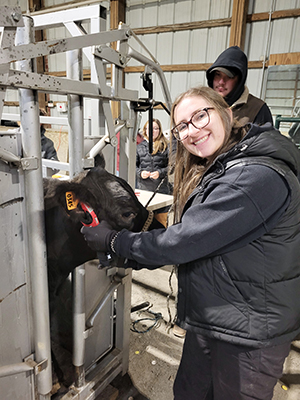
Fort Worth gets his new ear tag at the Carroll County weigh-in by Crystal Stowers on January 17.
