
Balloons Over Maryland

Richard D. L. Fulton
Together We Will Touch the Sky– Anderson Abruzzo International Balloon Museum Foundation
Etruscan artifacts from around 630 B.C. have been recovered, which depict the legend of man’s first attempt to become airborne, the Greek story of Daedalus and Icarus (the son of Daedalus).
According to the legend, Daedalus had designed a labyrinth (which subsequently became the home for a creature named Minotaur) for King Minos of Crete. To keep the existence of the labyrinth a secret, King Minos imprisoned both Daedalus and his son in a tall tower.
To make a long myth shorter, Icarus created two pairs of wings, consisting of feathers and wax, with which the duo employed to facilitate their escape from the tower. However, despite his father’s warning, Icarus flew too high, resulting in the wax melting, and his wings falling apart… thereby resulting in history’s first crash landing.
Apparently, the idea of achieving a successfully manned flight was not again attempted until 1783, a year when, somewhat, “the sky became the limit.”
Maryland’s First Flight
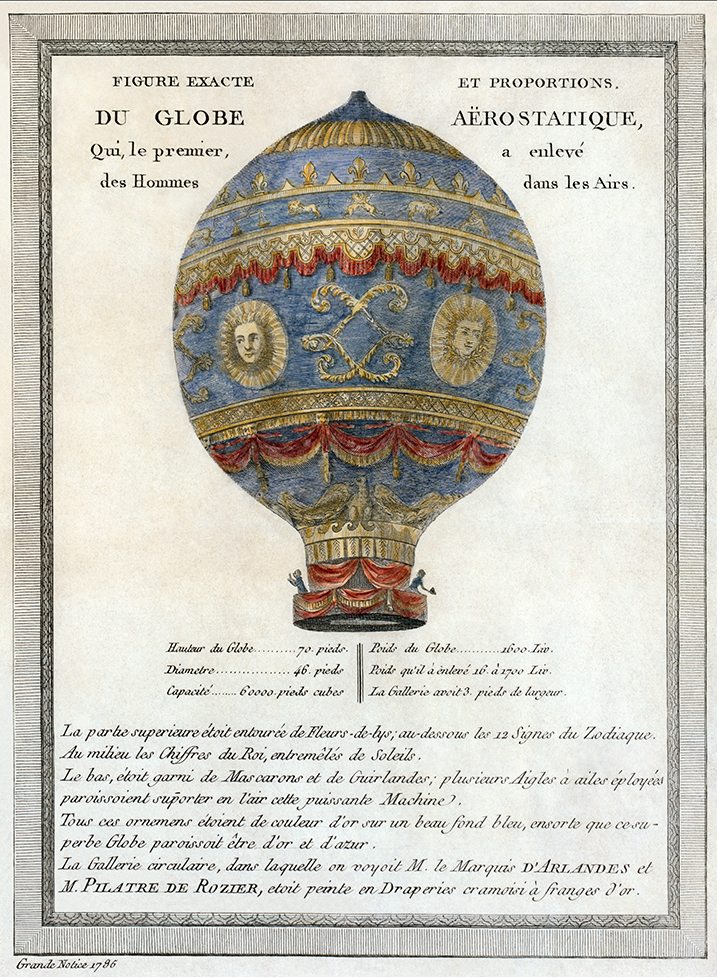
The invention of a piloted hot air balloon did not occur in Maryland (the first successful launch of a piloted hot air balloon occurred in France in 1783), but Maryland came in with a close second, launching the first piloted hot air balloon in the United States in 1784.
It took a tavern keeper from Bladensburg, Peter Carnes (in the interest of “transparency,” Carnes also happened to be a lawyer, just for the record), to get America off the ground. Having heard about the successful French balloon, Carnes was so confident that he could accomplish this challenge, that he had even announced in the local newspapers his intent to get Maryland into the air and launch his own balloon, according to famousdaily.com.
Having completed his balloon, Carnes was ready to launch his “manned” hot air balloon on June 23, 1784.
Sadly, some writers have managed to get Carnes’ proposed launch confused with that of another, later hot air balloon launch, executed by a man named Jean-Pierre-François Blanchard, who launched his balloon in 1793 from the Walnut Street Prison yard in Philadelphia. As a result, these same writers have written that Carnes launched his balloon from the prison yard. He did not. That was where Blanchard launched his balloon from. The confusion had also resulted in some folks stating that Blanchard’s hot air balloon was the first to fly in America.
Carnes launched his balloon from a fenced-in yard on a property belonging to Colonel John Eager Howard, a soldier and patriot who had also been elected governor of Maryland in 1788. The launch site was located near what eventually had become the site of Baltimore’s Washington Monument.
But when launch-time approached for Carnes’ balloon, it was realized that Carnes was too heavy to permit the balloon to ascend. It was then that a 13-year-old boy, Edward Warren, being lightweight enough, saved the day when he volunteered to take the balloon up, preceding Blanchard’s flight by nine years.
From Hot Air to Gas
Early “Manned” hot air balloons saw little practical use, other than for pleasure, with rare exceptions, one being their use for observing enemy positions and movements during the Great Rebellion (1861-1865).
Hydrogen gas balloons began to replace hot air balloons as early as the late 1700s, despite the explosive risks involved. Hydrogen gas did not require constant heating, allowing for longer flights. As balloon development evolved, larger “balloons” or blimps being manufactured could hold increasingly voluminous amounts of hydrogen gas, resulting in larger airships, which proved useful for commercial cargo and passenger service.
The use of a bag to hold heated air evolved into three types of air ships: non-rigid (meaning the gases forced the bag—now called an envelope—to maintain a shape); semi-rigid (meaning that the envelope had some structural assemblages to hold its shape); and rigid (those whose envelopes had a fixed shape).
Of course, the use of hydrogen, an explosive gas, didn’t come without considerable risk, most publicly demonstrated in 1937 when the hydrogen-laden Hindenburg caught fire and blew up in Lakehurst, New Jersey, killing 36 individuals. In the wake of that disaster, hydrogen was then quicky replaced by the use of inert, non-explosive helium.
As lighter-than-air craft evolved, they served a number of purposes, from manned and unmanned uses and for civilian and non-civilian uses, but they never saw the degree of passenger conveyance that had existed before the Hindenburg disaster.
Maryland had a number of large-blimp installations up to and during World War II. However, they had done some work with blimps in more recent times.
The Navy’s Air Test and Evaluation Squadron ONE (VX-1), based on the Patuxent River, worked on blimps, especially for submarine surveillance, but have recently been “transitioned” away from manned blimps. The Army’s JLENS (Joint Land Attack Cruise Missile Defense Elevated Netted Sensor System) unmanned blimps, operated from Aberdeen Proving Ground, as part of a test to detect cruise missiles and other threats that could have threatened the Nation’s Capital, and the East Coast in general.
It was from the Patuxent River facility that, in 2016, one of the tethered blimps broke its tether and “drifted more than 120 miles north into Pennsylvania, dragging a long tether that knocked out power to thousands,” according to an October 28, 2015, story on NBC News.
Hot air ballooning basically fell into obscurity until Paul Edward Yost, an inventor who also worked for General Mills’ high-altitude research division, created a system by which balloons could generate on-board heating systems to heat the air. Prior to his invention, the air for hot air balloons was generated on the ground, and balloons could only fly as long as the pre-heated air lasted.
Yost employed an on-board kerosene burner in 1955 on his prototype to supply heated air while the balloon remained aloft as long as the fuel lasted. In 1960, he substituted a propane burner for the kerosene-fueled burner. He was subsequently dubbed “Father of the Modern-Day Hot-Air Balloon.” His invention had also eventually given rise to the hot air ballooning tourism industry.
Maryland Ballooning Today
Today, Maryland serves as the home to at least several major ballooning tourism enterprises, including, but possibly not limited to:
Tail Winds over Frederick:
A “family-owned and locally operated” business headquartered in Frederick County. According to the company’s website, Tailwinds is managed by co-owners Patrick, the company pilot who has been certified by the Federal Aviation Administration (FAA) in Airplanes and Hot Air Balloons, and his wife, Meagan.
The company offers flights of up to seven passengers; private flights of up to three passengers; and wedding, party, and corporate event flights.
For additional information, or to book flights, visit the company website at tailwindsoverfrederick.com.
Sky Candy Ballooning:
Sky Candy Ballooning is owned by pilot, Steve Andrews, and possesses an FAA commercial pilot’s certificate. The operation is located in Central Maryland and is headquartered in Glen Bernie.
Sky Candy offers flights for one to four passengers, group packages of up to five passengers, and a “will you marry me” proposal flight. The company offers a “hands-on” experience, in which passengers will have an (optional) opportunity to participate in the assembly, inflation, and breakdown of a hot-air balloon.
For additional information or to book flights, visit the company website at skycandyballooning.com.
Delmarva Balloon Rides:
Pilot, Todd Davis, has been a hot-air balloonist for over 20 years and holds an FAA Commercial Pilot Certification. They provide balloon flyovers along Maryland’s Eastern Shore and Chesapeake Bay.
The company is based in Chester, and provides multi-passenger flights, private flights for two passengers, and several special occasion flights, as well as offering to fly corporate advertising banners.
For additional information or to book flights, visit the company website at delmarvaballoonrides.com.
France’s first hot air balloon ever launched, which inspired Peter Carnes to create one in Maryland.
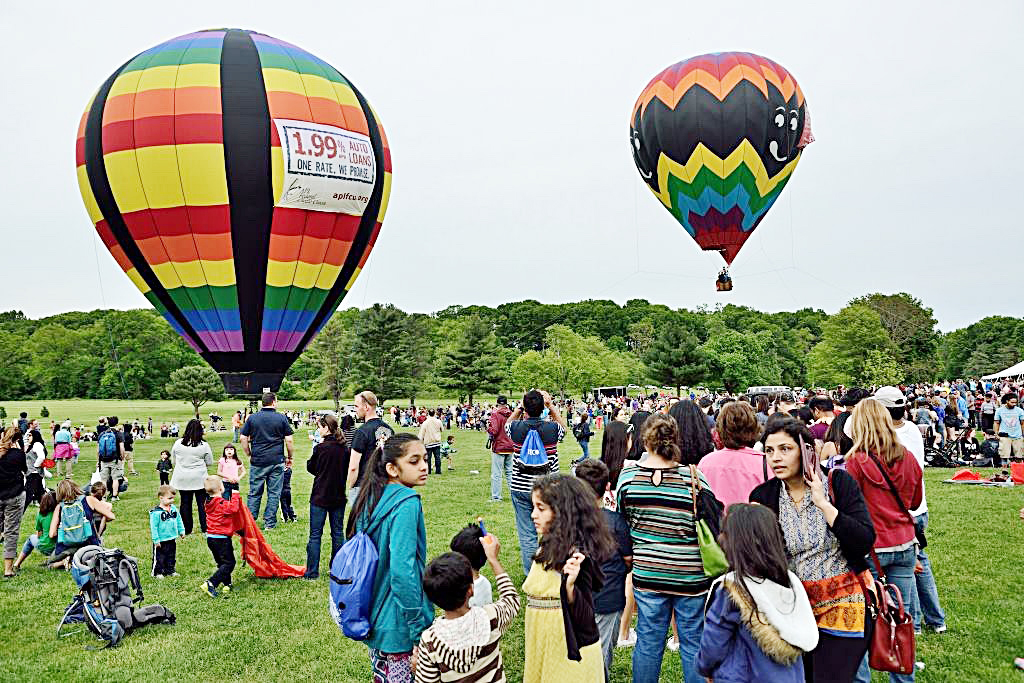
Passengers awaiting boarding the hot air balloons.
