
LOOKING BACK
Apples Church Celebrates Its Centennial a Second Time
by James Rada, Jr.
On April 13, 1932, a child was baptized at Apples Church in Thurmont. On the surface, it doesn’t seem unusual. More than one person was baptized at the church each year, and some of them were children.
However, April 13 was the centennial anniversary of the laying of the cornerstone for the second Apples Church. The (Frederick) News reported, “An infant, descended from one of the original members of the first congregation, will be baptized, a baptismal bowl 150 years old being used.”
This may be referring to a small pottery bowl made at Lynn’s Potter. It was used as a baptismal bowl for many years until it became part of the collection of the Historical Society of the Reformed Church. If it is this bowl, it was actually made in 1822 and purchased for 20 cents to be used at the church.
It was one of a number of special events held that day at the church as members of the congregation reenacted events from 1832. Other events included Rev. Dr. P. E. Helmer, pastor of Apples Church, giving a historical address taken from the records of the church; children who were descendants of the original congregations planting a memorial scarlet oak; and a community choir singing musical selections.
It was quite a celebration for a small congregation, but while the church was 100 years old, the site had been the scene for religious services since 1764. The News noted that there were gravestones in the cemetery dating back 168 years.
The church is named after Peter Apple, a German immigrant who settled on land that by 1932 was owned by William Stoner. Arriving in Maryland in 1717, he was one of the first settlers in the Monocacy section of the county. His log home was among the first homes in that region.
On March 19, 1760, he deeded an acre of land to Matthias Ambrose, Jacob Matthews, and Jacob Ambrose as trustees for a schoolhouse. “It is more than probable that church services were held in this schoolhouse by visiting ministers of both denominations, and that, as was customary in all country congregations of the day, sermons were read by the schoolmaster from time to time,” George Wireman wrote in Gateway to the Mountains.
In 1770, the first church, constructed from logs, was built on the site, and the congregations were formally organized. According to The News, the delay in organizing the congregation was not due to getting a permanent church, but from the lack of ministers to preach to the congregations.
Wireman disputes the date, writing that the church was built in 1765 and the land deeded to the church trustees, Martin Dustmain and Henry Firor, trustees of the Lutheran and Reformed congregations respectively, was done in 1768.
Jacob Weymer was the first regular pastor of the Evangelical Reformed congregation, and it is believed that Philip Matthews, one of Apple’s grandsons, was the first pastor for the German Lutheran congregation.
“From time to time additions and enlargements were made to the old log church, but the rapid growth of the congregation made it all too small,” The News reported.
The stone church was built in 1826 and included a gallery and a high pulpit. Wireman also wrote that it had a gun rack placed in one corner for the stacking of guns. “Many of the members traveled great distances through the mountains to attend services, and the guns were carried for protection against marauding Indians and the wild beasts.”
The cost to build it was $1,306.20, or about $43,000 today, adjusted for inflation. The reason it cost so little was that members of both congregations did nearly all the construction.
In 1857, the two congregations decided to separate, and the German Lutheran congregation built a new church in Mechanicstown.
Like the 1932 centennial celebration, the congregation also held a centennial celebration for the construction of the log church in 1870.
A few years later, though, the Evangelical Reformed congregation also voted to move into Mechanicstown, where they built Trinity Church. A few local families continued to meet there until 1885, when it was completely abandoned.
“This was a great grief to families who had grown up in the congregation, and in 1885, they approached the Rev. A. B. Stoner, with the request that, if they would clean and repair the old building, he should hold a few services there during the summer with the hope of reviving the old congregation,” Wireman wrote. “This was so successful that in August of 1885, a petition was signed by 35 members pledging $80.00 a year toward the minister’s salary, if the services in the old church were resumed. At the first communion service, held the following day, the entire congregation of Trinity Church was present.”
The church was remodeled in 1912. The walls were lowered, and the gallery, wine-glass pulpit, and top tier of windows were removed.
During the 1932 centennial celebration, an endowment fund was established to maintain the cemetery, which had been cleaned up and beautified ahead of the centennial celebration.
Besides the April celebration, the congregation also held more general events celebrating both the centennial of the stone church and the 166th anniversary of the log church.
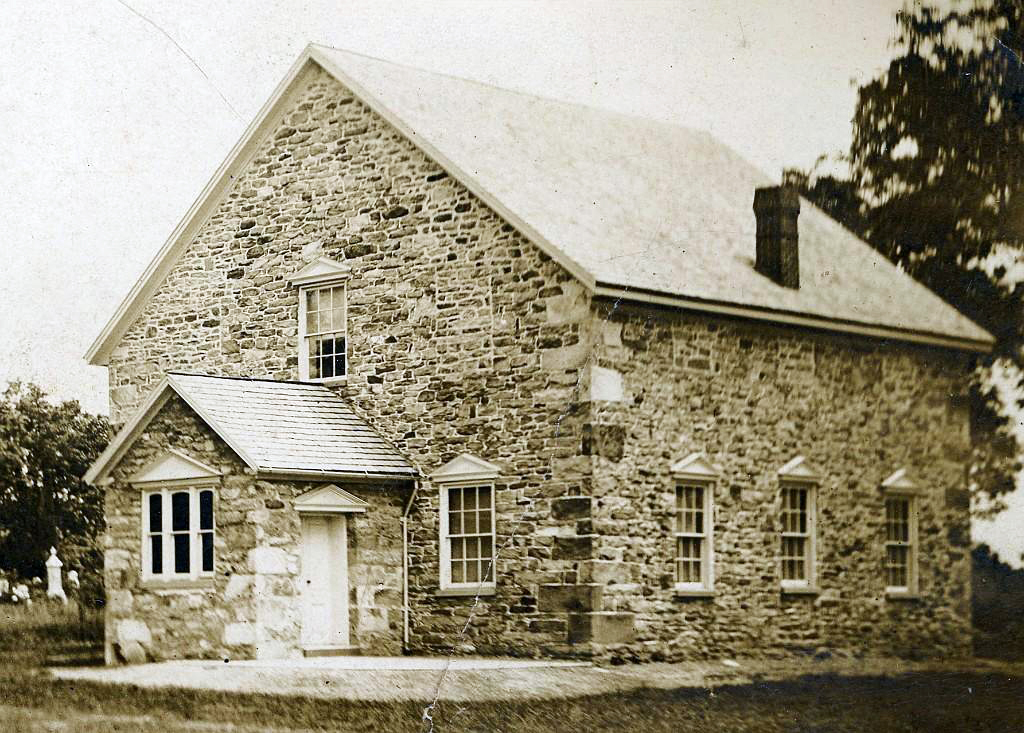
Apples Church
