
Veteran Spotlight
by Richard D. L. Fulton
Clinton Austin Reed
Clinton Austin Reed was born on August 24, 1924, in Thurmont to parents Samuel Howard and Daisy Reed.
Reed attended Thurmont High School and was subsequently employed at the Area Engineers Company at Camp Ritchie before entering the service. The (Frederick) News reported on July 26, 1944, that Reed had also been a radio entertainer sometime before entering military service and had also served in the State Military Police in Frederick.
Reed married Margaret Lucille Covell on September 26, 1942, in Hagerstown, Maryland, by Reverend Robinson, and had two daughters, Georgetta Lea (born in 1943) and Judith Ann (born in 1945, nine months after her father had been killed in France).
Reed had registered for the draft on December 15, 1942, at Winchester Hall in Frederick. His draft card noted that he was 18 years of age and weighed 140 pounds. He was described as being 5’11” in height, with a light complexion, hazel eyes, and brown hair.
Reed was inducted into the Army on March 10, 1943, and had received his training at Camp Wheeler, Georgia, and Camp Shenango, Pennsylvania. He was assigned to serve in the 29th Division infantry regiment of the Army. He and his unit arrived in England in July 1943, where he was then assigned to the Headquarters Company of the division.
Reed and the 29th Division entered the war via the D-Day landing on June 6, 1944, generally regarded as the most difficult beach to capture, due to the German-occupied and fortified cliffs that overlooked the beach. The Allied campaign had been dubbed “Operation Overlord,” conceived with the intent to drive the Germans out of France.
In spite of the many difficulties the American troops and those of the allies encountered as they endeavored to drive the Germans out of their many defensive positions, by July 7, the 29th Division had pushed forward towards an entrenched and fortified German position located at Saint-Lo, France (the capital of the Manche department in the region of Normandy), a “mere” 38 miles from Omaha Beach.
Although American infantry had only reached Saint-Lo in July, the city had been pounded by Allied bombardment beginning on D-Day. By the end of the bombardment, up to 95 percent of the city had been destroyed, according to wwiimemorialfriends.org.
The ensuing battle at Saint-Lo, fought from July 7 through July 19, is considered “one of the most difficult and bloody phases of the Normandy Campaign.”
However, Reed was killed as the 29th Division fought its way towards the targeted city, having been fatally struck down on June 17, 1944, eleven days after the beach landing, while his unit was engaged in preparing to assault Saint-Lo, thereby deeming him the “sixth man from the county to be reported killed in France, and the second from Thurmont,” according to the July 27, 1944 edition of The (Frederick) News.
The 29th and 30th Infantry Divisions sustained 11,000 casualties before Saint-Lo was captured. Reportedly, the Germans suffered nearly the same number of casualties. In all, the advance from Omaha Beach to Saint-Lo had resulted in some 40,000 American casualties, more than 1,000 casualties per mile.
Reed’s body arrived in New York on January 21, 1948, aboard the Army transport Corporal Eric Gibson, along with the remains of 1,753 other soldiers, including 41 from Maryland. The bodies were removed from the ship on the next day in Brooklyn, accompanied by a brief public ceremony, according to the January 22 News Post.
At his burial in the Blue Ridge Cemetery in Thurmont, Taps were sounded by Edward Hobbs of Thurmont. According to The News, the funeral had been largely attended.
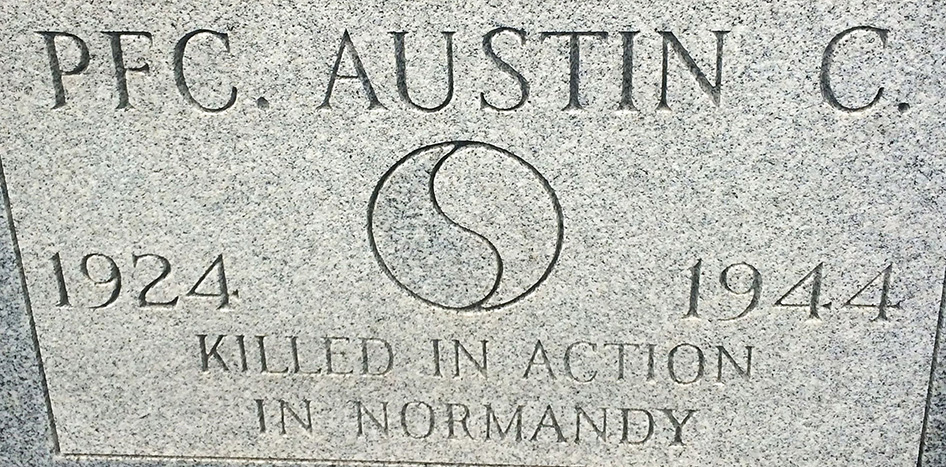
Blue Ridge Cemetery Grave of PFC Clinton Austin Reed.
