
Maryland Amusement Parks
Part I
Richard D. L Fulton
Amusement parks and their subgenera, theme parks, trace their origins back to the 1800s, and many continue to thrive exceedingly well today.
The difference between an amusement park and a theme park is that amusement parks provide general entertainment, while theme parks tend to focus more on storytelling. For example, Glen Echo Park would be classified as an amusement park, while the Enchanted Forest (Ellicott City , Maryland) would be classified as a theme park.
There was no shortage of amusement parks and theme parks in Maryland. In fact, some claim that there were dozens over the course of some 130 years, several of which still exist. However, only a select few could be discussed in Part I and Part II of “Maryland Amusement Parks” due to space constraints.
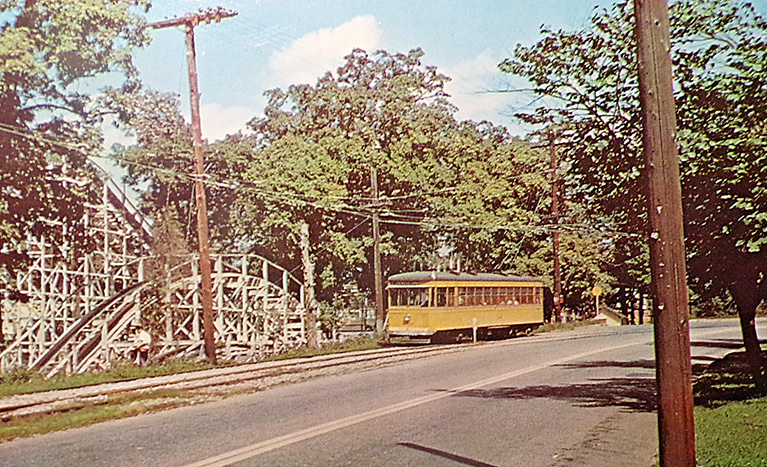
Gwynn Oak Park
Gwynn Oak (Amusement) Park made its media debut to Baltimoreans via a July 2, 1894, article published in The ( Baltimore) Sun, in which it was reported “Gwynn Oak Park, a new suburban resort, was opened to the public yesterday,” further describing the park as being situated within “thirty-fiv e acres of pretty woodland…”
The amusement park was located in the Gwynn Oak community in Baltimore County.
Access was provided by Gwynn Oak, Walbrook, and Powhattan Railway (GOW&P) trolleys (founded by the park developers). The GOW&P got off to a rough start on opening day when one of the trolleys jumped the tracks, north of Walbrook. However, there were no reported injuries from the mishap. Amenities offered upon opening included “a handsome pavilion,” and “booths with various kinds of entertainment,” as well as a lake that was being created for boating and swimming, according to The Sun.
In many of the older amusement parks in Maryland, individuals of African descent were prohibited from using the parks. Gwynn Oak Amusement Park was the first such park in Maryland to desegregate, having done so in 1963.
Over the decades, the amusement park grew to encompass some 60 acres in size, and featured such rides as several roller coasters, a Ferris wheel, a whip, and a carousel (merry-go-round), along with a Dixie Ballroom, which was used for
dances, wedding receptions, large parties, etc. The park also offered tennis courts, a baseball diamond, and ice skating (in the winter season).
The park was heavily damaged by Hurricane Agnes in 1972, and never resumed operations after that due to various of its rides auctioned off in 1974, except for the merry-go-round, which was relocated in 1981 to the National Mall in Washington, D.C.
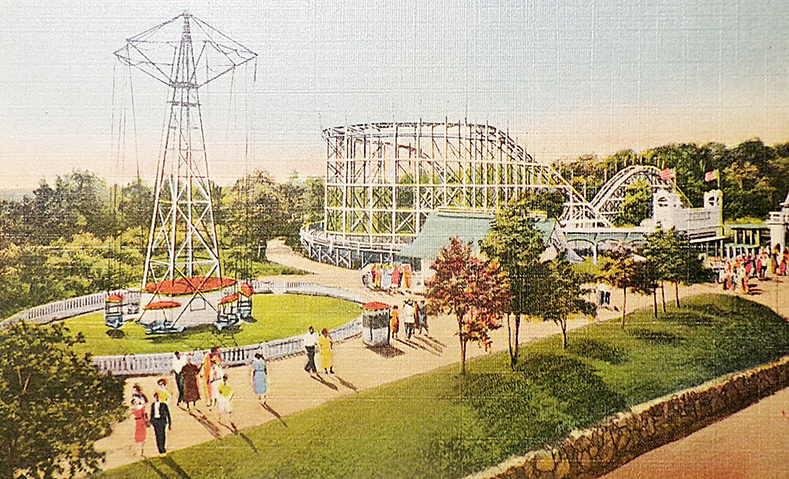
Carlin’s Park
The (Baltimore) Sun readers learned on April 1, 1919, that the intent of housing developer John J. Carlin was to construct an amusement park on vacant property he owned, which was located at the intersection of Reisterstown Road and Druid Park Drive.
Carlin had previously erected a pavilion on the general site, in which events were held as early as 1917, according to various articles in the 1917 The Sun newspaper.
The Sun reported, “Plans for a big amusement park near Druid Hill Park were unfolded before the Board of Estimates yesterday…” during which Carlin stated the park would be 70 acres in size, and further requested immediate action (approval), as he wanted to have the park opened by June 15.
By mid-April, he was given the go-ahead to commence with construction, according to the April 15 issue of The Sun. Carlin stated at that time that he had $150,000 worth of interested investors and expected to spend as much as $400,000 on the park project by the end of the year (not including the purchase of additional land).
Carlin’s (Amusement) Park, under its initial name of Liberty Heights Park, officially opened on August 13, 1919, in the midst of a torrential rain, although not all of the proposed attractions had been finished. The park’s name was later changed to Carlin’s (Amusement) Park.
The park closed soon after Carlin’s death in 1954. But before the end had arrived at the park had grown to the point where it encompassed numerous attractions, along with 30 rides, an Olympic Pool, and a Roller Rink.
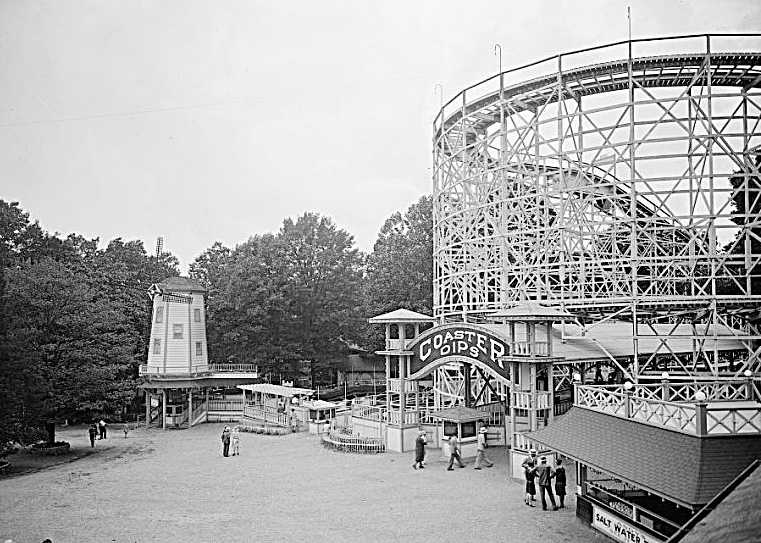
Glen Echo Park
The nine-acre Glen Echo (Amusement) Park was located in the Town of Glen Echo in Montgomery County.
According to the National Park Service (NPS), Glen Echo (Amusement) Park traces its founding back to having been “a small, haphazard amusement park” for a few years, sometime after 1903 up until 1907, when a new manager, William Shaw, began to initiate “extensive alterations” to the amusement park.
However, again, referring to the NPS’s Glen Echo website, a more official beginning appears to have occurred in 1911, when the park was purchased by the Washington Railway and Electric Company, which had been seeking “for a way to increase ridership on that particular (Washington, D.C., to Glen Echo) line.”
The change in ownership of the amusement park got off to a not-too-amusing beginning when, on July 23, 1911, dozens of men and women were arrested by Montgomery County Sheriff William E. Viett for working at the park in violation of the “Sunday labor laws.” The park was then strictly forbidden to operate on Sundays.
Ultimately, the park served as having been home to seven rollercoasters, bumper cars, a scenic railway, an amphitheater, a carousel, an arcade, a pool, a ballroom, a puppet theater, and picnic areas. Having been established as a “Whites Only” park, Glen Echo was desegregated in 1961.
As to the park‘s demise, the NPS had reported that “as more and more households had automobiles, and were using them to travel to places further, and farther away; and several Montgomery County, Maryland inquiries and ordinances concerning visitor safety led to the amusement park management’s decision to close the park permanently in 1968.”
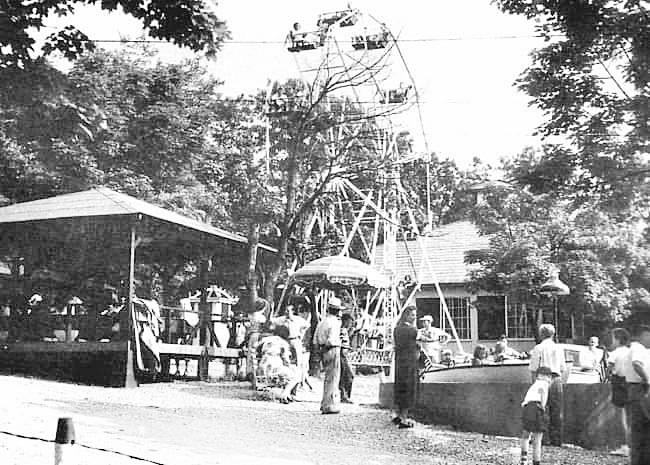
Braddock Heights Park
Braddock Heights Amusement Park in Frederick County offered one attribute not offered by most amusement parks in Maryland, that being…. a mountaintop version of the parks that proliferated in the more-populated areas.
According to lostamusementparks.napha.org, the Braddock Heights Amusement Park was established in 1898, two years after Braddock Heights itself was built by George William Smith as a resort community in 1896.
Smith was determined to establish that a non-urban trolley service could be successfully accomplished in Maryland, and he became the president of the fledgling Frederick and Middletown Railway.
On August 20, 1896, Smith’s vision became a reality when a 30-foot trolley began its first journey from Frederick—amid much fanfare—and mad e its way up the side of Catoctin Mountain and headed toward Braddock Heights, according to the August 21, 1896, edition of The (Frederick) Citizen.
Of course, there was yet another reason for the trolley’s first stop having been Braddock Heights. Smith had also recently established that location for being a proposed resort, which he indeed commenced to create in 1898.
At its peak, the Braddock Heights Amusement Park included a Ferris Wheel, a “whimsical” carousel, a roller rink, a duckpin bowling alley, an arcade with a movie theater, a pool, an observation tower that turned into a super-sliding board, and a mini-train ride.
The park was closed in 1962, reportedly due to the fact that the cost of upkeep of the rides had become too expensive.
Note: Maryland Amusement Parks — Part II: Four more amusement parks will be covered in the April edition of The Catoctin Banner, and will include the Tolchester Beach Amusement Park, Marshall Hall Amusement Park, Enchanted Forest Theme Park, and the Pen Mar Amusement Park.
Gwynn Oak Amusement Park, 1955, with Baltimore Transit Company streetcar. Source: Collection of Richard D. L. Fulton
Carlin’s Amusement Park, undated.
Glen Echo Amusement Park, undated. Source: Library of Congress Braddock Heights Amusement Park, undated. Source:
